The 1970 FIFA World Cup was the ninth edition of the quadrennial international association football championship held from May 31 to June 21 in Mexico, marking the first World Cup tournament held outside Europe and South America.
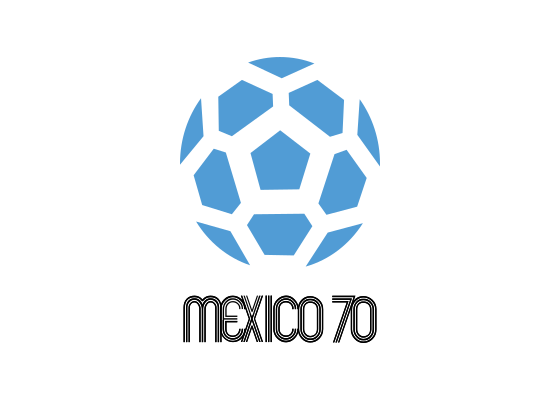
The 1970 FIFA World Cup logo features an abstract design in sky blue (#519cd5) and white (#ffffff), creating a clean, modern mark that reflects the tournament’s historic significance. The composition uses geometric shapes arranged to suggest movement, celebration, and the global nature of the competition. The blue and white color scheme references both the sky and clouds, as well as football’s universal appeal that transcends borders. The design has a simplified, optimistic quality that captures the spirit of the early 1970s, when the tournament brought world-class football to North America for the first time. The abstract forms avoid literal representation, allowing the mark to communicate energy and international unity.
Meaning and Symbolism
- Sky Blue: Represents the clear skies of Mexico, openness, and the global reach of the World Cup arriving in a new continent for the first time.
- White Accents: Symbolize purity of sport, the universality of football, and the coming together of nations in peaceful competition.
- Abstract Forms: Suggest movement, the dynamic nature of football, and the forward-looking spirit of bringing the tournament to new territory.
- Geometric Simplicity: Reflects modernist design trends of the era and the tournament’s role in advancing global football.
Design and History
The 1970 World Cup was a watershed moment in football history, being the first tournament held outside Europe and South America and the first in North America. Teams from 75 nations entered the competition, with qualification rounds beginning in May 1968. The final tournament featured 16 teams, including debuts from El Salvador, Israel, and Morocco.
The logo needed to work across various media in an era before digital reproduction, requiring clean lines and high contrast that would reproduce well in print and on television. The abstract approach allowed the mark to transcend language barriers and cultural differences, essential for a truly global sporting event.
The tournament is remembered for Brazil’s dominant performance, defeating Italy 4-1 in the final to claim their third World Cup title. Brazil’s path to victory included a 3-1 semi-final win over Uruguay and a 1-0 group stage victory over defending champions England, cementing the 1970 team as one of the greatest in football history.
The 1970 World Cup was also the first to be broadcast in color television to a global audience, making the visual identity particularly important for the tournament’s international reach and media presence.
Typography
Period typography for the 1970 World Cup used bold, modern letterforms consistent with late 1960s and early 1970s design trends, emphasizing clarity and international readability.
FAQ
Q: Why was the 1970 World Cup historically significant?
A: It was the first World Cup held outside Europe and South America and the first in North America, expanding the tournament’s global reach and demonstrating football’s universal appeal.
Q: Who won the 1970 World Cup?
A: Brazil won the tournament, defeating Italy 4-1 in the final, claiming their third World Cup title and establishing themselves as one of the greatest teams in football history.
Q: What do the blue and white colors represent?
A: The sky blue and white symbolize the clear Mexican skies, the openness of bringing the tournament to a new continent, and the universal nature of football transcending borders.
More logos with similar colors