The 1974 FIFA World Cup was the tenth FIFA World Cup, a quadrennial association football tournament for men’s senior national teams, played in West Germany from June 13 to July 7, marking the first tournament to feature the new FIFA World Cup Trophy.
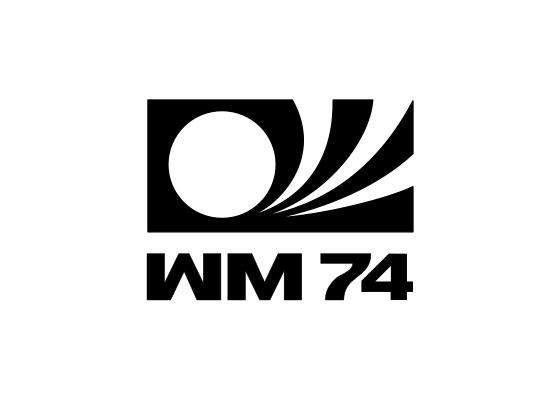
The 1974 FIFA World Cup logo is rendered in pure black (#000000), creating a stark, minimalist design that reflects German efficiency and modernist design principles. The abstract mark uses geometric forms to suggest both football and international competition without literal representation. The monochromatic approach gives the design a timeless, authoritative quality appropriate for a major sporting event. The black-only palette ensures maximum contrast and reproduction quality across all media, from printed materials to television broadcasts. The design’s simplicity aligns with the minimalist aesthetic that characterized German design in the 1970s.
Meaning and Symbolism
- Black Color: Represents strength, authority, and the serious competitive nature of the tournament, while reflecting German design traditions of clarity and function.
- Abstract Geometry: Suggests the universal language of football and the coming together of nations through sport without relying on national symbols.
- Minimalist Approach: Reflects German modernist design philosophy emphasizing essential forms and eliminating unnecessary decoration.
- High Contrast: Ensures visibility and recognition across all media formats, important for a global television audience.
Design and History
The 1974 World Cup marked a significant transition in tournament history, being the first to feature the FIFA World Cup Trophy created by Italian sculptor Silvio Gazzaniga. The previous trophy, the Jules Rimet Trophy, had been permanently awarded to Brazil after their third victory in 1970.
The tournament was the first of three World Cups to feature two rounds of group stages, a format that influenced the logo’s need to represent complex competition structures in a simple, memorable way. The abstract design approach allowed the mark to communicate the event’s significance without being tied to specific teams or match formats.
West Germany won the tournament on home soil, defeating the Netherlands 2-1 in the final at the Olympiastadion in Munich, securing their second World Cup title after their 1954 victory. The tournament saw first appearances from Australia, East Germany, Haiti, and Zaire, with East Germany making their only World Cup appearance before German reunification in 1990.
The black monochromatic design reflected the technological limitations of the era while turning those constraints into a strength through bold, confident simplicity. This approach ensured the logo worked effectively in newspapers, on television, and across various printed materials distributed globally.
Typography
The tournament materials used strong, geometric sans-serif typography consistent with 1970s modernist design trends in Germany, emphasizing functionality and international clarity.
FAQ
Q: What was historically significant about the 1974 World Cup?
A: It was the first tournament to feature the current FIFA World Cup Trophy after Brazil permanently won the Jules Rimet Trophy in 1970, and the first to use a two-round group stage format.
Q: Who won the 1974 World Cup?
A: West Germany won the tournament on home soil, defeating the Netherlands 2-1 in the final at Munich’s Olympiastadion for their second World Cup title.
Q: Why is the logo entirely black?
A: The monochromatic design reflects German modernist design principles emphasizing simplicity and function while ensuring maximum contrast and reproduction quality across all media formats.