The 2009 CONCACAF Gold Cup was the tenth edition of the tournament and the twentieth football championship of North America, Central America, and the Caribbean.
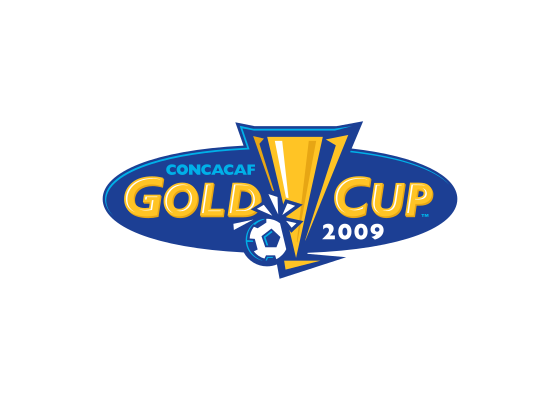
The logo continues the abstract, shield-inspired approach introduced in 2007 while refining the execution with sharper geometric elements. The design features an upward-pointing composition built from angular shapes that suggest both a trophy and a rising flame. The color scheme layers bright cyan blue, deep royal blue, and golden orange in distinct bands that create depth through overlapping forms. White “2009” numerals sit prominently in the upper section, with the “GOLD CUP” wordmark positioned below in clean sans-serif letters. The overall silhouette maintains the organic, non-rectangular form while introducing more defined edges and points compared to the softer arcs of the 2007 edition.
Meaning and Symbolism
- Angular Geometry: The sharp, pointed forms suggest competitive intensity and the decisive nature of tournament knockout rounds.
- Cyan and Royal Blue Layers: The dual blue tones represent unity across Caribbean and North American regions while providing visual depth.
- Golden Orange Accents: The warm metallic tones reference the Gold Cup trophy itself and create visual warmth against cool blues.
- Upward Thrust: The vertical emphasis and pointed top symbolize achievement, aspiration, and the ultimate goal of championship victory.
Design and History
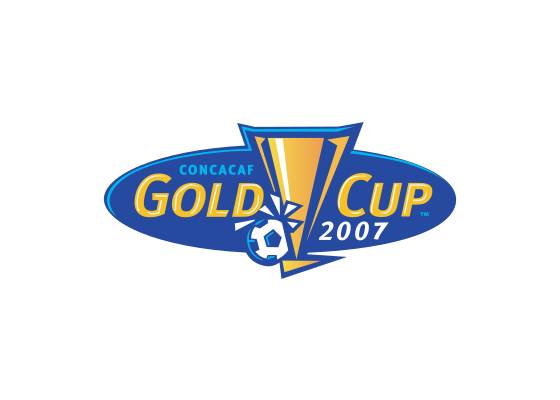
The 2009 Gold Cup logo refined the organic approach of 2007 while introducing more structured geometric elements. This represented a middle ground between the strictly rectangular compositions of 2003-2005 and the purely curved forms of 2007. The design team appears to have sought a balance between contemporary fluidity and the crisp reproduction required for digital broadcast applications, which had become the primary viewing medium for tournament matches.
The tournament marked the fourth consecutive edition without guest teams from other confederations, and the logo’s design emphasized CONCACAF identity through its focused color palette and streamlined composition. The reduction back to three primary colors from 2007’s expanded palette suggested a return to visual efficiency while maintaining the dynamic, ascending form language that had characterized the previous edition.
The 2009 mark demonstrated increased sophistication in how graphic elements intersected and overlapped. Rather than simple layering, the design employed precise geometric relationships between shapes, creating a more technical, engineered appearance. This reflected the growing influence of digital design tools and vector-based workflows in sports branding, where precise mathematical relationships between elements became easier to execute and maintain across applications.
Typography
The wordmark employs a bold, slightly condensed sans-serif typeface with uniform stroke weights and squared terminals. The “2009” numerals receive prominent placement and scale, maintaining strong hierarchy over the “GOLD CUP” text below. The white letterforms provide maximum contrast against the darker background elements, ensuring legibility across broadcast graphics, signage, and promotional materials. The typographic treatment prioritizes clarity and authority over decorative qualities.
FAQ
Q: How does the 2009 logo differ from the 2007 design?
A: While both use shield-like, upward-pointing forms, the 2009 version introduces more angular geometry and defined edges compared to 2007’s flowing arcs, creating a sharper, more technical appearance.
Q: Why return to a three-color palette after 2007’s expanded range?
A: The simplified color scheme improved reproduction consistency across various media while maintaining visual impact, reflecting practical considerations for tournament-wide brand deployment.
Q: What do the overlapping geometric shapes represent?
A: The layered forms suggest the convergence of multiple nations and the complex interplay of teams advancing through tournament stages toward a unified championship moment.
More logos with similar colors