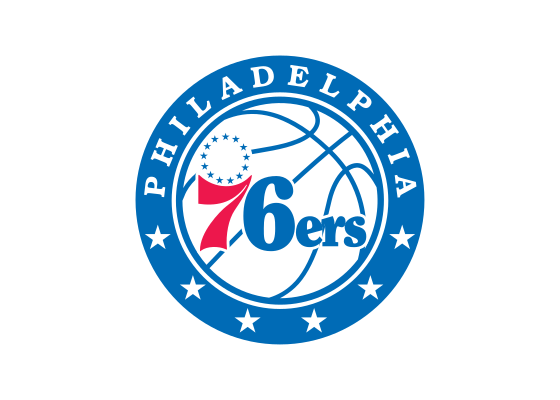
The Philadelphia 76ers logo represents one of the NBA’s oldest franchises, originally founded in 1946 as the Syracuse Nationals before relocating to Philadelphia in 1963.
The logo features a circular composition with the numerals “76” prominently displayed at the center, surrounded by a ring of thirteen stars and a basketball outline. The color palette combines royal blue, vibrant red, and white, creating a distinctly American patriotic theme. The numerals are rendered in a bold, slightly custom typeface with strong angles and clean geometry. The stars encircle the composition in a deliberate arrangement that references the original thirteen colonies, connecting the team’s identity to Philadelphia’s role as the birthplace of American independence. This circular badge format creates a cohesive, instantly recognizable mark that works effectively on uniforms, merchandise, and digital platforms.
Meaning and Symbolism
- The Number 76: Directly references 1776, the year of the signing of the Declaration of Independence in Philadelphia, anchoring the team to the city’s revolutionary heritage.
- Thirteen Stars: Represent the original thirteen colonies, reinforcing the historical connection and creating a visual echo of early American flag designs.
- Royal Blue: Evokes trust, tradition, and the team’s established legacy as one of the NBA’s founding franchises.
- Red Accent: Adds energy and competitive fire while completing the red-white-blue patriotic color story.
Design and History
The 76ers name and visual identity were established when the franchise relocated from Syracuse to Philadelphia in 1963. Team owner Irv Kosloff and general manager Eddie Gottlieb deliberately chose branding that would connect the new Philadelphia team to the city’s historical significance. This decision proved remarkably durable, as the core concept of combining basketball imagery with patriotic symbolism has persisted for over six decades.
The logo has undergone several refinements while maintaining its essential character. Early versions featured more elaborate star arrangements and different typographic treatments for the numerals. A notable redesign in 1977 introduced a simplified approach with the basketball in profile and a cleaner arrangement of stars. The 1997 refresh brought bolder colors and more aggressive geometry, aligning with the NBA’s broader shift toward contemporary sports branding during that era.
The current iteration, introduced in 2015, represents a return to classic principles with modern execution. The design team refined proportions, adjusted the star arrangement for better balance, and specified precise color values that reproduce consistently across physical and digital applications. The updated mark maintains instant recognition while performing better at small sizes on mobile devices and social media platforms. The circular format creates natural synergy with the basketball itself, making the logo particularly effective on court surfaces and spherical merchandise.
Typography
The numerals employ a custom sans-serif design with angular cuts and strong vertical emphasis. The “7” features a distinctive angled crossbar that creates dynamic tension, while the “6” maintains harmonious proportions with a closed counter. The letterforms balance athletic aggression with legibility, ensuring the mark reads clearly from courtside seats and television broadcasts alike. When the full “76ers” wordmark appears alongside the circular badge, it typically uses a complementary bold sans-serif with similar angular characteristics that unify the identity system.
FAQ
Q: Why did the team choose such overtly patriotic imagery? A: Philadelphia’s role as the birthplace of American independence made the revolutionary theme a natural fit. The 1776 reference creates an instant emotional connection to the city’s identity and pride.
Q: How many times has the logo been redesigned? A: The core concept has remained stable since 1963, but the team has executed approximately five major refinements, with the most recent updates in 1997 and 2015 modernizing proportions and color specifications.
Q: Do the stars have any specific arrangement pattern? A: Yes, the thirteen stars are deliberately positioned in a circular pattern that suggests both unity and the orbital motion of the basketball, creating visual dynamism while maintaining the historical reference.
More logos with similar colors