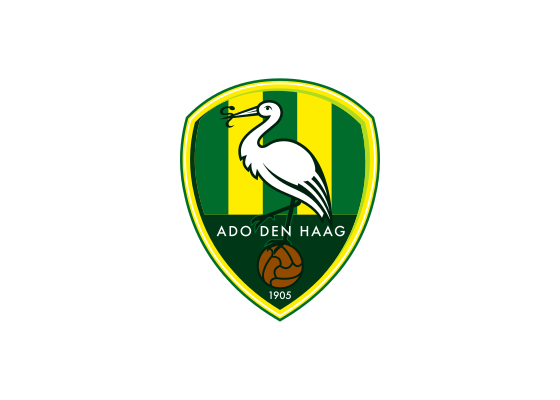
The ADO Den Haag badge employs traditional shield heraldry in the club’s distinctive green and yellow colors to represent this historic Hague-based football club whose name translates to “Everything Through Practice.”
The crest features a classic shield silhouette with internal divisions creating distinct color zones. The design uses a spectrum of greens from deep forest to bright lime, complemented by gold yellow and strategic white accents, with brown tones providing earthiness and depth. The shield contains typographic and symbolic elements that reference both the club name (ADO) and its city of origin (Den Haag/The Hague). The color progression from dark to bright greens creates visual dimension across the badge surface. The traditional shield format aligns with Dutch football heraldic conventions while the specific green and yellow palette distinguishes ADO from the Netherlands’ dominant clubs.
Meaning and Symbolism
- Shield form: Represents club heritage dating to 1905 and traditional Dutch football identity
- Green spectrum: Serves as the primary club color, distinguishing ADO from Ajax, Feyenoord, and PSV
- Yellow/gold accents: Provides contrast and energy, completing the traditional green-yellow color scheme
- Layered composition: References both the club’s history and The Hague’s civic character
Design and History
Alles Door Oefening Den Haag (Everything Through Practice) carries a name that embodies the working-class football ethos: success through dedication rather than natural talent or financial advantage. This philosophy extends to the club’s position in Dutch football. Despite originating from one of the Netherlands’ three traditional major cities (alongside Amsterdam and Rotterdam), ADO has never matched the success of Ajax, Feyenoord, or PSV.
The green and yellow colors create immediate differentiation in a league dominated by red and white (Ajax, Feyenoord) and red, white, and blue (PSV). This distinctive palette gives ADO strong visual identity even without matching the trophy cabinets of the established powers. The shield format connects to European football tradition while the specific color treatments and internal divisions create uniqueness.
The badge underwent particular significance during the club’s various identity shifts. For a period, the organization operated as FC Den Haag for professional operations while ADO represented the amateur branch, creating branding complexity that required eventual resolution. Following relegation from the Eredivisie to Eerste Divisie (second tier) in 2020-21, the badge represents both historic pride and contemporary challenges.
The crest functions across multiple contexts: traditional applications like jerseys and scarves where the green-yellow combination creates strong supporter identity, plus modern digital and broadcast environments where the shield outline and color contrast ensure recognition. The design accommodates sponsor integration while maintaining the core symbolic elements that connect to the club’s 1905 founding and Hague civic identity.
Despite lacking the success of the Netherlands’ traditional big three, ADO maintains passionate local support and significant rivalries, particularly with Ajax and Feyenoord. The badge serves as a rallying symbol for Hague football identity in a Dutch football culture dominated by clubs from other cities.
Typography
The shield incorporates letterforms for the ADO abbreviation in treatments that vary by badge version, typically using bold, condensed characters that maintain legibility within the heraldic format.
FAQ
Q: What does ADO mean? A: Alles Door Oefening translates to “Everything Through Practice” in English, reflecting a working-class football philosophy that success comes through dedication and training.
Q: Why green and yellow instead of typical Dutch colors? A: The distinctive green-yellow palette differentiates ADO from the red-white combinations used by Ajax, Feyenoord, and the red-white-blue of PSV, creating unique identity in Dutch football.
Q: How has relegation affected the badge’s meaning? A: While the design itself remained consistent, the badge now represents a club competing in Eerste Divisie (second tier) after relegation from Eredivisie in 2020-21, adding layers of aspiration to return to top-flight football.
More logos with similar colors