The Air Berlin logo represented Germany’s second-largest airline and Europe’s tenth-largest carrier at its peak, operating from 1978 until its insolvency in 2017.
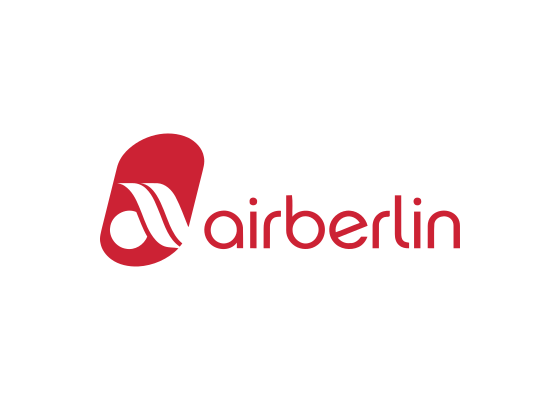
The Air Berlin emblem featured a bold abstract symbol rendered in a vibrant crimson red (#cc2234). The mark consisted of two curved, ribbon-like forms creating a dynamic circular composition that suggested both movement and unity. The design evoked a stylized letter “a” while maintaining enough abstraction to work as a standalone symbol. The flowing curves created a sense of energy and forward motion, appropriate for an airline brand. The wordmark appeared in a modern sans-serif typeface, typically in the same red or a neutral color depending on application.
Meaning and Symbolism
- Curved ribbon forms: Represent flight paths and air currents, while creating a dynamic sense of movement and energy
- Circular composition: Suggests global connectivity and the continuous nature of air travel
- Vibrant red color: Differentiates Air Berlin from blue-dominated airline branding while conveying energy, passion, and approachability
- Dual interpretation: Works as both an abstract mark and a stylized lowercase “a” for “air”
Design and History
Air Berlin was founded in 1978 by Lelco, an American company, and operated initially from West Berlin. Following German reunification in 1990, the airline transformed into a German company and grew to become the country’s second-largest carrier. The red logo became iconic in German aviation, appearing on aircraft at major hubs including Berlin Tegel Airport and Düsseldorf Airport.
The design team created a mark that would stand out in the competitive European airline market while avoiding the literal wing, globe, and bird imagery common in aviation branding. The flowing curves suggested speed and fluidity without resorting to cliché representations. The red color was a bold choice for a major carrier, as most established airlines favored blue for its associations with sky and trust. Air Berlin’s red conveyed a more dynamic, accessible personality aligned with its positioning as a more affordable alternative to Lufthansa.
The logo remained consistent throughout the airline’s growth years, including its 2012 entry into the Oneworld alliance. The distinctive red livery became a familiar sight across Europe as Air Berlin expanded its route network. After years of financial losses, the airline filed for insolvency on August 15, 2017, and ceased all operations by October 27, 2017, ending a nearly 40-year chapter in German aviation history. The logo, however, remains recognizable as a symbol of that era.
Typography
The Air Berlin wordmark employed a clean, contemporary sans-serif typeface with lowercase letters that echoed the approachable, modern character of the symbol. The letterforms featured consistent stroke weights and subtle geometric foundations. The lowercase treatment was unusual for airline branding, contributing to the carrier’s accessible, less formal positioning.
FAQ
Q: What happened to Air Berlin? A: Air Berlin filed for insolvency on August 15, 2017, after years of financial losses, and ceased all operations on October 27, 2017, ending nearly 40 years of service.
Q: Why did Air Berlin use red in its logo? A: The vibrant red differentiated Air Berlin from the blue-dominated airline industry, conveying energy and approachability while creating strong visual recognition for the brand.
Q: Was Air Berlin part of an airline alliance? A: Yes, Air Berlin joined the Oneworld airline alliance in 2012, aligning with carriers like American Airlines, British Airways, and Cathay Pacific.