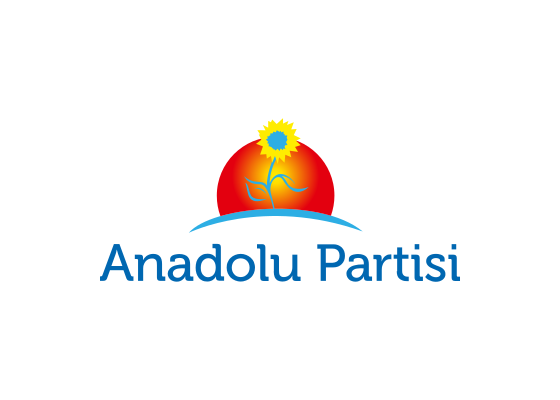
The Anadolu Partisi (Anatolia Party) logo featured a rising sun and sunflower combination representing the geographic regions of Anatolia and Thrace for this short-lived Turkish political party founded in 2014.
The Anatolia Party emblem combined natural symbolism with bold color choices, pairing a yellow sunflower with a rising sun rendered in vibrant blues and reds. The sunflower occupied the foreground, its petals radiating outward in bright yellow, while behind it a stylized sun rose with alternating blue and red rays. This layered composition created visual complexity and attempted to communicate regional representation through agricultural and celestial imagery. The color palette of blue, red, and yellow connected to Turkish national colors while distinguishing the party from competitors.
Meaning and Symbolism
- Sunflower: Represented the Thrace region of Turkey, the European portion of the country where sunflower cultivation is common and economically significant.
- Rising sun: Symbolized Anatolia, the vast Asian portion of Turkey, with the sun’s emergence suggesting new beginnings and the party’s aspirations for political renewal.
- Yellow coloration: Conveyed optimism, energy, and agricultural prosperity, connecting the urban political movement to rural constituencies.
- Blue and red rays: The alternating colors in the sun’s rays referenced Turkish flag elements while adding dynamic movement to the composition.
Design and History
Anadolu Partisi was founded by Emine Ülker Tarhan following her resignation from the Republican People’s Party (CHP) in November 2014. Tarhan’s departure stemmed from dissatisfaction with Kemal Kılıçdaroğlu’s leadership of the main opposition party. The Anatolia Party logo needed to quickly establish visual identity and communicate the party’s claim to represent all geographic regions of Turkey, both European Thrace and Asian Anatolia.
The choice of natural symbols rather than abstract geometric forms positioned the party as connected to Turkey’s agricultural heritage and regional diversity. Sunflowers and sun imagery appear frequently in Turkish political and cultural iconography, making these elements immediately recognizable to voters. However, the logo faced a fundamental challenge: Turkish political parties law reportedly prohibited party names referencing geographic regions, leading to legal complaints about the “Anatolia Party” name itself despite precedent from the earlier Great Anatolia Party.
The visual complexity of overlapping sunflower and sun elements created recognition challenges, particularly when reproduced at small sizes on ballot materials or campaign literature. Political logos must function under demanding conditions, from outdoor banners to television broadcasts to printed ballots, and the Anatolia Party mark struggled with these practical constraints. The multiple yellow tones and the intricate ray pattern required precise color reproduction that was difficult to achieve consistently across campaign materials.
The party’s electoral performance matched its brief existence. At the June 2015 general election, Anadolu Partisi received only 0.06% of votes, failing to make any significant impact on Turkish politics. Following this disappointment, Tarhan decided to boycott the snap general election held in November 2015, effectively ending the party’s active political participation. The logo disappeared from Turkish political discourse as quickly as it had emerged.
Typography
The Anadolu Partisi wordmark, appearing below the sunflower and sun emblem, used a bold sans-serif typeface with strong stroke weight. The letterforms needed to compete visually with the complex symbol above while maintaining legibility on campaign materials. Turkish political party logos typically emphasize the party name prominently, as voters often identify parties by text as much as by symbol. The typography’s straightforward approach contrasted with the elaborate natural imagery, attempting to balance symbolic richness with practical clarity.
FAQ
Q: Why did the party choose agricultural symbols for a political logo? A: The sunflower and sun imagery connected the party to Turkey’s agricultural regions and suggested growth, vitality, and new beginnings. These natural symbols attempted to communicate inclusiveness and representation of both urban and rural constituencies across Anatolia and Thrace.
Q: What legal challenges did the party face regarding its name and logo? A: Former MP Yılmaz Hastürk filed a legal complaint claiming Turkish political parties law forbade party names referencing geographic regions. Despite this complaint, a previous party called Great Anatolia Party had operated without legal problems, creating precedent uncertainty.
Q: Why did the Anatolia Party have such a short political life? A: The party won only 0.06% of votes in the June 2015 election, demonstrating minimal voter appeal. Founder Emine Ülker Tarhan boycotted the November 2015 snap election, effectively ending the party’s electoral participation. The party failed to differentiate itself sufficiently from established opposition parties or build the grassroots organization necessary for political success in Turkey’s competitive party system.
More logos with similar colors