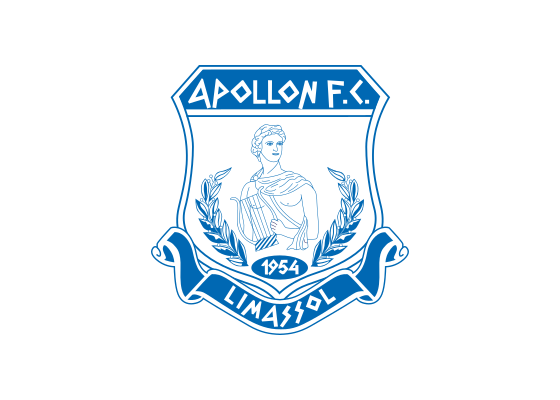
The Apollon Limassol FC emblem represents a Cypriot multi-sport club founded in 1954, competing in football, basketball, and volleyball.
The Apollon Limassol badge features a distinctive abstract design dominated by bright blue and deep indigo, creating a modern departure from traditional football club heraldry. The central element resembles a stylized flame or wing formation rendered in overlapping geometric shapes, with the bright blue forming the primary structure and deep indigo providing depth and contrast. White accents define edges and create separation between color zones. The club name appears in capital letters, typically positioned below or alongside the symbol. The overall design suggests movement, aspiration, and competitive energy while maintaining the clean lines necessary for reproduction across jerseys, signage, and digital platforms.
Meaning and Symbolism
- Flame or wing formation: Represents athletic aspiration, competitive spirit, and the upward trajectory of success
- Bright blue: Conveys loyalty, stability, and connection to the Mediterranean location of Limassol
- Deep indigo: Adds gravitas and depth, suggesting the club’s rich history and serious competitive intent
- Upward movement: Symbolizes the drive for excellence and the four UEFA Europa League group stage appearances
Design and History
Founded in 1954, Apollon Limassol needed a visual identity that could represent multiple sports while maintaining strong recognition in football, where the club achieved its greatest visibility. The modern abstract approach distinguished Apollon from Cyprus’s other major clubs, which tend toward traditional shield and crest designs. This differentiation was particularly important in Limassol, where Apollon competes for local support with other established teams.
The flame-like or wing-like form references the club’s mythological namesake, Apollo, the Greek god associated with light, music, and athletic excellence. However, rather than literal classical imagery, the design interprets these themes through contemporary geometric abstraction. This allowed the mark to feel both rooted in heritage and forward-looking, appealing to younger supporters while respecting the club’s six-decade history.
The dual-blue color scheme created strong contrast in televised matches and stood out among Cypriot football clubs’ typically red, yellow, or green palettes. The combination of bright and deep blues provided enough tonal variation to create dimension and visual interest while maintaining cohesive brand recognition across the club’s football, basketball, and volleyball operations.
As Apollon achieved success in European competition, qualifying for the UEFA Europa League group stages four times, the modern emblem held its own alongside the established badges of Western European clubs. The abstract design’s scalability and clarity proved particularly effective in small digital formats used by sports media and betting platforms.
Typography
The Apollon Limassol wordmark typically uses a bold, condensed sans-serif typeface with consistent stroke weights and tight letter spacing. The all-caps treatment creates visual strength and ensures legibility when the emblem is reproduced at small sizes on merchandise or in match graphics. The letterforms are straightforward and unadorned, allowing the abstract symbol to carry the creative energy of the brand.
FAQ
Q: What does the flame or wing shape in the Apollon Limassol logo represent? A: The upward-reaching form symbolizes athletic aspiration and competitive excellence, referencing the club’s mythological namesake Apollo while suggesting the upward trajectory of sporting success.
Q: Why does Apollon use blue instead of the reds and yellows common in Mediterranean football? A: The bright blue connects to the Mediterranean waters surrounding Limassol while distinguishing Apollon from rival clubs, and the addition of deep indigo creates visual depth and suggests the club’s historical gravitas.
Q: How does the modern abstract design relate to the club’s name? A: Rather than literal classical imagery of Apollo, the design interprets themes of light and excellence through contemporary geometric forms, creating a badge that honors heritage while appealing to modern supporters.
More logos with similar colors