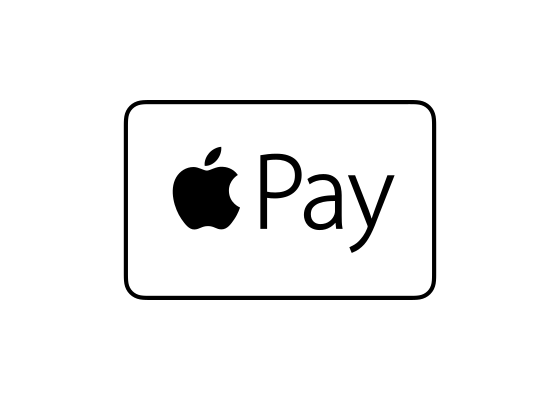
The Apple Pay logo represents Apple’s mobile payment and digital wallet service launched in 2014, enabling contactless transactions through iPhone, Apple Watch, and other devices.
The Apple Pay mark combines Apple’s iconic bitten apple symbol with the word “Pay” in Apple’s proprietary San Francisco typeface, typically rendered in black or white depending on context. The apple symbol maintains its perfect circular proportions and distinctive bite, while “Pay” appears in a clean, modern sans-serif that matches Apple’s broader typographic system. The mark often appears within a rounded rectangle container, echoing the shape of credit cards and payment buttons. The design leverages Apple’s established brand equity while clearly signaling the payment function.
Meaning and Symbolism
- Apple symbol: Transfers decades of brand trust, innovation, and premium positioning to the payment service
- “Pay” addition: Creates immediate functional clarity without lengthy explanation
- Black or white treatment: Maintains Apple’s minimalist aesthetic and ensures versatility across payment contexts
- Rounded rectangle container: References physical credit cards and creates a button-like appearance for tap-to-pay interfaces
Design and History
When Apple entered the mobile payments space in 2014, the company faced the challenge of building trust in a category plagued by security concerns and complicated user experiences. Rather than creating an entirely new brand identity, Apple leveraged its existing symbol’s association with quality, security, and seamless experiences. The addition of “Pay” created a distinct service brand while maintaining unmistakable Apple parentage.
The decision to use Apple’s proprietary San Francisco typeface for “Pay” ensured visual consistency across the expanding ecosystem of Apple services. As Apple Pay joined Apple Music, Apple TV, and other service brands, the typographic system created a family relationship while the descriptive names maintained clarity about each service’s function. This approach became the template for Apple’s entire services strategy.
The rounded rectangle container served multiple purposes. It created immediate association with physical credit cards, helping users understand that Apple Pay replaced traditional payment cards. The shape also worked perfectly as a payment button in apps and on websites, with the rounded corners matching Apple’s interface design language across iOS and macOS. The container’s proportions were optimized for both horizontal (card-like) and more square button orientations.
The black and white color options reflected Apple’s minimalist philosophy while ensuring the mark worked across varied contexts: white on dark iPhone screens, black on light e-commerce websites, metallic finishes on retail payment terminals. This flexibility became crucial as Apple Pay expanded from in-store contactless payments to in-app purchases, online checkout, and person-to-person transactions.
The mark’s simplicity proved strategic as Apple Pay rolled out internationally. Unlike wordmarks requiring translation, the universally recognized Apple symbol combined with the English word “Pay” (widely understood in commerce globally) created consistency across markets while maintaining local adaptability when necessary.
Typography
The “Pay” portion of the Apple Pay mark uses Apple’s San Francisco typeface, designed specifically for legibility at small sizes across Apple’s devices and interfaces. The letterforms feature generous apertures, consistent stroke weights, and subtle rounding that maintains clarity whether the mark appears on a watch face, phone screen, or billboard. The typeface’s geometric construction with humanist details creates the technical precision and friendly approachability that define Apple’s design language.
FAQ
Q: Why does Apple Pay use the existing Apple logo rather than a unique symbol? A: Leveraging the established Apple symbol immediately transferred decades of brand trust, innovation, and premium positioning to the payment service, crucial for building confidence in a category where security concerns dominated.
Q: What does the rounded rectangle container represent? A: The rounded rectangle references physical credit cards, helping users understand that Apple Pay replaces traditional payment methods, while also serving as an effective button shape for tap-to-pay interfaces across apps and websites.
Q: How does the black and white color scheme serve Apple Pay? A: The monochromatic approach maintains Apple’s minimalist aesthetic while ensuring versatility across contexts from dark iPhone screens to light websites to metallic retail terminals, supporting Apple Pay’s presence across digital and physical payment environments.