Norwegian Second Division Logos
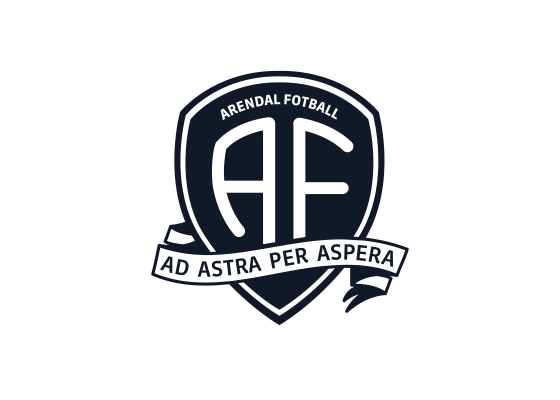
The Arendal Fotball badge represents a Norwegian professional football club based in Arendal, competing in the 2. divisjon, the third tier of Norwegian football.
The Arendal emblem employs the traditional shield format common in European football, rendered in deep navy and white that evokes maritime heritage appropriate for a coastal Norwegian town. The dark navy conveys professionalism and authority while referencing the sea central to Arendal’s identity as a southern Norwegian port city. White provides clean contrast, ensuring excellent legibility across all applications from kits to digital platforms. The shield shape connects Arendal to global football heraldic traditions while the restrained color palette suggests Nordic design sensibility favoring simplicity over elaborate decoration. This straightforward approach works efficiently for a third-tier club operating with modest budgets where functional branding matters more than elaborate visual systems.
Meaning and Symbolism
- Deep navy: References Arendal’s coastal location and maritime heritage while projecting professional football credibility
- Shield form: Connects to European football heraldic traditions, representing strength and competitive pride
- Navy and white palette: Evokes Nordic design principles of simplicity, clarity, and functional elegance
- Clean composition: Reflects practical branding appropriate for third-tier clubs with limited marketing budgets
Design and History
Arendal Fotball competes in Norway’s 2. divisjon, the third tier of Norwegian football’s league system. This level features semi-professional and amateur clubs representing smaller cities and towns throughout Norway. Teams at this level typically operate with modest budgets, relying heavily on local support, volunteer labor, and players balancing football with other careers or education. The visual identity needed to project professional ambition while remaining realistic about operational resources.
The coastal town of Arendal sits on Norway’s southern coast, making it one of the country’s more temperate locations despite still experiencing Nordic climate. The town’s economy historically centered on shipping, fishing, and maritime trade, connections potentially influencing the navy color choice. In Norwegian football, regional identity matters intensely, with clubs representing not just teams but civic pride and local community.
Norwegian football operates in challenging environment compared to larger European leagues. The long winter limits outdoor playing seasons, smaller population provides limited attendance and commercial revenue, and player talent frequently migrates to wealthier leagues abroad. Third-tier clubs like Arendal face additional challenges, competing for local attention with higher-level clubs and managing limited resources. Visual identity at this level prioritizes recognizability and community connection over sophisticated brand systems.
The badge’s simplicity serves practical purposes. Third-tier clubs must reproduce badges cost-effectively across limited merchandise runs, basic signage, and volunteer-produced materials. Complex multi-color designs increase production costs that small clubs struggle to justify. The two-color approach enables affordable reproduction while maintaining professional appearance.
Typography
The typography within the shield uses clean, legible letterforms appropriate for Norwegian language and football contexts. The letterform styling balances contemporary aesthetics with traditional football badge conventions. Character spacing and sizing accommodate the shield’s geometric constraints while ensuring the club name remains readable on jerseys and in stadium signage, essential for brand recognition in competitive football environments.
FAQ
Q: What division does Arendal Fotball compete in? A: Arendal competes in the 2. divisjon, the third tier of Norwegian football’s league system, featuring semi-professional and amateur clubs.
Q: Where is Arendal located? A: Arendal is a coastal town in southern Norway, with maritime heritage potentially reflected in the club’s navy color choice.
Q: Why is the badge design relatively simple? A: Third-tier clubs operate with modest budgets, making cost-effective two-color designs practical for merchandise, signage, and materials reproduction while maintaining professional appearance.
More logos with similar colors