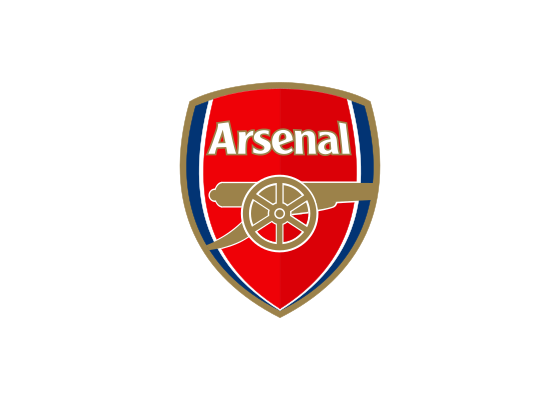
The Arsenal logo centers on a single cannon facing left, rendered in gold against a deep red shield. This iconic mark represents both the club’s industrial heritage and its enduring position as one of England’s most successful football institutions.
Arsenal’s visual identity has evolved significantly since the club’s founding in 1886, but the cannon has remained constant. The current design, introduced in 2002, strips away decorative elements in favor of a bold, simplified approach. The forward-facing cannon symbolizes attacking football and ambition, while the shield shape provides stability and tradition. Red and white, the club’s signature colors since 1933, dominate the palette, with gold accents adding prestige.
The logo works exceptionally well at small sizes, particularly on mobile devices and merchandise. The clean lines and strong contrast ensure instant recognition whether viewed on a stadium screen or a supporter’s pin. The eastward-facing cannon has become so distinctive that Arsenal is often referred to simply as “The Gunners,” a nickname that originates from the club’s foundation by workers at the Royal Arsenal armaments factory in Woolwich.
Meaning and Symbolism
- Cannon: References the club’s origins at the Royal Arsenal armaments factory, connecting modern success to industrial heritage
- Red shield: Represents strength, passion, and the club’s competitive spirit in English football
- Gold detailing: Conveys prestige and championship ambition, reflecting Arsenal’s 13 league titles
- Left-facing orientation: Symbolizes forward motion and attacking play, core to Arsenal’s football philosophy
- Simplified design: Demonstrates confidence and modernity, moving away from ornate Victorian-era crests
Design and History
The Arsenal crest has undergone numerous transformations since the club’s founding. Early versions featured elaborate coats of arms and Gothic lettering reflecting Victorian design sensibilities. The cannon first appeared prominently in the 1920s when the club moved to Highbury and established itself in North London.
The 2002 redesign, created to modernize the club’s image, proved controversial initially but has since become beloved by supporters. The decision to remove text and decorative elements was strategic, acknowledging that Arsenal’s global recognition required no written explanation. This approach preceded similar minimalist redesigns across football, positioning Arsenal as a visual trendsetter.
The current mark balances heritage with contemporary design principles. While the cannon honors the club’s past, the execution feels modern and scalable across digital platforms. This careful balance helps Arsenal maintain tradition while appealing to new generations of supporters worldwide.
Typography
Arsenal uses a custom sans-serif typeface for the wordmark that appears alongside the crest on official communications. The letterforms feature slightly condensed proportions with clean, geometric construction. This typographic approach complements the logo’s simplicity while ensuring excellent legibility across applications, from match programs to digital interfaces. When text appears with the cannon, it typically uses the club’s signature red or white, maintaining visual consistency with the primary mark.
FAQ
Q: Why does the Arsenal cannon face left instead of right?
A: The cannon faces east, the direction of the club’s original home in Woolwich, East London. This orientation has remained consistent through multiple redesigns, serving as a subtle reference to Arsenal’s founding location even after the club moved north to Highbury in 1913.
Q: When did Arsenal start using red and white as their primary colors?
A: Arsenal adopted the iconic red shirts with white sleeves in 1933 under manager Herbert Chapman. Before this, the club wore various combinations including red and blue. The color change was inspired by Chapman’s desire to create a distinctive, recognizable look that would help the team stand out on the pitch.
Q: Has the Arsenal logo always featured a cannon?
A: While the cannon has been the central element since the 1920s, early Arsenal crests featured more complex heraldic designs. The club experimented with various styles throughout the 20th century, but the cannon remained the most consistent symbol before becoming the sole focus in the minimalist 2002 redesign.
More logos with similar colors