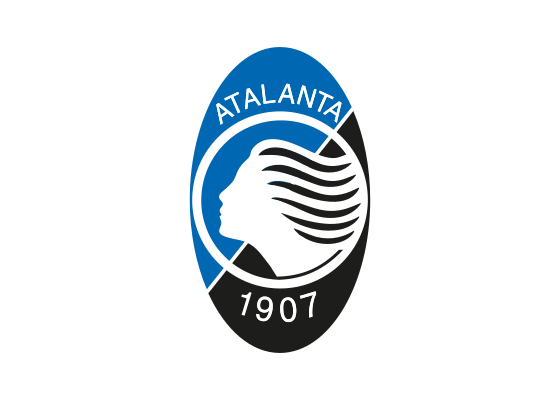
The Atalanta logo represents one of Italy’s most storied football clubs, founded in 1907 by students in Bergamo. Known as La Dea (The Goddess), the club’s visual identity reflects its deep connection to classical mythology and the fierce competitive spirit of the Nerazzurri.
The Atalanta crest uses a bold oval format that encloses the club’s name and founding year within a structured composition. The choice of blue and black as primary colors creates striking contrast while establishing immediate recognition across Serie A. The wordmark sits prominently at the top, with clean letterforms that balance traditional authority with modern legibility. Below, the year 1907 anchors the design, establishing historical credibility. The oval shape itself references the classical form of ancient medallions, a deliberate nod to the club’s name derived from the Greek huntress Atalanta.
The color palette serves both aesthetic and symbolic purposes. The deep blue represents loyalty and determination, while black adds weight and intensity. Together, these colors create the Nerazzurri identity that distinguishes Atalanta from regional rivals. The white accents provide necessary breathing room and ensure the logo remains functional across different applications, from kits to broadcast graphics. The overall composition maintains simplicity, a strategic choice that allows the badge to work effectively at any scale.
Meaning and Symbolism
- Oval format echoes ancient Greek medallions, connecting to the club’s mythological namesake
- Blue and black stripes represent the Nerazzurri identity, symbolizing determination and strength
- 1907 foundation date establishes heritage and authenticates the club’s long history in Italian football
- Clean typography balances tradition with modern clarity, ensuring immediate recognition
- Bergamo connection reinforced through classical design elements that honor the city’s Renaissance heritage
Design and History
The current Atalanta logo evolved from decades of refinement while maintaining core elements that supporters recognize. The oval badge format has remained consistent since the mid-20th century, though typography and proportions have been modernized. The decision to prominently display the founding year came later, as clubs increasingly emphasized their historical roots during the competitive branding era of the 1990s and 2000s. The blue and black color scheme has been constant, connecting every iteration of the badge to the club’s unwavering identity.
The club’s nickname, La Dea, refers to Atalanta of Greek mythology, a huntress known for her speed and fierce independence. This mythological connection influenced design decisions that favor clean, athletic lines rather than ornate decoration. The logo avoids unnecessary flourishes, instead using geometric precision to convey strength and forward momentum. This approach aligns with the club’s playing philosophy, particularly under recent management that emphasized fast-paced, aggressive football.
In recent years, Atalanta has experienced a renaissance on the pitch, regularly competing in European competitions and challenging Italy’s traditional powerhouses. The logo has remained stable through this period, serving as a constant visual anchor even as the club’s fortunes have improved dramatically. This consistency has allowed supporters to build deeper emotional connections to the crest, which now appears on merchandise worn by fans across Europe.
Typography
The wordmark typography uses bold, condensed letterforms that maximize presence within the limited oval space. The uppercase treatment conveys authority, while the slightly curved baseline follows the outer edge of the oval, creating visual harmony. Letter spacing is tight but controlled, ensuring legibility while maintaining impact. The weight and proportion of the typeface suggest strength without aggression, appropriate for a club that values technical skill alongside physicality. This typographic approach has remained largely consistent, with only minor adjustments to stroke weight and character spacing over the years.
FAQ
Q: Why is Atalanta called La Dea?
A: The nickname means “The Goddess” in Italian, referring to Atalanta from Greek mythology, a huntress celebrated for her speed and skill. The name was chosen by the club’s founders, who were classical studies students.
Q: What do the blue and black colors represent?
A: The blue and black stripes create the Nerazzurri identity (literally “black-blues” in Italian), symbolizing determination, strength, and the club’s unwavering competitive spirit. These colors have been worn since the club’s founding.
Q: Has the Atalanta logo changed significantly over time?
A: While the oval format and color scheme have remained constant, the logo has undergone typographic refinements and proportion adjustments. The most significant change was the prominent addition of the 1907 founding date to emphasize the club’s heritage.
More logos with similar colors