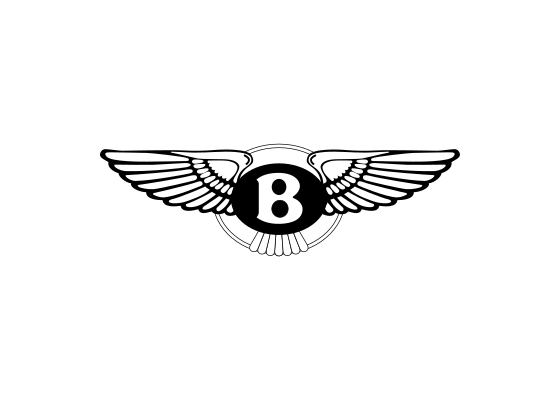
The Bentley logo combines a winged B emblem with stark black and white (#000000, #ffffff) coloring, establishing the British luxury automaker’s identity through heraldic symbolism and aeronautical references.
The Bentley emblem centers on a capital B flanked by outstretched wings, contained within a circular badge. This winged motif directly references aviation, connecting the brand to speed, engineering excellence, and the golden age of flight. The wings extend symmetrically from the letter, creating a balanced composition that suggests forward motion. The black background provides maximum contrast against the white elements, ensuring immediate recognition from any distance. This high-contrast approach reflects British design sensibilities where clarity and legibility are paramount.
The logo’s monochromatic palette aligns Bentley with other prestigious British luxury brands that favor restraint over chromatic flourish. The starkness of black and white conveys timelessness, refusing to participate in color trends that might date the identity. This choice positions Bentley alongside Rolls-Royce and Jaguar in the pantheon of British automotive heritage, though Bentley’s winged emblem distinguishes it as the most overtly aeronautical.
Since joining the Volkswagen Group in 1998, Bentley has maintained this core identity while refining the execution. The logo appears on distinctive grilles, steering wheels, and center caps, always rendered in premium materials that match the cars themselves.
Meaning and Symbolism
- Winged B: References both the brand’s aviation-inspired performance heritage and the aspirational nature of luxury ownership, suggesting vehicles that elevate their drivers above ordinary experience.
- Aviation motif: Connects to founder W.O. Bentley’s World War I aircraft engine work for the Royal Air Force, establishing engineering credibility through military-grade precision.
- Circular badge: Contains the composition in a format that works equally well on radiator grilles, wheels, and documentation, providing brand consistency across all touchpoints.
- Black and white palette: Signals British restraint, premium positioning, and architectural permanence in contrast to more colorful mass-market automotive brands.
Design and History
W.O. Bentley founded his company in 1919, with the winged B appearing in the brand’s earliest identity systems. The logo draws from British heraldry traditions where family crests communicated lineage and achievement. The aviation reference was intentional, capitalizing on public fascination with flight during the interwar period when Bentley established its racing reputation.
The logo gained prestige through Bentley’s five victories at Le Mans between 1924 and 1930, with the winged emblem adorning some of the era’s most successful racing cars. These wins established the brand’s performance credentials before its 1931 acquisition by Rolls-Royce. During the Rolls-Royce ownership period (1931-1998), the winged B remained distinct from the Rolls-Royce Spirit of Ecstasy, allowing Bentley to maintain its sportier positioning.
When Volkswagen acquired Bentley in 1998, the German parent invested heavily in modernizing manufacturing while preserving British design heritage. The logo underwent subtle refinements, with cleaner lines and more precise geometry, but the core winged B concept remained unchanged. This continuity reinforces Bentley’s positioning as a heritage luxury brand, even as it introduces contemporary models like the Bentayga SUV and electrification initiatives.
Typography
The Bentley logo uses a bold, serif B that balances classical proportions with automotive strength. The letterform’s thick strokes provide visual weight appropriate for a brand building 5,000-pound grand tourers, while the serifs nod to British typographic traditions. The B’s curves are engineered rather than calligraphic, with controlled geometry that suggests precision manufacturing. When the wordmark appears alongside the emblem, Bentley typically uses a refined sans-serif that provides modern clarity without competing with the heritage badge.
FAQ
Q: Why does Bentley use wings in its logo?
A: The wings reference founder W.O. Bentley’s aviation engineering background with the Royal Air Force during World War I, connecting the brand to precision engineering and performance.
Q: Has the Bentley logo changed since Volkswagen purchased the brand?
A: The core winged B concept has remained unchanged since 1919, though VW has refined the execution with cleaner lines and more precise geometry while preserving the heritage design.
Q: What’s the difference between the Bentley and Aston Martin winged logos?
A: Bentley’s wings are more compact and contain a B within a circle, while Aston Martin’s wings are horizontal and open, with the brand name spelled out across the center.
More logos with similar colors