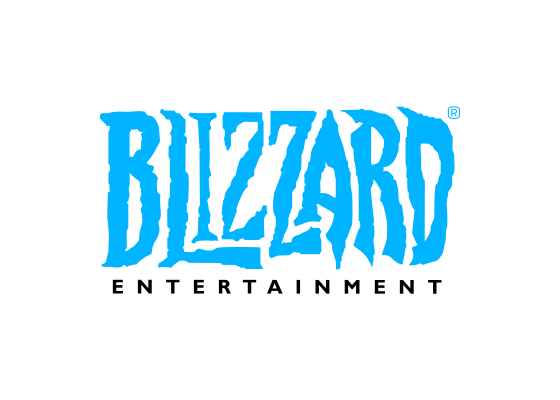
The Blizzard Entertainment logo features the company name in vibrant cyan blue (#00b4ff), representing the studio’s focus on polished, premium gaming experiences in franchises like World of Warcraft, Diablo, StarCraft, and Overwatch. This bright typographic identity reflects Blizzard’s philosophy of releasing games “when they’re done” rather than meeting arbitrary deadlines.
The bold, geometric letterforms convey confidence and technical precision, appropriate for a studio known for obsessive polish and balance refinement. The wide stance of the letters creates a stable, authoritative presence that matches Blizzard’s position as one of gaming’s most prestigious developers. The bright cyan differentiates Blizzard from competitors while suggesting the frost and ice imagery that appears frequently in Warcraft lore and the company’s name itself.
This typographic approach evolved from Blizzard’s early emphasis on gameplay over spectacle. The studio built its reputation on mechanics-first design, where StarCraft’s competitive balance or World of Warcraft’s endgame progression mattered more than cutting-edge graphics. The straightforward wordmark reflects this prioritization of substance over visual flourish, though the vibrant blue ensures the brand never feels corporate or sterile.
Meaning and Symbolism
- Cyan blue color: Suggests frost and ice while providing energetic vibrancy, connecting to the “Blizzard” name and differentiating from darker gaming industry palettes.
- Bold, geometric letterforms: Convey technical precision and the obsessive polish that defines Blizzard’s development philosophy.
- Wide letter spacing: Creates stability and authority, reflecting Blizzard’s position as one of gaming’s most respected premium studios.
- Purely typographic identity: Emphasizes substance over spectacle, aligning with Blizzard’s mechanics-first design philosophy.
Design and History
Three UCLA graduates founded Silicon & Synapse in 1991, initially creating ports of other companies’ games for different platforms. The studio became Chaos Studios briefly in 1993 before settling on Blizzard Entertainment in 1994, just before releasing Warcraft: Orcs & Humans. This real-time strategy game established Blizzard’s approach: take existing genres and refine them to near-perfection rather than chasing novelty.
Warcraft II (1995), Diablo (1996), and StarCraft (1998) solidified Blizzard’s reputation for polish and longevity. These titles remained popular for years rather than months, defying industry assumptions about game lifecycles. World of Warcraft’s 2004 launch transformed Blizzard from prestigious developer into cultural phenomenon, with subscription revenue funding the studio’s extended development cycles. The cyan wordmark appeared consistently across this growth, building extraordinary brand equity.
Activision merged with Vivendi Games (Blizzard’s parent company) in 2008, creating Activision Blizzard. Despite corporate consolidation, Blizzard maintained operational independence until cultural pressures and quality concerns emerged in the late 2010s. Microsoft acquired Activision Blizzard for $69 billion in 2023, the gaming industry’s largest acquisition. The cyan Blizzard mark persists unchanged, though it now represents a subsidiary within Microsoft’s gaming empire rather than an independent studio.
Typography
The Blizzard wordmark employs a custom bold sans-serif with distinctive geometric characteristics. The “A” uses a flat apex rather than a pointed peak, creating an industrial, constructed aesthetic. The “Z” characters feature parallel diagonal strokes with perpendicular terminals, emphasizing the geometric precision throughout. Stroke weights remain remarkably consistent, avoiding any calligraphic variation that might suggest organic or hand-drawn qualities. The letterforms sit slightly condensed, creating density and impact without sacrificing legibility. The cyan color appears consistently at #00b4ff, bright enough to pop against dark backgrounds while maintaining professionalism against light surfaces.
FAQ
Q: Why does Blizzard use such a bright cyan blue?
A: The vibrant cyan connects to the “Blizzard” frost imagery while providing energetic differentiation from the darker blues and blacks dominating gaming branding.
Q: When did Blizzard Entertainment get its current name?
A: The studio adopted “Blizzard Entertainment” in 1994 after operating as Silicon & Synapse (1991-1993) and briefly as Chaos Studios in 1993.
Q: Has Microsoft changed Blizzard’s branding after the acquisition?
A: Following Microsoft’s $69 billion acquisition of Activision Blizzard in 2023, the Blizzard logo and branding have remained unchanged, maintaining continuity with decades of brand equity.