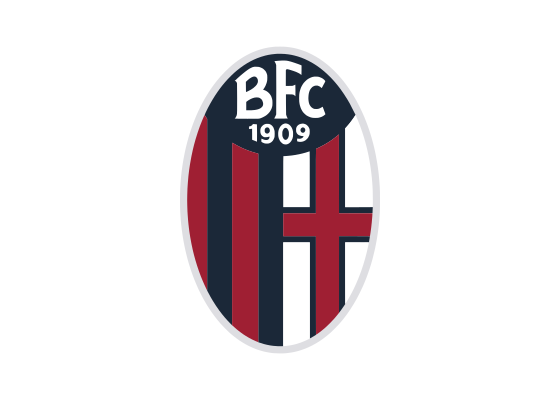
The Bologna logo embodies one of Italian football’s founding institutions, established in 1909. As one of the original Serie A members, the club’s crest reflects over a century of tradition through its balanced composition and distinctive red and blue color scheme.
The Bologna crest employs a classic oval badge structure that frames the club’s initials and founding year with architectural precision. The design centers on “BFC 1909,” presented in bold serif typography that commands attention while respecting historical conventions. The deep navy blue background provides a stable foundation, while vibrant red accents create dynamic contrast. A white border defines the oval’s edge, ensuring the logo maintains clarity against any background. The composition avoids unnecessary complexity, instead relying on typographic hierarchy and strategic color placement to communicate the club’s identity.
The color selection carries both visual and symbolic weight. Navy blue represents stability and authority, appropriate for a club that helped establish Italian professional football. The red injection adds passion and energy, reflecting the competitive fire that drove Bologna to seven Scudetti, including multiple championships in the 1930s. Gray tones in supporting elements add sophistication without diluting the primary palette. This restrained approach allows the logo to age gracefully while remaining immediately recognizable in match broadcasts and merchandising.
Meaning and Symbolism
- Oval format follows traditional Italian badge conventions, connecting Bologna to the broader history of calcio
- BFC initials directly identify Bologna Football Club while maintaining visual simplicity
- 1909 foundation date establishes the club as one of Serie A’s founding members and champions
- Navy and red palette balances institutional authority with competitive passion and energy
- Serif typography conveys heritage and permanence, appropriate for a club with seven league titles
Design and History
Bologna’s visual identity has evolved gradually since the club’s founding, with the current logo maintaining elements that date back decades. The oval badge became standard in the mid-20th century, aligning with broader trends in Italian football branding. The prominent display of “1909” gained importance as the club sought to emphasize its founding status during periods when newer clubs achieved greater on-pitch success. The typography has been refined over time, with recent versions using cleaner, more legible letterforms while preserving the essential character.
The club’s glory years came during the late 1930s and early 1960s, when Bologna won five of their seven Scudetti. The logo from this era featured similar elements but with more ornate detailing, reflecting the decorative aesthetic of mid-century Italian design. As football branding modernized in the 1980s and 1990s, Bologna simplified their crest while retaining the core components that supporters associated with championship success. This balance between modernization and tradition has allowed the logo to remain relevant across different eras.
Bologna’s crest now appears on kits worn by a team experiencing a competitive resurgence under Canadian ownership. The stability of the visual identity has provided continuity through ownership changes and fluctuating league positions. The logo’s traditional elements remind fans of past glories while the clean execution suggests forward momentum. This duality makes the badge effective for both heritage marketing and attracting new supporters.
Typography
The typography combines uppercase letterforms in a bold serif style that prioritizes readability and authority. The “BFC” letters use consistent stroke weights, creating visual rhythm across the initials. The numerals “1909” employ a slightly different weight, providing subtle hierarchy while maintaining family resemblance. Letter spacing is calibrated to fill the oval efficiently without crowding, a practical consideration for badge applications on curved surfaces like match balls. The overall typographic treatment feels anchored in tradition without appearing dated, a balance achieved through careful proportion and weight adjustments.
FAQ
Q: Why does Bologna’s logo use red and blue?
A: The red and blue are Bologna’s traditional club colors, used since the club’s founding in 1909. The navy blue represents stability and institutional authority, while red adds the passion associated with competitive football. Together they create immediate recognition.
Q: How many championships has Bologna won?
A: Bologna have won seven Serie A titles, with five coming during their dominant period in the late 1930s. They also won two Coppa Italia titles in the 1970s, making them one of Italy’s most decorated clubs despite recent struggles.
Q: What does BFC stand for?
A: BFC stands for Bologna Football Club, the club’s official name since its 1909 founding. The initials appear prominently on the crest, providing immediate identification even at small sizes or from a distance.
More logos with similar colors