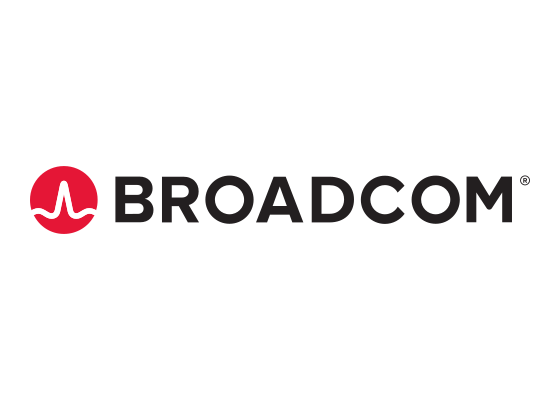
The Broadcom logo features bold black letterforms with a distinctive red accent (#e51636), representing one of the world’s largest semiconductor and infrastructure software companies. Through aggressive acquisitions totaling over $100 billion since 2015, Broadcom consolidated networking, broadband, wireless, storage, and industrial markets under a single visual identity.
The mark’s most notable feature is the stylized “B” where the vertical stem meets the bowls at sharp angles, creating a dynamic, technical quality. The red accent typically appears as an underline or architectural element in brand applications, adding energy to what could otherwise be purely corporate black typography. This color combination conveys professionalism and technical authority while the red suggests innovation and aggressive market positioning.
Broadcom’s logo appears across an enormous range of technologies, from Wi-Fi and Bluetooth chips in consumer devices to networking infrastructure powering data centers. The company supplies semiconductors for iPhones, broadband modems, fiber-optic networks, and enterprise storage systems. This breadth required a logo generic enough to encompass diverse product categories yet distinctive enough to maintain identity through countless acquisitions that absorbed brands like Brocade, CA Technologies, and Symantec’s enterprise security business.
Meaning and Symbolism
- Sharp geometric “B”: The angular letter construction suggests precision engineering and technical sophistication appropriate for a company designing chips with nanometer-scale features.
- Black dominance (#231f20): The dark, authoritative color conveys enterprise credibility and B2B positioning, differentiating Broadcom from consumer-facing semiconductor brands.
- Red accent (#e51636): The bright red adds energy and visual interest, signaling that Broadcom pursues innovation and market leadership, not just operational efficiency.
- Wordmark simplicity: The text-only logo works across countless acquired product lines without imagery that might feel limiting or dated as technologies evolve.
Design and History
Broadcom originated in 1991 when Henry Samueli and Henry Nicholas founded the company in Southern California, initially focusing on cable modem and set-top box chips. The company rode the broadband boom of the late 1990s and early 2000s, eventually diversifying into wireless communications, enterprise networking, and data center infrastructure. Broadcom became known for supplying the “picks and shovels” of the internet era: the underlying silicon that made connectivity possible.
After Singapore-based Avago Technologies acquired Broadcom in 2016 for $37 billion, the combined company adopted the Broadcom name and brand, recognizing its stronger market recognition. Under CEO Hock Tan, this new Broadcom pursued aggressive acquisitions to consolidate semiconductor and infrastructure software markets. The company attempted to purchase Qualcomm for $117 billion (blocked by U.S. regulators) and successfully acquired CA Technologies ($18.9 billion) and Symantec’s enterprise security division ($10.7 billion).
These acquisitions made Broadcom one of the largest semiconductor companies globally by revenue, competing with Intel, Samsung, and TSMC. The logo needed to work across wildly different contexts: networking chips in routers, Wi-Fi modules in smartphones, fiber-optic components in telecom infrastructure, and enterprise software for mainframe management. The straightforward black wordmark with red accent provides enough flexibility to span these domains while maintaining brand consistency. The mark appears on technologies reaching billions of devices annually, from the Wi-Fi chips in consumer electronics to the storage controllers in data centers running cloud services.
Typography
The Broadcom wordmark employs a bold, authoritative sans-serif with substantial stroke weight that ensures visibility and impact in enterprise contexts. The letterforms feature clean geometric construction with the distinctive angular “B” creating visual interest and brand recognition. Characters maintain consistent weight throughout, though the “o” uses perfect circular geometry while letters like “m” feature straight stems and sharp angles. The tight letter spacing creates horizontal compression appropriate for a technology company optimizing for efficiency. This typography balances technical precision with accessibility, making semiconductor infrastructure feel professional and trustworthy to enterprise customers.
FAQ
Q: What products does Broadcom make?
A: Broadcom designs semiconductors and infrastructure software for networking (Ethernet switches, routers), wireless (Wi-Fi, Bluetooth), broadband (cable modems), storage (controllers), and enterprise software (mainframe management, security).
Q: Why is Broadcom less well-known than Intel despite similar revenue?
A: Broadcom primarily serves business customers and operates behind the scenes, supplying chips integrated into other companies’ products rather than selling consumer-facing processors with visible branding like Intel Inside.
Q: What’s the significance of the red accent in Broadcom’s logo?
A: The red (#e51636) adds energy and visual distinction to the corporate black wordmark, signaling that Broadcom pursues aggressive market consolidation and innovation, not just operational management of mature products.
More logos with similar colors