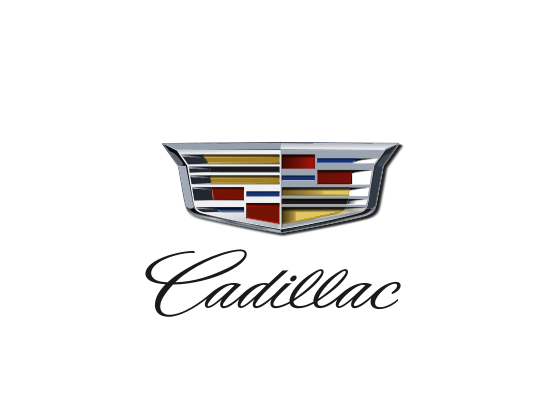
The Cadillac logo features a heraldic crest with a shield divided into quadrants, rendered primarily in gold gradients (#916d00 to #f3e3b2) and navy blue (#14327a), representing the American luxury automaker’s connection to French nobility and its positioning as General Motors’ prestige brand.
The Cadillac crest draws directly from the coat of arms of French explorer Antoine Laumet de La Mothe, sieur de Cadillac, who founded Detroit in 1701. The shield divides into four quadrants, with alternating patterns of small squares (representing knights’ armor) and horizontal stripes. A wreath surrounds the shield, while a stylized duck or merlet (a heraldic bird with no feet, symbolizing perpetual motion) sits atop the composition. This elaborate heraldry immediately distinguishes Cadillac from competitors using simplified geometric marks, signaling a brand that trades on heritage rather than modernist minimalism.
The gold coloring dominates the mark, appearing in rich gradients that suggest precious metal rather than flat paint. This metallic treatment reinforces luxury positioning and creates visual depth through sophisticated shading from darker bronze tones to bright golden highlights. The navy blue quadrants provide contrast and reference royal lineage, connecting Cadillac to European nobility even as an American brand. The complexity of the crest creates challenges in small-scale applications, but Cadillac has maintained this ornate design through multiple refreshes, recognizing that simplification would compromise the heritage story the logo tells.
Modern iterations have sharpened the crest’s edges and flattened some dimensional elements for better digital reproduction, but the core heraldic composition remains unchanged from the 1906 original. This continuity matters for Cadillac’s positioning as “Standard of the World,” a tagline used throughout the brand’s history.
Meaning and Symbolism
- Heraldic crest: Connects Cadillac to Antoine de La Mothe Cadillac, Detroit’s founder, establishing lineage that positions the brand as American automotive royalty with European noble ancestry.
- Gold coloring: Signals luxury, prestige, and precious metal craftsmanship, differentiating Cadillac from mass-market brands while justifying premium pricing that historically reached twice the cost of mainstream General Motors vehicles.
- Quadrant division: References medieval armor and defensive strength, suggesting vehicles built to protect occupants with substantial construction rather than lightweight efficiency.
- Merlet bird: Symbolizes perpetual motion and restless innovation, representing Cadillac’s technological leadership from electric starters (1912) to Super Cruise autonomous driving systems.
Design and History
When Henry Leland founded Cadillac in 1902, he chose the name to honor Detroit’s French founder. The coat of arms appeared on the first vehicles in 1906, establishing immediate differentiation in the nascent automotive market. This heraldic approach was unusual for American manufacturers, most of whom favored initials or simple emblems. The European aristocratic reference positioned Cadillac above domestic competitors, attracting buyers seeking social status along with transportation.
The crest gained credibility through Cadillac’s engineering innovations. The 1912 Cadillac Model Thirty introduced the electric self-starter, eliminating dangerous hand-cranking and making automobiles accessible to women. This breakthrough earned Cadillac the Dewar Trophy from the Royal Automobile Club of Britain, validating the brand’s “Standard of the World” claim. The gold crest became associated with technological leadership, not just styling pretense.
Cadillac’s peak influence came in the 1950s through 1970s, when models like the Eldorado and DeVille defined American luxury. The crest appeared on massive chrome grilles and opera windows, becoming synonymous with excess and achievement. This era established Cadillac as the default American status symbol, from Elvis Presley’s pink Cadillacs to presidential limousines.
The brand’s decline in the 1980s damaged the crest’s prestige, as quality problems and badge-engineering with cheaper GM brands eroded Cadillac’s premium positioning. A 2000 redesign sharpened the crest’s edges and introduced bolder colors, attempting to revitalize the mark for younger buyers. The current version, refined in 2014, flattens the dimensional rendering while maintaining the gold and navy palette, balancing heritage with contemporary aesthetics.
Typography
Cadillac’s wordmark uses a refined serif typeface with distinctive characteristics that reinforce the brand’s luxury positioning. The letterforms feature tall, elegant proportions and subtle bracketing on the serifs, suggesting classic American typography from the brand’s golden age. The spacing is generous, creating an unhurried, confident presentation that matches the crest’s heraldic formality. Recent applications pair the traditional wordmark with a supporting sans-serif for model names and marketing copy, creating hierarchy while maintaining the premium voice across all touchpoints.
FAQ
Q: Is the Cadillac logo really based on a French nobleman’s coat of arms?
A: Yes, the crest derives from Antoine Laumet de La Mothe, sieur de Cadillac, who founded Detroit in 1701, though some historians question whether Cadillac actually held legitimate noble status.
Q: Why does Cadillac use such a complex logo compared to other luxury brands?
A: The heraldic complexity differentiates Cadillac from minimalist competitors and tells a heritage story about Detroit’s founding and American automotive royalty, even if it creates reproduction challenges.
Q: Has the Cadillac crest changed significantly over the years?
A: The core composition has remained consistent since 1906, though executions have varied from ornate to streamlined, with the current version balancing heritage detail with contemporary flat design principles.
More logos with similar colors