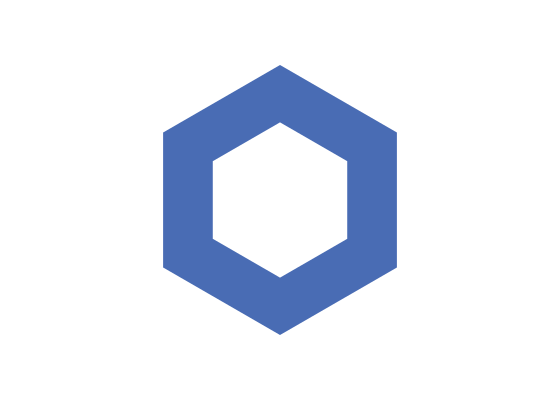
The Chainlink logo features interlocking hexagons in professional blue (#496cb4) that visualize the network’s role as decentralized middleware connecting smart contracts to real-world data. Unlike cryptocurrency platforms focused on payments or applications, Chainlink provides the critical infrastructure that makes blockchain useful beyond isolated networks.
The hexagonal pattern represents the network of independent node operators that retrieve, validate, and deliver external data to smart contracts. These linked shapes communicate reliability through redundancy: if one oracle fails, others maintain data integrity. The geometric precision reflects Chainlink’s technical approach to the oracle problem, which plagued early smart contract platforms that couldn’t access off-chain information like prices, weather data, or sports scores.
The blue color anchors Chainlink in the language of trust and infrastructure rather than speculative trading. This choice distinguishes the project from flashier cryptocurrencies and positions LINK tokens as utility assets that power oracle services rather than stores of value. The logo appears across DeFi protocols that rely on Chainlink price feeds to secure billions in total value locked, from Aave to Synthetix to countless derivatives platforms.
Meaning and Symbolism
- Interlocking hexagons: The linked geometric shapes visualize Chainlink’s decentralized oracle network, where multiple independent nodes validate data to prevent single points of failure.
- Professional blue (#496cb4): The corporate-friendly shade positions Chainlink as enterprise-grade infrastructure rather than speculative crypto, appealing to traditional companies exploring blockchain.
- Honeycomb structure: The hexagonal pattern suggests natural efficiency and distributed strength, paralleling how Chainlink nodes work collectively to secure data feeds.
- Circular container: When the hexagons appear within a circle, the form suggests completeness and the closing of the loop between blockchains and external data sources.
Design and History
Chainlink launched in 2017 under the leadership of Sergey Nazarov and Steve Ellis, who identified a critical limitation in smart contract platforms: inability to access external data. Ethereum could execute complex logic, but smart contracts remained blind to real-world information. This “oracle problem” prevented use cases like decentralized insurance, prediction markets, or any application requiring external data inputs. Chainlink proposed a solution using cryptographically secured nodes that fetch and validate off-chain data.
The project raised $32 million in its 2017 ICO and spent years building infrastructure before gaining traction during the 2020 DeFi summer. As decentralized finance protocols proliferated, they needed reliable price feeds to prevent manipulation and liquidation errors. Chainlink became the dominant oracle solution, with its price feeds securing tens of billions in DeFi value. The hexagonal logo appeared across major protocols announcing Chainlink integrations.
The brand identity emphasizes Chainlink as infrastructure rather than an application or currency. The logo rarely appears consumer-facing, instead showing up in developer documentation, protocol announcements, and enterprise partnership materials. This B2B positioning aligns with Chainlink’s expansion into traditional industries, partnering with SWIFT for cross-chain banking messaging and weather data providers for parametric insurance. The professional blue and geometric precision help Chainlink bridge crypto-native and traditional business contexts.
Typography
The Chainlink wordmark employs a clean, technical sans-serif with slightly condensed proportions that maximize horizontal space efficiency. Letterforms feature uniform stroke weights and precise geometry that echo the hexagonal symbol’s mathematical construction. The “i” uses a simple circular dot, while the “k” maintains clean, unadorned angles. This typeface balances approachability with technical credibility, avoiding both the playfulness of rounded fonts and the severity of ultra-geometric options. The result feels professional and reliable, appropriate for infrastructure that secures billions in value across decentralized finance protocols.
FAQ
Q: What problem does Chainlink solve?
A: Chainlink provides decentralized oracles that allow smart contracts to access external data like prices, weather, or sports scores, solving the “oracle problem” that limited early blockchain applications.
Q: Why does the Chainlink logo use hexagons?
A: The interlocking hexagons visualize the network of independent oracle nodes that work together to validate data, preventing single points of failure or manipulation through decentralized redundancy.
Q: How did Chainlink become the dominant oracle provider?
A: By launching infrastructure before the 2020 DeFi boom, Chainlink became the go-to solution when decentralized protocols needed reliable price feeds, securing billions in total value locked across major platforms.