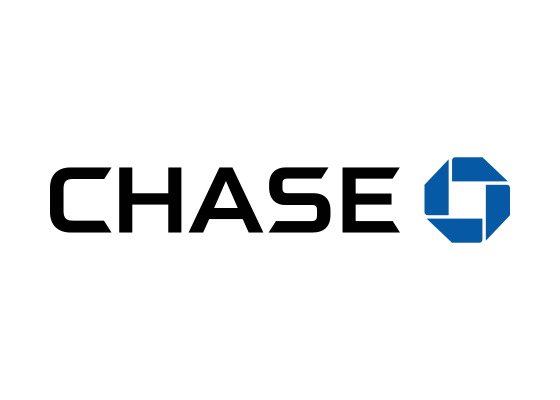
The Chase logo features a bold blue octagon containing a white square set at a 45-degree angle, creating an abstract geometric symbol that suggests both motion and security. Designed by Chermayeff & Geismar in 1960, it is one of the earliest and most enduring abstract banking logos, predating the digital era by decades yet remaining perfectly suited for it.
Chase’s logo works because it is radically simple. A square inside an octagon. No gradients, no illustrative details, no literal imagery. The blue (#0659A5) communicates trust and reliability, standard banking psychology, but the geometry is what makes the mark distinctive. The 45-degree rotation of the inner square introduces movement without sacrificing stability. It suggests forward momentum, progress, and efficiency, qualities David Rockefeller wanted associated with Chase Manhattan after the 1955 merger that created the institution.
The octagon shape has been interpreted as a bank vault, a coin, or an abstract representation of the compass rose, pointing in all directions to reflect the bank’s global ambitions. None of these interpretations are official, which is the mark’s strength. It is abstract enough to allow multiple readings while remaining instantly recognizable. The negative space, the white square, functions as a visual anchor, preventing the octagon from feeling heavy or static.
In 2004, Chase refined the logo to work better in digital environments. The octagon became solid blue rather than outlined, and the white square was given cleaner edges. The bank name was set in a custom sans-serif with strong, confident letterforms. The update was subtle, a testament to the original design’s longevity. Few logos from 1960 remain in active use without major overhauls.
Meaning and Symbolism
- Octagon shape: The eight-sided form has been associated with bank vaults, Chinese coins, or simply geometric efficiency. Its symmetry conveys balance and order, essential qualities for a financial institution.
- 45-degree angle: Rotating the inner square adds dynamism to what could have been a static design. The angle suggests motion, progress, and forward-thinking without sacrificing the stability a bank needs to project.
- Blue and white palette: Blue (#0659A5) is the universal color of trust in banking. White provides contrast and clarity, ensuring the logo reads cleanly at any size or distance.
- Abstract form: By avoiding literal imagery, the logo transcends cultural and linguistic barriers. It works equally well in Manhattan, Manila, or Mumbai without requiring translation or explanation.
Design and History
In 1955, Chase National Bank merged with Bank of the Manhattan Company, creating Chase Manhattan Bank, the largest commercial bank in New York and the second largest in the United States. David Rockefeller, Vice Chairman at the time, recognized that the new institution needed a modern identity to match its ambitions. The existing logos were outdated, complex, and tied to the past. Rockefeller wanted a simple, powerful symbol that could unify the merged entities and establish a global presence.
He commissioned Brownjohn, Chermayeff & Geismar, a young design firm that would later become one of the most influential in corporate identity. The brief was clear: create a logo that worked across all applications, from building signage to business cards, and that communicated security, stability, and modernity. The design team explored multiple directions before arriving at the octagon and square. The final mark was inspired by a traditional Chinese coin, though the team abstracted the concept so thoroughly that the reference became secondary to the geometry itself.
The logo debuted on November 21, 1960, alongside the “You Have a Friend at Chase” advertising campaign. Some executives resisted the abstract design initially, preferring something more traditional. But the logo proved remarkably versatile. It worked in solid blue, in black and white for newspaper ads, as a dimensional sign on buildings, and embossed on credit cards. The design’s flexibility ensured consistency across all customer touchpoints, a relatively new concept in corporate branding at the time.
Chase Manhattan’s custom typeface, developed to accompany the logo, was an uppercase extended sans-serif that could be condensed or expanded depending on the application. The typeface unified the bank’s global operations, from its New York headquarters to partnerships in Peru, Venezuela, and Belgium. This level of design coordination was ahead of its time, predating the comprehensive brand systems that would become standard in the 1970s and 1980s.
Typography
The Chase wordmark uses a custom sans-serif typeface with strong, even strokes and wide letterforms. The letters are uppercase, confident, and slightly condensed, designed to sit alongside the octagon without competing with it. The current version, refined in 2004, has slightly heavier strokes than the original, improving legibility on digital screens. The typeface is proprietary and consistent across all Chase applications, from ATM interfaces to mobile apps, reinforcing brand recognition through typographic discipline.
FAQ
Q: When was the Chase logo designed?
A: The octagon logo was designed by Chermayeff & Geismar in 1960 for Chase Manhattan Bank, following the 1955 merger of Chase National Bank and Bank of the Manhattan Company.
Q: What does the Chase logo symbolize?
A: The octagon has been interpreted as a bank vault, a coin, or a compass rose, though the design is intentionally abstract to allow multiple meanings while communicating stability and forward motion.
Q: Has the Chase logo changed over time?
A: The 2004 refinement changed the octagon from outlined to solid blue and updated the typography, but the fundamental geometry and color palette have remained consistent since 1960.
More logos with similar colors