The Coca-Cola Company Logos
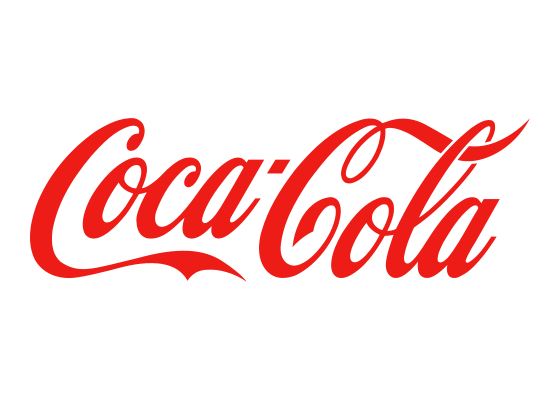
The Coca-Cola logo is a flowing script wordmark in Spencerian calligraphy that has remained essentially unchanged since 1886, making it one of the most enduring brand identities in commercial history.
The logo spells “Coca-Cola” in an elegant, flowing script with distinctive flourishes and connected letters. The Spencerian script style, popular in American business correspondence during the late 19th century, gives the wordmark a sense of handwritten authenticity and timeless elegance. The letters are tall and dynamic, with exaggerated curves and rhythmic strokes that create visual movement across the composition.
The red color (#ed1c16) is inseparable from the brand identity. Coca-Cola Red is one of the most recognized colors in global commerce, associated with energy, passion, and refreshment. The script appears most commonly in white on red backgrounds or red on white, creating maximum contrast and instant recognition. The wordmark’s curves and rhythm suggest refreshment and enjoyment, while the formality of the calligraphy communicates heritage and quality.
Meaning and Symbolism
- Spencerian script: The handwritten calligraphic style communicates tradition, elegance, and authenticity. It connects modern Coca-Cola to its origins as a pharmacist’s fountain drink in 1886.
- Red color (#ed1c16): Coca-Cola Red evokes excitement, energy, and appetite stimulation. The color is warm and inviting, perfectly suited to a refreshment brand.
- Flowing letterforms: The connected script and rhythmic curves create visual movement that suggests liquid, refreshment, and the enjoyment of drinking Coca-Cola.
- Unchanged since 1886: The logo’s longevity communicates stability, tradition, and a brand promise that has remained consistent across generations.
Design and History
Frank Mason Robinson, the bookkeeper for Coca-Cola inventor John Pemberton, created the logo in 1886. Robinson believed that “the two Cs would look well in advertising” and wrote out the name in Spencerian script, the standard business penmanship of the era. His handwritten wordmark became the basis for the logo that would eventually appear on billions of bottles, cans, and signs worldwide.
The Spencerian script style was already familiar to American consumers in 1886, as it was taught in business schools and used for formal correspondence. This familiarity made the logo feel established and trustworthy from the beginning, even though Coca-Cola was a brand-new product. The ornate calligraphy also positioned the drink as something special rather than an ordinary fountain beverage.
The logo underwent subtle refinements over the decades to improve reproducibility and consistency, but the fundamental character of Robinson’s original script has never changed. In 1923, the distinctive wave or “dynamic ribbon” device was introduced, adding a graphic element that emphasized the brand’s energy and movement. Industrial designer Raymond Loewy contributed refinements to the wave design in the 1960s, giving it a more streamlined, modern appearance.
The consistency of the Coca-Cola script is remarkable considering the massive changes in design trends, printing technology, and media over 140 years. While other brands have updated their identities to appear contemporary, Coca-Cola recognized early that the script itself was the brand’s most valuable asset. The logo appears on everything from vintage tin signs to digital interfaces, and it remains instantly recognizable in every context.
Typography
The Coca-Cola logo is custom lettering based on Spencerian script, not a standardized typeface. Spencerian calligraphy, developed by Platt Rogers Spencer in the mid-1800s, featured flowing oval forms, contrast between thick and thin strokes, and connected letters that could be written quickly with a flexible nib pen. The Coca-Cola script emphasizes these characteristics, with particularly pronounced loops and flourishes on the capital “C” letters. For body copy and supporting typography, Coca-Cola has used various serif and sans-serif typefaces over the years, but the script wordmark remains the brand’s primary identifier and appears without modification across all applications.
FAQ
Q: Who designed the Coca-Cola logo?
A: Frank Mason Robinson, bookkeeper for Coca-Cola inventor John Pemberton, created the script logo in 1886. He wrote the name in Spencerian calligraphy, the standard business script of the era.
Q: What does the red color symbolize?
A: Red (#ed1c16) represents excitement, passion, energy, and appetite stimulation. Coca-Cola Red is one of the most recognized brand colors globally.
Q: Has the Coca-Cola logo ever changed?
A: The fundamental script has remained unchanged since 1886. Minor refinements have improved consistency and reproducibility, and the “dynamic ribbon” wave element was added in 1923, but Robinson’s original calligraphy remains intact.