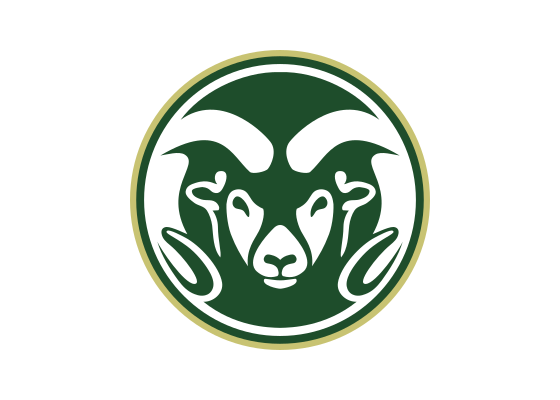
The Colorado State Rams logo features a fierce ram’s head in forest green and gold, representing a Mountain West Conference program whose mascot reflects both the Rocky Mountain landscape and the competitive determination of Fort Collins athletics since 1870.
Meaning and Symbolism
- The ram embodies Rocky Mountain wildlife and the rugged determination required to compete at altitude in Fort Collins, one of college football’s highest-elevation stadiums
- The forest green and gold color scheme reflects Colorado’s natural landscape—evergreen forests and golden aspen leaves—while distinguishing CSU from rival Colorado’s silver and gold
- The aggressive, forward-facing ram head with prominent curved horns projects strength and the battering-ram mentality expected in physical Mountain West Conference competition
- The circular framing creates a cohesive badge-like composition that works effectively on helmets, uniforms, and marketing materials while suggesting unity and completeness
- The muscular neck and intense expression transform what could be a pastoral symbol into a credible athletic identity appropriate for Division I FBS football
History and Evolution
Colorado State University fielded its first football team in 1890, competing as Colorado Agricultural College until the name changed in 1957. The Rams nickname and identity emerged as the agricultural school embraced its heritage while developing competitive athletic programs. The university joined the Mountain West Conference at its founding in 1999 after decades in the Western Athletic Conference, establishing regional rivalries with Air Force (Ram-Falcon Trophy) and Wyoming (Bronze Boot, played since 1899).
The athletic program underwent significant facility upgrades in recent decades, replacing Hughes Stadium (1968-2016) with the new Colorado State Stadium (later Canvas Stadium) that opened in 2017 with 41,000 capacity and modern amenities. The ram head logo evolved alongside these improvements, with the current aggressive design emerging in the 2010s to project the program’s ambitions. The visual identity emphasizes CSU’s research university status while maintaining connection to agricultural and ranching heritage that shaped Colorado’s development.
Typography and Design
The ram head employs bold, confident linework that emphasizes the animal’s distinctive curved horns, muscular build, and determined expression. The design captures essential ram characteristics through stylized forms that balance recognizability with athletic abstraction. The forward orientation and slightly lowered head suggest the charging posture rams use when confronting challenges, appropriate for competitive athletics.
The forest green dominates the primary logo with gold providing accent color and contrast. This two-color approach ensures effective reproduction across applications from embroidered apparel to vehicle graphics to stadium signage. The circular frame contains the design while allowing it to work as a standalone mark or integrated with “Colorado State” or “Rams” typography in various lockup configurations.
Frequently Asked Questions
Who designed the Colorado State Rams logo?
The current aggressive ram head design was developed through collaboration between the athletic department and brand consultants in the 2010s as CSU sought to project strength appropriate for Mountain West Conference competition and the new stadium era.
When was the Colorado State Rams logo last updated?
The ram head received significant updates in the 2010s coinciding with the new stadium construction and facilities improvements, with subsequent refinements to optimize reproduction across digital and physical media.
What do the colors in the Colorado State Rams logo represent?
Forest green and gold reflect Colorado’s natural landscape—evergreen forests and golden aspen—while distinguishing CSU from rival University of Colorado and creating a distinctive Mountain West Conference identity.
More logos with similar colors