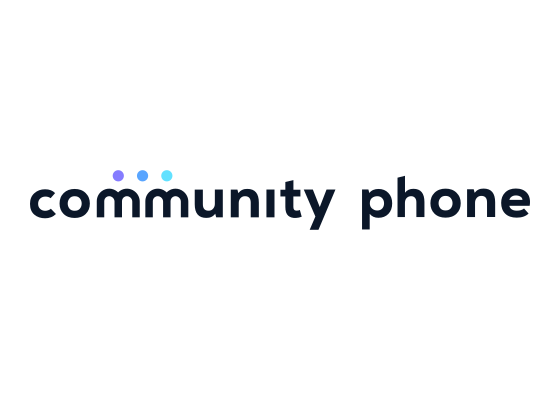
Community Phone’s vibrant blue and turquoise wordmark reflects the Y Combinator-backed startup’s mission to make traditional landline service more powerful and accessible. The modern, tech-forward palette conveys innovation for a company bringing cellular connectivity and smart features to landline phones, serving seniors and rural customers underserved by mobile-first carriers.
Meaning and Symbolism
- Deep navy (#0b1729) establishes trust and reliability essential for phone service, particularly for elderly customers depending on landlines for emergency communication
- Bright blue (#59a5ff) and turquoise (#62e1ff) suggest innovation, technology, and modern solutions applied to traditional telephony
- Purple-blue accent (#857cff) adds tech startup energy, reflecting Community Phone’s venture-backed positioning and Y Combinator pedigree
- Vibrant gradient palette differentiates from traditional telecom blues (AT&T, Verizon) while maintaining category recognition
- Modern color scheme signals that Community Phone enhances rather than abandons landline technology for underserved markets
History and Evolution
Community Phone was founded to address a critical gap in telecommunications: the decline of traditional landline service and its impact on elderly, rural, and vulnerable populations who depend on reliable home phone service. As major carriers including AT&T and Verizon discontinued copper landline networks in favor of mobile and fiber, millions of Americans faced reduced service quality or complete loss of home phone access. Community Phone developed a solution using cellular networks to deliver landline-like service through fixed base stations, providing dial tone, reliable emergency services, and familiar handset experience without requiring mobile devices or broadband internet.
The company participated in Y Combinator, the prestigious Silicon Valley accelerator, gaining credibility and early funding. Community Phone positioned itself as a venture-backed technology company rather than a traditional telecom carrier, emphasizing mission-driven service to underserved communities. The service proved particularly valuable for seniors preferring familiar corded phones, rural customers lacking reliable cell coverage indoors, and households needing backup phone service during internet or power outages. By 2024, Community Phone served customers nationwide, running on AT&T’s cellular network while maintaining independence from legacy phone companies. The company offered month-to-month contracts without credit checks, simple pricing, and customer service focused on less tech-savvy users. Community Phone represented a new category: cellular-based landline replacement service bridging traditional telephony and modern wireless infrastructure.
Typography and Design
The Community Phone wordmark employs a clean, modern sans-serif typeface with friendly, approachable letterforms that balance tech startup aesthetics with accessibility for older demographics. The vibrant blue and turquoise palette creates visual energy and optimism, differentiating from staid telecom incumbents while avoiding intimidating tech-forward design. The gradient color treatment adds contemporary polish without sacrificing clarity or legibility. The text-only logo ensures simplicity and recognition across website, mobile app, packaging, and printed materials sent to customers who may be less digitally native. The identity successfully positions Community Phone as innovative yet trustworthy, venture-backed yet mission-driven, tech-forward yet accessible to seniors and traditional landline users seeking modern reliability without mobile complexity.
Frequently Asked Questions
Who designed the Community Phone logo? The designer of the Community Phone logo has not been publicly documented, though it was likely developed during or shortly after the company’s Y Combinator participation as it established market positioning.
When was the Community Phone logo last updated? The vibrant blue and turquoise wordmark has remained consistent in recent years as Community Phone scaled from startup to nationwide service provider.
What do the colors in the Community Phone logo represent? The navy blue represents trust and reliability in phone service, especially for elderly customers, while bright blues and turquoise convey innovation and modern technology. The gradient palette differentiates Community Phone from traditional carriers while maintaining telecommunications category recognition.
More logos with similar colors