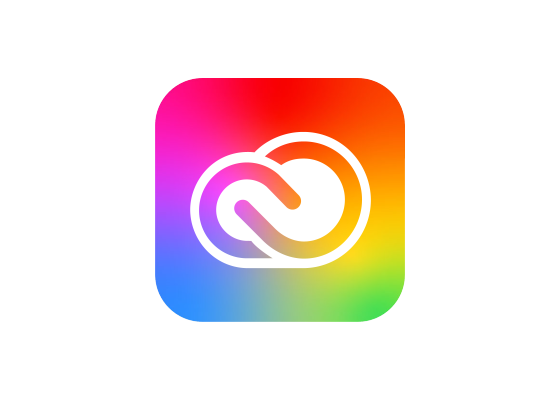
The Creative Cloud logo features a vibrant multi-color cloud icon paired with the “Creative Cloud” wordmark, representing Adobe’s transformation from boxed software to subscription-based creative tools accessible anywhere.
The cloud symbol employs Adobe’s signature application colors—the magenta of InDesign, blue of Photoshop, orange of Illustrator, purple of Premiere Pro—arranged in a flowing, overlapping gradient. This rainbow effect communicates that Creative Cloud provides unified access to Adobe’s entire creative suite rather than individual applications. The soft, organic cloud shape contrasts with the hard-edged squares of individual app icons, suggesting flexibility and the ability to move seamlessly between tools.
Marva and John Warnock, Adobe’s founders, influenced the company’s design direction since the 1980s, though the Creative Cloud identity emerged under later design leadership as Adobe pivoted from Creative Suite to subscription services. The cloud metaphor proved essential—it communicated both the technical reality (cloud storage, cross-device sync) and the conceptual promise (creative tools available anywhere, anytime) that justified the controversial shift from perpetual licenses to subscriptions.
Meaning and Symbolism
- Multi-color gradient cloud: Represents unified access to Adobe’s diverse creative applications through a single subscription
- Flowing, organic shape: Suggests flexibility and seamless workflow across applications versus isolated software packages
- Signature Adobe colors: Each hue references a core application (magenta=InDesign, blue=Photoshop, orange=Illustrator), creating instant recognition
- Cloud metaphor: Communicates both technical infrastructure (cloud storage, syncing) and philosophical promise (creativity untethered from physical media)
Design and History
Adobe launched Creative Cloud in 2011 as a subscription alternative to Creative Suite, though the service initially coexisted with perpetual licenses. In 2013, Adobe made the controversial decision to cease development of Creative Suite, making Creative Cloud the only way to access current versions of Photoshop, Illustrator, and other professional tools. This decision prompted significant backlash from customers accustomed to owning software outright.
The Creative Cloud logo played a crucial role in this transition, visually communicating the value proposition. The multi-colored gradient cloud suggested that subscribers gained access to the entire Adobe ecosystem rather than individual applications. The flowing, connected colors emphasized integration—assets, fonts, and settings syncing across applications and devices. Adobe invested heavily in cloud services (Libraries, Adobe Fonts, cloud storage) that justified the subscription model beyond simply renting software.
The 2020 refresh maintained the cloud concept while refining the gradient and proportions to work better at small sizes in operating system docks and mobile interfaces. The Creative Cloud identity successfully transformed Adobe from a software vendor to a platform company, with the logo representing not just applications but an ecosystem of connected creative tools, services, and community features that wouldn’t have been possible under the perpetual license model.
Typography
The wordmark uses Adobe Clean, the company’s proprietary sans-serif designed in-house to unify branding across all Adobe products and marketing materials. Adobe Clean features clean geometric construction with subtle humanist details, providing excellent screen readability while maintaining personality. The font’s consistent stroke weights and generous spacing ensure legibility across interfaces from desktop applications to mobile apps. The sentence case setting (“Creative Cloud” not “CREATIVE CLOUD”) reinforces accessibility and the user-friendly positioning of cloud services versus enterprise software. Adobe Clean’s contemporary character aligns with Creative Cloud’s positioning as modern, flexible, and cloud-native.
FAQ
Q: Why did Adobe choose a rainbow gradient for Creative Cloud?
A: Each color in the gradient references a core Adobe application (magenta for InDesign, blue for Photoshop, orange for Illustrator, purple for Premiere Pro), visually communicating that Creative Cloud provides unified access to Adobe’s entire creative suite through a single subscription rather than purchasing applications individually.
Q: Who designed the Creative Cloud logo?
A: While Adobe founders Marva and John Warnock influenced the company’s design direction, the Creative Cloud identity emerged from Adobe’s internal design team as the company transitioned from Creative Suite to subscription services. The logo evolved from the original 2011 launch through refinements in 2020.
Q: How does the Creative Cloud logo differ from individual app icons?
A: Individual Adobe applications use solid-color squares with two-letter codes (Ps, Ai, Id), while Creative Cloud uses a multi-color flowing gradient cloud. This differentiation communicates that Creative Cloud is the platform providing access to applications rather than an application itself, emphasizing the ecosystem versus individual tools.