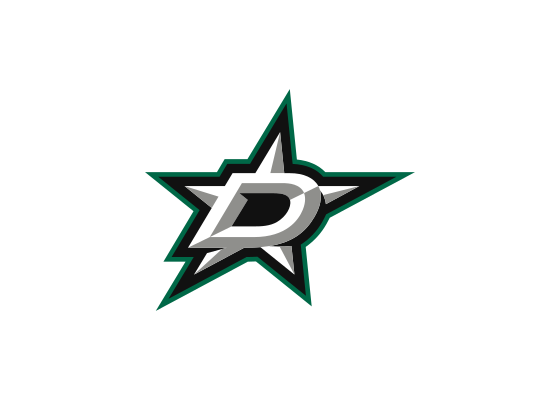
The Dallas Stars logo features a bold “D” overlaid on a geometric star, merging Texas state symbolism with typographic simplicity while metallic treatments add dimensional depth appropriate to the team’s 2013 modern redesign.
The Stars logo represents smart evolution from geographic literalism to typographic confidence. The franchise’s Minnesota North Stars heritage (1967-1993) featured illustrative stars and complex compositions that aged poorly. Upon relocating to Dallas in 1993, the team initially maintained star-heavy imagery but gradually moved toward cleaner geometric expression. The current 2013 design strips the concept to essentials: a letter for the city, a star for Texas and the team name, executed with contemporary dimensional effects.
The metallic black “D” provides immediate Dallas identification while the angled star creates dynamic geometry that prevents the mark from feeling static. This approach demonstrates how heritage symbols can be modernized through reduction rather than addition, allowing the fundamental concept (stars represent Texas and team identity) to persist while execution evolves to contemporary standards.
Meaning and Symbolism
- The star references both Texas state symbolism (the Lone Star State) and the team name “Stars”
- The “D” grounds the mark in Dallas civic identity following relocation from Minnesota
- Green coloring (Victory Green) ties the design to Texas landscape and differentiates from typical blue-heavy hockey palettes
- Metallic black treatment suggests industrial strength and modern sophistication
- Angled orientation creates forward motion and prevents the star from reading as static decoration
Design and History
The franchise’s visual identity evolution tracks its geographic journey. As Minnesota North Stars (1967-1993), the team used green and gold with illustrative star compositions and prominent “N” letterforms. These designs referenced northern wilderness and the state name’s “North Star” connection. Relocation to Dallas required complete rebranding to establish Texas connection and abandon Minnesota associations.
Early Dallas iterations (1993-2013) featured elaborate stars with the team name integrated across star points, gold coloring, and complex multi-element compositions. While functional, these designs felt increasingly dated as design trends moved toward simplification. The 2013 redesign represented philosophical transformation from decorative to structural, allowing geometric clarity to replace illustrative complexity.
The current mark’s metallic effects add contemporary dimension without relying on gradients or glossy treatments that date quickly. The black metallic “D” and dimensional star create depth through highlight and shadow zones that work in both flat reproduction and dimensional applications. This technical sophistication helps the mark feel current while avoiding trendy effects likely to age poorly.
Typography
The Stars employ bold sans-serif letterforms with subtle industrial character appropriate to the metallic logo aesthetic. The wordmark “STARS” typically appears in condensed capitals with consistent weight, occasionally incorporating dimensional effects that echo the primary logo’s metallic treatment. “DALLAS” uses similar proportions but often appears in smaller scale, creating clear hierarchy. The type system maintains straightforward legibility while allowing enough personality to distinguish the face from generic athletic fonts.
FAQ
Q: What happened to the gold color from the Minnesota era? A: Gold tied the franchise to Minnesota’s original identity. The shift to Victory Green upon relocating to Dallas established fresh visual territory while maintaining enough similarity (green instead of gold, both warm tones) to avoid complete disconnection. Green also references Texas landscape and allowed ownership of color space in a blue-heavy league.
Q: Why use a star when so many teams have star imagery? A: For Dallas and Texas, star symbolism carries specific cultural weight through the state’s Lone Star identity. The franchise name also requires star representation. The solution came through execution rather than concept abandonment, using geometric simplification and metallic effects to differentiate from generic star treatments.
Q: How does the D-and-star compare to the Minnesota designs? A: Minnesota logos featured complex compositions with multiple elements competing for attention. The Dallas simplification reduced the concept to two elements (letter and star) with clear hierarchy, improving scalability and reproduction while allowing bolder color blocking and stronger visual impact at distance or small sizes.
More logos with similar colors