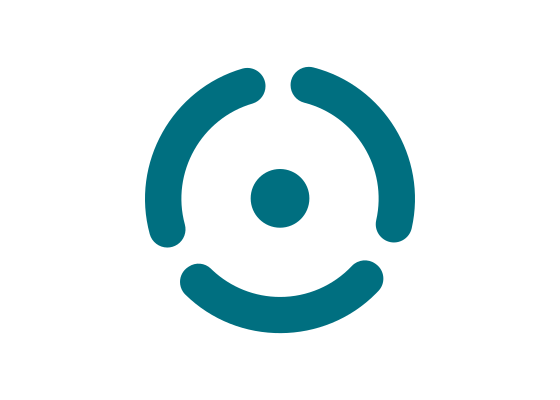
The Dashlane logo features a stylized D icon in deep teal, representing the company’s mission to simplify password management and digital identity protection for individuals and businesses.
The 2020 Dashlane rebrand introduced a more refined, professional identity to support the company’s evolution from consumer password manager to comprehensive identity security platform. The D icon uses flowing curves that suggest both movement (the “dash” in Dashlane) and protection, creating a distinctive mark that works across digital contexts from browser extensions to enterprise dashboards. The deep teal palette projects trust and sophistication while differentiating from competitors using brighter blues or greens.
The identity needed to bridge consumer and business markets as Dashlane expanded into enterprise password management alongside its consumer product. The mark maintains approachability for individual users while projecting enough seriousness for IT administrators evaluating security tools for entire organizations. This balance helps Dashlane compete against both consumer-focused tools like 1Password and enterprise-oriented solutions from established security vendors.
Meaning and Symbolism
- Stylized D Icon: The flowing letterform suggests both the speed implied by “dash” and the protective enclosure of secure password storage.
- Deep Teal Color: Projects sophistication and trustworthiness while creating calming associations important for security products that protect sensitive data.
- Curved Forms: The organic shapes humanize what could be overly technical security software, making password management feel accessible rather than intimidating.
- Professional Refinement: The 2020 update elevated Dashlane’s visual language to compete credibly in enterprise markets requiring polished, serious security tools.
Design and History
Dashlane launched in 2012 in New York, founded by Bernard Liautaud, Alexis Fogel, Guillaume Maron, and Jean Guillou. The service initially focused on consumer password management with a freemium model, competing against LastPass and newer entrants like 1Password. Dashlane differentiated through its user interface design, emphasizing ease of use over technical features that intimidated mainstream users.
The company expanded into business password management as organizations recognized that employee password hygiene represented a significant security vulnerability. Data breaches increasingly resulted from weak or reused passwords rather than sophisticated hacking. Dashlane’s enterprise offering provided IT administrators tools to enforce password policies while giving employees convenient access to work credentials.
The 2020 rebrand supported this evolution into dual-market positioning. The refreshed identity maintained continuity with earlier Dashlane versions while adding sophistication appropriate for enterprise sales. The mark appears across consumer apps for iOS, Android, Windows, and macOS, plus business admin dashboards and browser extensions. Dashlane competes in a crowded market through interface design excellence and security features including dark web monitoring that alerts users when credentials appear in data breaches.
Typography
The Dashlane wordmark uses a contemporary sans-serif typeface with lowercase letterforms that feel approachable and modern. The geometric construction maintains clean lines and consistent stroke weights, projecting technical competence without excessive formality. The type appears in either the deep teal or dark gray depending on background, ensuring flexibility across light and dark interfaces. The letterforms have generous proportions that ensure legibility at small sizes in browser toolbars and mobile apps where users frequently interact with the password manager.
FAQ
Q: What is Dashlane’s business model?
A: Dashlane operates on a freemium model with a free tier offering limited functionality (typically 50 passwords on one device) and paid subscriptions unlocking unlimited passwords, multi-device sync, dark web monitoring, and VPN access. The company also offers business plans with admin controls for organizations managing employee credentials.
Q: How does Dashlane compare to 1Password and LastPass?
A: Dashlane emphasizes user experience design and includes built-in VPN and dark web monitoring in paid plans. 1Password focuses on family and team features with local vault storage options. LastPass offers more affordable pricing but faced security incidents in 2022 that damaged reputation. Each competes on different combinations of features, security, and user experience.
Q: Why did Dashlane rebrand in 2020?
A: The 2020 rebrand supported Dashlane’s expansion into enterprise markets where the previous identity felt too consumer-focused. The updated visual language projects sophistication appropriate for IT decision-makers while maintaining approachability for individual users. The rebrand coincided with increased competition in password management as data breaches made credential security mainstream concern.