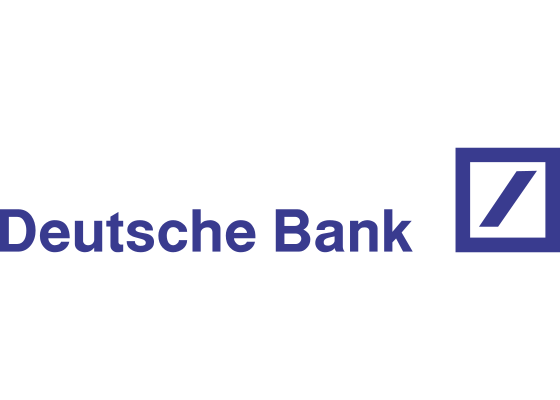
The Deutsche Bank logo features a diagonal slash contained within a square, a minimalist geometric mark that has represented the German bank since 1974. Designed by Anton Stankowski, the logo’s 53-degree angle conveys upward movement, growth, and dynamism while remaining abstract enough to function as both a corporate symbol and a work of art.
Deutsche Bank’s logo is unusual in banking because it looks like abstract art first and a corporate identity second. The diagonal line bisects the square frame at precisely 53 degrees, creating a composition that suggests ascent without becoming literal. The line is slightly thinner than the square’s border, maintaining a ratio of 10:10.3, a detail that prevents the mark from feeling heavy or clunky. The blue (#393B8F) is darker and more saturated than the pale blues typically associated with financial institutions, giving the mark a modern, confident character.
Stankowski described the design as “dynamic, ascending, and secure,” three qualities Deutsche Bank wanted to project in the 1970s as international banking became increasingly competitive. The slanted line could represent growth, a forward slash in typography, or simply an abstract form open to interpretation. This ambiguity has allowed the logo to remain relevant across decades and market conditions. It works equally well during boom periods and financial crises because it does not promise anything specific beyond stability and forward motion.
The square frame anchors the diagonal, preventing the design from feeling unbalanced or chaotic. Together, the elements create a mark that is both static and kinetic, grounded yet aspirational. Few banking logos achieve this duality.
Meaning and Symbolism
- Diagonal slash: The 53-degree angle suggests growth, progress, and upward movement. It evokes a rising graph without literalizing the metaphor, allowing the mark to function across economic conditions.
- Square frame: The bold border provides structure and containment, symbolizing security and institutional solidity. It prevents the diagonal from feeling unanchored or aggressive.
- Blue palette: The deep blue (#393B8F) communicates trust and authority. Stankowski chose a shade darker than typical banking blues, differentiating Deutsche Bank from competitors while maintaining professional seriousness.
- Abstract form: By avoiding literal imagery, the logo functions as both a corporate identifier and a piece of abstract art. This openness to interpretation has contributed to its longevity.
Design and History
In the early 1970s, Deutsche Bank faced growing international competition and market shifts that demanded a more modern corporate image. The bank had redesigned its logo twice before without success, and by 1972, executives recognized the need for a bolder approach. The bank commissioned eight small design studios, paying each 3,000 Deutsche marks, and assembled an independent panel to select the winner. Anton Stankowski’s “line in a square” won.
Stankowski was not a typical corporate designer. He was known for blending art and design, often using abstract forms to represent intangible concepts. The diagonal line was a recurring motif in his paintings, and he adapted it for Deutsche Bank’s identity. The logo debuted at the bank’s annual press conference in April 1974, a striking departure from the previous letter-based designs.
The comprehensive rollout extended beyond the logo itself. Stankowski and his partner, Karl Duschek, developed a full corporate identity system that included a vibrant color palette, patterns, and a wordmark set in Univers, a modern sans-serif typeface. Blue became the primary color, chosen for its universal association with trust. Interestingly, the system included two shades of blue based on the theory that women preferred greenish-blue tones while men favored ultramarine. A color matrix of 72 possible combinations allowed designers to create harmonious pairings across applications.
The logo’s simplicity made it adaptable. It worked in solid blue, in black and white, as a dimensional sign on buildings, and even as the basis for commissioned artworks. The slant became a visual motif that extended throughout Deutsche Bank’s visual language, appearing in patterns, dividers, and layout structures. This level of design integration was sophisticated for the 1970s and helped establish Deutsche Bank as a forward-thinking institution.
Typography
The Deutsche Bank wordmark uses Univers, a modernist sans-serif typeface designed by Adrian Frutiger in 1957. The letterforms are clean, geometric, and neutral, allowing the diagonal square logo to remain the dominant visual element. Univers was chosen for its international legibility and its association with Swiss design rigor, qualities that aligned with the bank’s desire to project professionalism and precision. The typeface has remained consistent across decades, reinforcing brand recognition through typographic discipline.
FAQ
Q: Who designed the Deutsche Bank logo?
A: Anton Stankowski designed the diagonal slash logo in 1972. It was officially unveiled at the bank’s annual press conference in April 1974.
Q: What does the diagonal line in the Deutsche Bank logo represent?
A: The 53-degree angle suggests growth, upward movement, and dynamism while remaining abstract enough to allow multiple interpretations. Stankowski described it as “dynamic, ascending, and secure.”
Q: Has the Deutsche Bank logo changed since 1974?
A: The fundamental design has remained unchanged since its introduction, though digital refinements have improved consistency across applications. The core geometry and blue color have endured for over 50 years.