The Walt Disney Company Logos
The Disney logo is a custom script wordmark spelling “Walt Disney” in flowing, connected letterforms that evoke the founder’s signature while functioning as one of the most recognized symbols in global entertainment.
The script appears in dark charcoal (#231f20) or white depending on context, with exaggerated ascenders on the “W” and “D” and distinctive loops throughout. The letterforms are connected in a cursive style that suggests handwriting, creating an impression of personal authorship and creative vision. The dot over the “i” is often misread because of its unusual placement, but this quirk has become part of the logo’s character rather than a flaw.
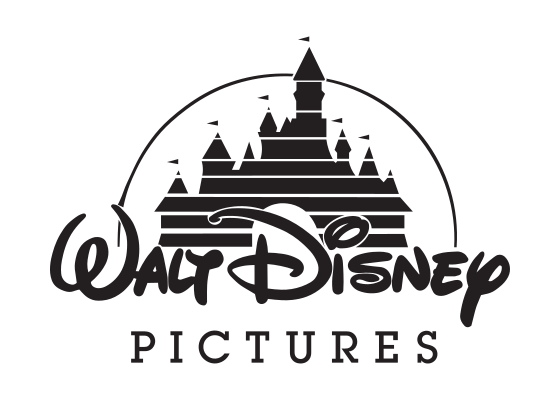
In film productions, the wordmark curves in an arc over an illustration of Cinderella Castle, creating a combined mark that functions as both a logo and a promise of magical storytelling. The script itself carries extraordinary cultural weight, communicating nostalgia, imagination, and a personal touch from the founder even though Walt Disney died in 1966. The longevity and consistency of the script have made it inseparable from the Disney brand promise.
Meaning and Symbolism
- Script letterforms: The handwritten quality connects the corporation to Walt Disney as a person, suggesting that one man’s creative vision guides the company even as it became the largest entertainment conglomerate in the world.
- Cinderella Castle: In the production logo, the castle serves as visual shorthand for Disney’s core promise of magic, fantasy, and escape into imaginary worlds. The castle represents the idea of Disney rather than any specific location.
- Arc composition: The wordmark curving over the castle creates a protective, encompassing gesture, as if the Disney name is watching over the fantasy world below.
- Dark charcoal color (#231f20): The near-black gives the script weight and permanence, reading as elegant and authoritative while offsetting the playfulness of the flowing letterforms.
Design and History
Walt Disney’s actual signature was loose, quick, and varied considerably throughout his life. The “Walt Disney” logo is not a reproduction of his handwriting but an idealized, standardized version created by the company’s designers. This distinction matters because the logo’s power comes partly from the illusion of personal authorship. Every time the script appears, it suggests Walt’s hand at work, maintaining a personal connection that most corporate brands cannot claim.
The script evolved gradually through the 1930s and 1940s as the studio’s art department refined it for title cards, merchandise, and signage. By the time Disneyland opened in 1955, the “Walt Disney” script had become standardized enough to serve as a consistent brand mark across park signage, promotional materials, and Walt Disney’s weekly television show, which began in 1954 and brought the script into millions of American homes.
The castle logo added a second dimension to the identity. The first version in 1985 was relatively modest: a stylized outline of a fairy tale castle that preceded Walt Disney Pictures productions. It established the idea that watching a Disney film meant entering a different world, and the castle reinforced that transition. The castle also connected the studio to its theme parks, where castles serve as architectural centerpieces.
The current version of the castle logo, introduced in stages from 2006 to 2011, features a detailed CG rendering with atmospheric lighting and a shooting star sequence. The “Walt Disney” script arcs over the castle in every version, maintaining the core composition. The script’s longevity is remarkable: it has remained essentially unchanged for over 70 years while the company has grown from a film studio into a conglomerate encompassing theme parks, television networks, streaming services, consumer products, and acquired brands including Pixar, Marvel, and Lucasfilm.
Typography
The Disney script is proprietary lettering, not a typeface, drawn as custom calligraphy. It features connected, flowing cursive with exaggerated loops on the “W” and “D,” a distinctive backward-leaning “y,” and an “i” that is frequently misread due to its unusual dot placement. Several unofficial typefaces, most notably “Waltograph,” have been created by fans attempting to replicate the letterforms, but Disney has never released an official font. For body copy and secondary applications, Disney uses various typefaces depending on the division and context. The parks, films, streaming services, and corporate communications each have their own typographic systems, but the script remains reserved for the primary brand mark.
FAQ
Q: Is the Disney logo Walt Disney’s actual signature?
A: No. The logo is based on Walt Disney’s signature style but was created and refined by the company’s art department. Walt’s actual handwriting varied considerably and was less stylized.
Q: What castle is in the Disney logo?
A: The castle is inspired by the Sleeping Beauty Castle at Disneyland in Anaheim, California. It represents a fairy tale castle generically rather than depicting a specific structure.
Q: When was the castle added to the Disney logo?
A: The castle first appeared in the Walt Disney Pictures production logo in 1985. It has been updated several times since, with the current detailed CG version introduced between 2006 and 2011.