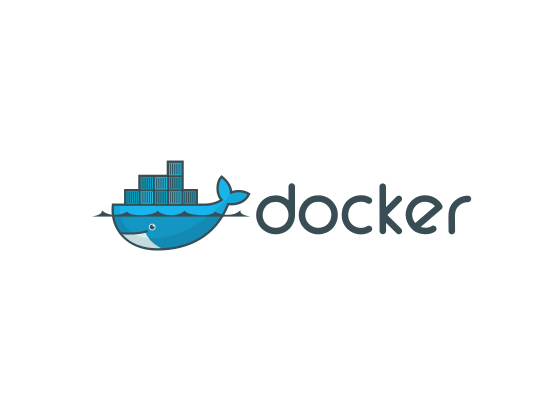
The Docker logo features a cheerful blue whale carrying colorful shipping containers on its back. This playful mascot represents containerized application deployment with memorable visual charm.
The whale character communicates Docker’s core value proposition with remarkable clarity. Just as cargo containers standardized global shipping by creating uniform packages, Docker containers standardize software deployment by bundling applications with their dependencies. The whale carries these containers effortlessly, suggesting how Docker simplifies the complex task of moving applications between development, testing, and production environments. The friendly, cartoon-like aesthetic makes an abstract technical concept immediately graspable.
The color palette reinforces this accessible positioning. The bright cyan whale contrasts sharply with enterprise software’s typical navy blues, signaling Docker’s developer-first philosophy. The multicolored containers in red, blue, cyan, and charcoal suggest diversity and modularity. This rainbow treatment implies that Docker works with any technology stack, language, or framework. The logo’s lighthearted tone helped Docker build grassroots adoption among developers before enterprise sales teams got involved.
Meaning and Symbolism
- Whale mascot: Represents powerful infrastructure that carries application containers across environments with ease and reliability.
- Shipping containers: Visual metaphor for Docker’s core innovation of packaging applications in standardized, portable units.
- Bright cyan color: Differentiates from traditional enterprise blues, signaling developer-friendly tools rather than legacy IT infrastructure.
- Multiple container colors: Suggests Docker’s support for diverse technology stacks, languages, and deployment scenarios.
Design and History
Solomon Hykes launched Docker in 2013 as an open-source project that revolutionized application deployment. The whale logo appeared early in the company’s history, created to make containerization technology approachable for developers unfamiliar with Linux kernel features. The mascot strategy proved remarkably effective, helping Docker achieve widespread adoption and a peak valuation exceeding $2 billion.
The logo’s playful character contrasts deliberately with the serious imagery typical of enterprise infrastructure companies. While competitors used abstract geometric symbols or corporate wordmarks, Docker embraced whimsy to stand out in a crowded container orchestration market. This approach aligned with the company’s open-source roots and developer community focus, where personality and culture matter as much as technical capabilities.
The whale carrying containers became so iconic that “Docker whale” entered developer vocabulary as shorthand for containerization technology itself. Despite facing competition from Kubernetes and cloud-native platforms, the logo remains instantly recognizable in DevOps circles. The friendly mascot helped transform an obscure Linux feature into a foundational technology adopted by millions of developers worldwide.
Typography
The Docker wordmark uses a bold, rounded sans-serif typeface that complements the friendly whale mascot. The letterforms feature consistent stroke weights and slightly softened corners that echo the whale’s approachable character. The all-lowercase treatment reinforces accessibility, avoiding the formal authority of capitalized branding in favor of developer-friendly casualness.
FAQ
Q: What does the whale symbolize in the Docker logo?
A: The whale represents powerful infrastructure that effortlessly carries application containers across different computing environments. Just as whales are massive yet graceful, Docker handles complex deployment challenges with elegant simplicity.
Q: Why does the Docker whale carry shipping containers?
A: The shipping containers visualize Docker’s core innovation of packaging applications in standardized units. Like cargo containers revolutionized global trade, Docker containers standardized software deployment by bundling apps with their dependencies.
Q: How did Docker’s playful logo help the company succeed?
A: The friendly whale mascot made containerization technology approachable for developers, helping Docker build grassroots adoption before enterprise sales. The memorable character differentiated Docker from serious competitors and became synonymous with containerization itself.
More logos with similar colors