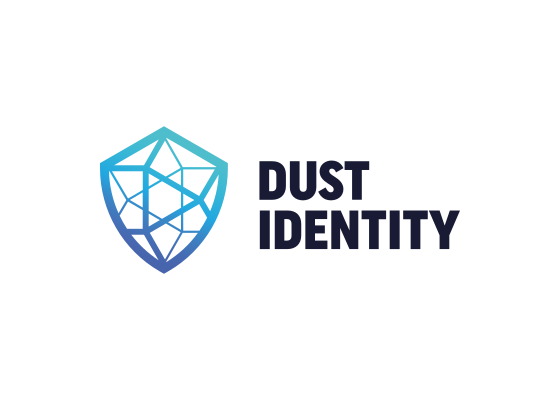
Dust Identity’s logo features a gradient spectrum from navy to turquoise with abstract geometric elements, representing the company’s revolutionary approach to product authentication using quantum-engineered nano-scale diamond dust technology.
Meaning and Symbolism
- The deep navy (#191b35) conveys security, trust, and the military-grade protection Dust Identity provides against counterfeiting
- The bright turquoise and blue gradient (#21a8e0 to #4fbecc) suggests innovation, technology, and the quantum properties that make the diamonds detectable
- The multi-color spectrum represents the unique optical signatures created by nitrogen vacancies in synthetic diamonds, impossible to counterfeit
- The abstract geometric shapes suggest molecular structures, quantum particles, and the nano-scale precision of the technology
- The gradient treatment symbolizes the seamless integration of physical diamonds into polymers, labels, and manufactured products
Meaning and Symbolism
- The deep navy (#191b35) conveys security, trust, and the defense-grade protection required for supply chain authentication
- The bright blues and turquoise (#21a8e0 through #4fbecc) represent innovation, quantum physics, and the cutting-edge science behind diamond-based authentication
- The gradient palette suggests the optical spectrum and the unique light signatures emitted by nitrogen-vacancy diamonds under specific conditions
- The abstract shapes evoke molecular structures, quantum particles, and the nano-scale engineering essential to the technology
- The color progression from dark to light symbolizes the revelation of hidden authenticity when Dust Identity’s diamonds are scanned
History and Evolution
Dust Identity was founded in 2018 by scientists from MIT, spinning out research conducted at the university’s Media Lab and other departments. The founders developed a breakthrough process to engineer synthetic nano-scale diamonds with quantum properties called “nitrogen vacancies”—defects in the diamond’s crystal structure that allow detection of the diamond’s orientation using laser scanning. After processing, these diamonds are embedded into physical objects using common polymers, creating an unclonable authentication layer that can verify product authenticity even after manufacturing.
The company emerged to address the massive global problem of counterfeiting, which costs industries hundreds of billions of dollars annually across pharmaceuticals, electronics, automotive parts, luxury goods, and defense equipment. Traditional anti-counterfeiting methods like holograms, serial numbers, and RFID tags can be copied or removed, but Dust Identity’s diamond-based approach is fundamentally impossible to replicate because the quantum properties of each diamond particle are intrinsically random. The technology requires specialized scanning equipment to read the diamonds, creating a closed system that prevents counterfeiting.
Dust Identity raised funding from venture capital firms and government agencies, including contracts with the U.S. Department of Defense to authenticate military equipment and critical infrastructure components. The platform includes both the physical diamond material and a digital cloud system that records and verifies authenticity at every point in the supply chain. The company targets industries where counterfeiting poses safety or security risks, positioning its technology as the most advanced authentication method available, leveraging fundamental physics that cannot be defeated by even sophisticated counterfeiters.
Typography and Design
The Dust Identity wordmark employs a modern, technical sans-serif typeface that conveys precision and scientific authority. The letterforms are clean and evenly spaced, reflecting the nano-scale accuracy required for quantum-engineered diamonds. The typography balances approachability with the serious security applications the technology enables, appealing to supply chain executives, procurement officers, and technical decision-makers.
The navy-to-turquoise gradient system creates a distinctive identity in the authentication and supply chain technology space, where many competitors use traditional security industry colors like red or black. The blue spectrum evokes trust, innovation, and the quantum physics underlying the technology. The gradient can be animated in digital applications to suggest scanning, detection, and authentication processes. The color palette photographs well across technical documentation, trade show displays, and executive presentations to Fortune 500 manufacturers and government agencies.
Frequently Asked Questions
Who designed the Dust Identity logo? The Dust Identity logo was developed in collaboration with branding specialists during the company’s 2018 founding, though specific external design agency attribution is not publicly available. The design reflects the quantum physics and nano-scale engineering at the heart of the technology.
When was the Dust Identity logo last updated? The Dust Identity logo and brand identity have remained consistent since the company’s 2018 founding as an MIT spinout. The core design continues to represent the company’s diamond-based authentication technology across defense, pharmaceutical, and manufacturing markets.
What do the colors in the Dust Identity logo represent? The navy represents security and trust, while the turquoise and blue gradients symbolize quantum physics, innovation, and the unique optical signatures of nitrogen-vacancy diamonds. The color spectrum also evokes the light-based detection process that reads the diamonds’ quantum properties, making authentication possible.
More logos with similar colors