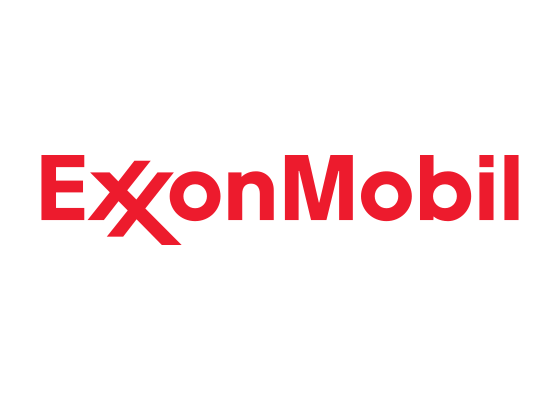
The ExxonMobil logo combines bold red letterforms with two blue X-shaped crosses dividing the company name, creating a distinctive wordmark that balances energy and engineering precision.
The ExxonMobil identity emerged from the 1999 merger of Exxon and Mobil, two Standard Oil descendants. The logo integrates elements from both legacy brands into a unified mark. The double-X letterforms in “Exxon” create a strong visual anchor, while the red color references Mobil’s historical branding. The blue crosses separating “Exxon” and “Mobil” serve as visual connectors, subtly referencing both companies’ engineering heritage. The wordmark uses a custom sans-serif typeface with slightly extended letterforms, giving the logo a horizontal emphasis that works well on signage, tanker trucks, and station canopies.
The all-caps construction and consistent letter spacing convey authority and scale, appropriate for the world’s largest publicly traded oil company by market capitalization. The logo’s simplicity allows it to function across vastly different contexts, from global marketing campaigns to complex industrial facilities. The red-and-blue palette is instantly recognizable and has become synonymous with petroleum infrastructure worldwide.
Meaning and Symbolism
- Double-X letterform: The bold Xs in “Exxon” create a memorable visual signature that anchors the brand and references multiplication, expansion, and crossing boundaries.
- Red and blue pairing: Red conveys energy, power, and petroleum’s vitality, while blue suggests reliability, engineering expertise, and corporate stability.
- Blue crosses: The two intersecting X-shapes dividing “Exxon” and “Mobil” symbolize the merger itself, connecting two historic brands into a unified global entity.
- All-caps wordmark: The uppercase letterforms communicate authority, scale, and the company’s position as a dominant force in global energy markets.
Design and History
ExxonMobil was formed on November 30, 1999, through the merger of Exxon Corporation (formerly Standard Oil of New Jersey) and Mobil Corporation (formerly Standard Oil of New York), both successors to John D. Rockefeller’s Standard Oil empire broken up in 1911. The merger created the world’s largest publicly traded petroleum company, reuniting two pieces of the original Standard Oil conglomerate. The combined logo was introduced shortly after the merger, integrating visual elements from both predecessor brands.
Exxon had used its double-X wordmark since 1972, when the company rebranded from Esso in most U.S. markets. Mobil’s historic red Pegasus symbol and circular “o” in its wordmark were iconic elements of mid-century American branding. The ExxonMobil identity preserved Exxon’s strong letterforms and red color while incorporating Mobil’s name into the unified mark. The blue crosses added during the merger serve as a visual link between the two names, creating a cohesive whole rather than a hyphenated combination.
Typography
The ExxonMobil wordmark uses a custom sans-serif typeface with slightly extended, condensed letterforms. The letters are uniformly weighted with clean, geometric shapes that prioritize legibility at distance. The extended horizontal proportions make the logo particularly effective on wide surfaces like gas station canopies and tanker ships. The typeface is proprietary and reserved exclusively for the company name.
FAQ
Q: Why does the logo have two Xs?
A: The double-X letterform was part of Exxon’s identity since 1972 and became a defining visual signature that was retained when the company merged with Mobil in 1999.
Q: What do the blue crosses mean?
A: The blue X-shaped crosses visually connect “Exxon” and “Mobil,” symbolizing the merger of two major Standard Oil successors into a unified global corporation.
Q: When was the current logo created?
A: The combined ExxonMobil wordmark was introduced in 1999 following the merger of Exxon Corporation and Mobil Corporation.