The EY logo represents Ernst & Young, one of the Big Four accounting and professional services firms, employing nearly 300,000 people across 700 offices in more than 150 countries providing assurance, tax, consulting, and advisory services.
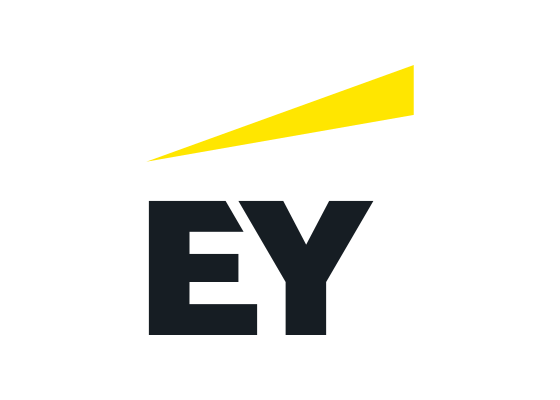
The EY logo features bold yellow geometric forms arranged as stylized triangular shapes alongside the simple “EY” letters, creating a striking visual identity that balances professionalism with contemporary energy. The bright yellow color makes immediate visual impact, distinguishing EY from competitors using traditional navy, black, or green palettes. The geometric shapes suggest building blocks, construction, or arrows pointing upward, communicating themes of growth, progress, and the structural frameworks EY helps clients build. The design combines abstract symbolism with straightforward typography, projecting both creative thinking and practical execution. The sharp angles and precise geometry convey analytical precision essential for accounting and consulting work, while the vibrant color suggests innovation and forward-thinking approaches.
The 2019 rebrand simplified the identity to just “EY” letters and geometric marks, eliminating the full “Ernst & Young” name from the primary logo. This reflected the practical reality that clients, employees, and media already used the abbreviated form in daily conversation. The streamlined approach aligned with digital communication trends favoring brevity and visual clarity across platforms from business cards to mobile applications to social media profiles.
Meaning and Symbolism
- Yellow geometric shapes: Represent building blocks of business success, upward momentum, and the structural frameworks EY creates helping clients navigate complex financial, regulatory, and strategic challenges.
- Bright yellow color: Suggests optimism, innovation, energy, and forward-thinking approaches, differentiating EY from competitors using conservative color palettes.
- Two-letter abbreviation: Reflects the natural linguistic evolution from “Ernst & Young” to the universally used “EY” shorthand, improving memorability and usability.
- Angular geometry: Conveys analytical precision, structural thinking, and the rigorous methodologies EY applies to assurance, tax, consulting, and advisory services.
Design and History
Ernst & Young formed in 1989 through the merger of Ernst & Whinney and Arthur Young & Co., both firms with accounting practices dating to the late 1800s. The merger created one of the world’s largest professional services organizations, competing directly with Deloitte, PricewaterhouseCoopers, and KPMG in the elite Big Four category. These firms dominate global markets for financial auditing, tax compliance, and management consulting, serving the majority of Fortune Global 500 companies and major governmental organizations.
The firm operated under the full “Ernst & Young” name for decades, but employees, clients, and journalists naturally shortened references to “EY” in conversation and informal writing. Recognizing this linguistic reality, the firm began informal use of “EY” branding before officially adopting it as the primary identity in 2013. The 2019 redesign further committed to the abbreviated form, making “EY” the hero element while relegating the full name to secondary positions.
This naming evolution aligned with broader industry trends toward simplified, acronym-based identities that work better in digital environments. As professional services firms compete increasingly through thought leadership content, social media engagement, and online talent recruitment, shorter names prove more effective for hashtags, domain names, and mobile-optimized communications. The two-letter form also translates more easily across the 150+ countries where EY operates, avoiding pronunciation challenges with longer English names.
The vibrant yellow color marked bold differentiation from Big Four category norms. While competitors maintained conservative navy blues and blacks, EY embraced optimistic brightness suggesting innovation, energy, and client-focused thinking. This visual risk demonstrated market confidence, signaling that EY possessed sufficient authority to challenge industry conventions without undermining professional credibility. The yellow also improved visibility in crowded airport advertising, conference sponsorships, and digital environments where attention competition intensifies.
Typography
The EY wordmark employs bold, contemporary sans-serif typography with strong geometric construction. The letterforms feature clean lines and confident weight that ensures legibility across applications from business cards to building facades. The typeface balances modern sensibility with professional authority, avoiding both overly technical feels and traditional formality in favor of accessible confidence.
FAQ
Q: What does EY stand for? A: EY represents Ernst & Young, one of the Big Four accounting firms. The company officially adopted “EY” as its primary brand name in 2013, though the abbreviation was used informally for years before formal adoption.
Q: When was Ernst & Young formed? A: The firm was created in 1989 through the merger of Ernst & Whinney and Arthur Young & Co., both firms with accounting practices dating to the late 1800s, creating one of the world’s largest professional services organizations.
Q: What services does EY provide? A: EY provides assurance services including financial audits, tax consulting and compliance, management consulting, and advisory services covering strategy, operations, technology, and financial services for corporations, governments, and institutions worldwide.
More logos with similar colors