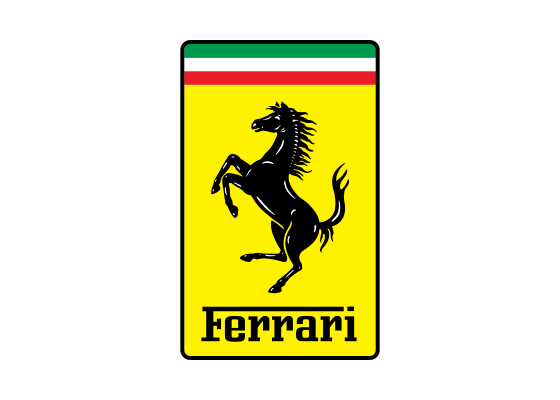
The Ferrari logo, known as the Cavallino Rampante, features a black prancing horse on a yellow shield flanked by Italian flag stripes, creating one of the most emotionally charged symbols in automotive history.
The horse rears on its hind legs, facing right, with its tail raised in a heraldic pose that communicates power, courage, and nobility. The yellow background (#fff200) was chosen by Enzo Ferrari as tribute to Modena, his hometown, whose city color is canary yellow. The shield shape frames the horse in a formal, heraldic context that elevates the logo beyond automotive branding into something closer to a family crest. The green, white, and red vertical stripes at the top declare Ferrari’s Italian identity with unmistakable clarity.
The letters “S F” at the bottom stand for Scuderia Ferrari, meaning “Ferrari Stable” in the tradition of racing stables. This connects every road car to the racing heritage that defines the brand. Above the shield, the word “FERRARI” appears in a serif typeface, completing the composition. The badge functions as both a logo and a declaration of origin, identity, and racing pedigree.
Meaning and Symbolism
- Prancing horse (Cavallino Rampante): The horse represents power, speed, and nobility. Its rearing pose is a traditional heraldic symbol of courage and superiority, rendered in black for graphic clarity against the yellow background.
- Yellow shield (#fff200): The canary yellow represents Modena, where Enzo Ferrari was born. The shield shape provides a formal heraldic frame that positions Ferrari’s identity closer to aristocratic lineage than corporate branding.
- Italian tricolor: The green, white, and red vertical stripes declare Ferrari’s national identity. The placement is deliberate: Ferrari is not just an Italian car company but Italy’s car company.
- “S F” initials: Scuderia Ferrari identifies the racing team that predates the car manufacturer, connecting every vehicle to Ferrari’s competition heritage.
Design and History
Enzo Ferrari adopted the prancing horse for his Scuderia Ferrari racing team in 1929, nearly two decades before Ferrari-badged cars existed. The horse’s origin involves World War I aviation and a meeting with a grieving mother. Count Francesco Baracca was Italy’s leading fighter ace during World War I, credited with 34 aerial victories before being killed in action in 1918. Baracca painted a prancing horse on the fuselage of his fighter planes.
According to Enzo Ferrari’s account, he met Baracca’s mother, Countess Paolina Baracca, at a racing event in 1923. The Countess told him to put her son’s prancing horse on his cars because it would bring him luck. Ferrari adopted the symbol for his racing team in 1929, placing the horse on a yellow shield representing Modena and adding the Italian tricolor. This origin story, whether entirely accurate or embellished, gave the Ferrari logo something no design agency could fabricate: a genuine backstory rooted in heroism, loss, and national identity.
When Enzo Ferrari began building cars under his own name in 1947, the badge transferred naturally from racing to production vehicles. The 125 S, Ferrari’s first car, carried the Cavallino Rampante on its nose, and every Ferrari since has done the same. The badge appears on the hood, the steering wheel, the key fob, and the engine cover.
The logo’s resistance to change is remarkable even by luxury car standards. The horse’s drawing has been refined, proportions tightened, and manufacturing improved, but the composition, color palette, and heraldic structure are unchanged from 1929. This consistency reflects Enzo Ferrari’s understanding that the Cavallino Rampante was not a marketing asset to be optimized but a talisman connecting every car to Baracca’s courage and Italian racing heritage.
Typography
The “FERRARI” wordmark uses a serifed typeface with classical proportions and moderate stroke contrast. The letters are tall and evenly spaced, with a formal quality that complements the heraldic badge. The “F” has distinctive horizontal bars, and the double “R” creates visual rhythm within the word. For broader communications, Ferrari uses proprietary typefaces that maintain the brand’s combination of Italian elegance and engineering precision. The typography is always secondary to the Cavallino Rampante badge, which is the brand’s true identifier.
FAQ
Q: What is the origin of the Ferrari prancing horse?
A: The horse was originally the emblem of Count Francesco Baracca, Italy’s top fighter ace in World War I. His mother gave Enzo Ferrari permission to use it in 1923, and he adopted it for his racing team in 1929.
Q: Why is the Ferrari logo yellow?
A: The yellow background (#fff200) represents Modena, Enzo Ferrari’s birthplace. Canary yellow is the traditional color of the city.
Q: What does “S F” stand for on the Ferrari badge?
A: Scuderia Ferrari, meaning “Ferrari Stable” in the tradition of horse racing stables. It identifies the Ferrari racing team, which predates the car company.
More logos with similar colors