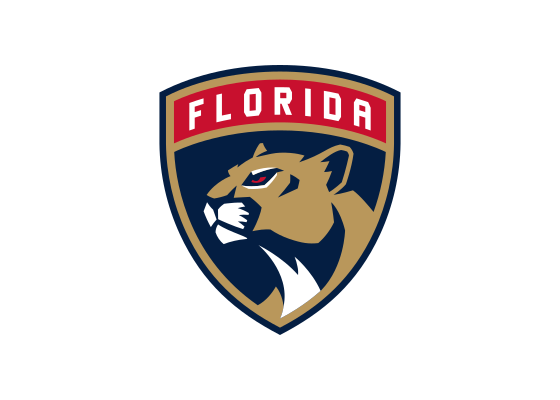
The Florida Panthers logo features a leaping panther within a military-style shield, connecting South Florida’s endangered wildlife to themes of protection, territorial defense, and aggressive athleticism through refined illustration and structured heraldry.
The Panthers logo successfully evolved from cartoonish mascot to sophisticated emblem through its 2016 redesign. The current mark replaces the overtly aggressive, pouncing cat of the 1993 original with a more composed, powerful panther positioned within a shield framework. This shift from illustration-forward to structure-forward design reflects broader sports branding maturity, where restraint often communicates strength more effectively than exaggerated action poses.
The shield element transforms the mark from simple mascot into insignia, evoking military patches and law enforcement badges appropriate to Florida’s large veteran and military retiree population. The “FLORIDA” tab across the shield’s top adds geographic specificity while the refined gold, navy, and red palette modernizes what was once a garish teal-and-yellow scheme that defined early-1990s excess.
Meaning and Symbolism
- The Florida panther (Puma concolor coryi) references the endangered subspecies native to southern Florida’s wetlands
- Shield structure suggests military insignia, honoring South Florida’s substantial veteran and active military community
- Gold color replaced teal to create more sophisticated, less dated palette appropriate to contemporary aesthetics
- Panther’s side profile position suggests vigilance and territorial awareness rather than chaotic aggression
- “FLORIDA” banner specifies geographic claim in a state with multiple major sports franchises
Design and History
The franchise launched in 1993 with Blockbuster Video magnate Wayne Huizenga as owner, debuting a logo featuring a vividly colored panther mid-leap with exaggerated musculature and fierce expression. While exciting, this design belonged firmly to early-1990s trends toward extreme illustration and bright color combinations (gold, teal, red, white). The aggressive stance and detailed rendering created reproduction challenges and dated the mark to its era.
The 1999 update maintained the leaping cat concept while refining details and adjusting colors slightly, but the fundamental approach remained unchanged. By the 2010s, this aesthetic felt increasingly anachronistic compared to the simplified, geometric logos emerging across sports. The 2016 redesign, created by Reebok’s design team, represented philosophical evolution rather than incremental adjustment.
The current mark calms the panther’s posture, places it within architectural shield structure, and reduces the color palette to navy, gold, and strategic red accents. These changes transformed the franchise’s visual identity from expansion-team enthusiasm to established-franchise confidence. The shield also provides flexibility for secondary marks and allows easier application across uniforms and collateral.
Typography
The Panthers wordmark features bold, condensed capitals with sharp serifs that balance traditional athletic lettering with contemporary aggressiveness. The “FLORIDA” element within the shield employs a different face, more condensed and geometric, creating differentiation between geographic identifier and team name. Secondary applications often use italicized versions to suggest forward motion, though the primary logo maintains upright orientation for stability and formality.
FAQ
Q: Why replace the teal and gold with navy and gold? A: Teal defined 1990s expansion team branding (Sharks, Jaguars, Marlins) but aged poorly. The shift to navy modernized the palette while maintaining gold as continuity element. Navy also photographs and reproduces better across digital platforms while feeling more sophisticated than bright teal.
Q: How does the shield change the logo’s meaning? A: The shield transforms the panther from wildlife mascot into protected insignia, suggesting organizational strength and institutional permanence. It also created a contained shape that allows better logo flexibility across applications, from small mobile icons to large arena signage.
Q: Is the Florida panther actually endangered? A: Yes. Fewer than 200 Florida panthers remain in the wild, making them one of North America’s most endangered mammals. The team’s adoption of this mascot has helped raise awareness of conservation efforts, though the logo itself focuses on athletic symbolism rather than environmental messaging.
More logos with similar colors