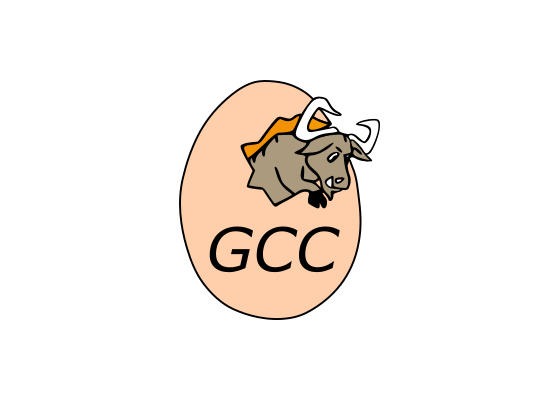
The GNU Compiler Collection logo depicts a stylized gnu (wildebeest) rendered in warm earth tones, connecting the compiler to the broader GNU Project’s commitment to free software while conveying the power and accessibility of one of computing’s most essential development tools.
Meaning and Symbolism
- The gnu animal serves as the living mascot of the GNU Project, creating immediate visual connection to the free software movement founded by Richard Stallman
- Warm gold, orange, and brown tones suggest approachability and openness, contrasting with proprietary software’s corporate coldness
- The gnu’s powerful stance symbolizes the compiler’s robust capabilities across multiple programming languages and hardware architectures
- The artistic, almost woodcut-like rendering evokes craftsmanship and the careful human effort behind open source development
- The circular composition creates a badge or seal effect, suggesting official certification and reliability for mission-critical software
History and Evolution
GCC originated in 1987 when Richard Stallman released version 1.0 as the GNU C Compiler, a crucial component of the free software movement’s goal to create a completely open alternative to proprietary Unix systems. The compiler initially supported only C programming but expanded to C++ by December 1987, beginning its evolution into a multi-language compilation system. As front ends were added for Fortran, Ada, Objective-C, Java, and eventually D, Go, and Rust, the name changed to GNU Compiler Collection to reflect its broader scope.
The gnu imagery has been associated with the GNU Project since its inception, making it a natural choice for GCC’s visual identity. The current logo design emerged from the open source community, with various artistic interpretations appearing over the years as contributors sought to give visual identity to this foundational tool. With approximately 15 million lines of code by 2019, GCC stands as one of the largest and most important open source projects in existence, powering everything from embedded systems to supercomputers. The compiler’s influence extends beyond technical capability; it serves as both the tool and the example that enabled the growth of Linux, countless open source projects, and the broader free software ecosystem.
Typography and Design
The GCC logo primarily relies on the iconic gnu illustration rather than prominent typography, though the “GCC” acronym often appears in clean, sans-serif fonts when used in documentation and promotional materials. This text is typically rendered in black or dark gray, maintaining legibility and professional appearance in technical contexts. The gnu illustration itself employs a limited palette of golds, oranges, browns, and creams that work effectively across digital and print media, with black outlines providing definition and white highlights adding dimensionality to the animal’s form.
Frequently Asked Questions
Who designed the GCC logo? The GCC logo emerged from the GNU Project community, with the gnu imagery being a core element of GNU Project branding since Richard Stallman founded it in 1983, though specific attribution for the current artistic rendering is not definitively documented.
When was the GCC logo last updated? The gnu illustration has remained relatively consistent for decades, with minor artistic refinements over time as the logo has been reproduced in various contexts, but no major redesign has occurred since the compiler’s early years.
What do the colors in the GCC logo represent? The warm earth tones of gold, orange, and brown convey approachability, openness, and the organic, community-driven nature of free software development, contrasting with the colder aesthetics often associated with proprietary commercial software.
More logos with similar colors