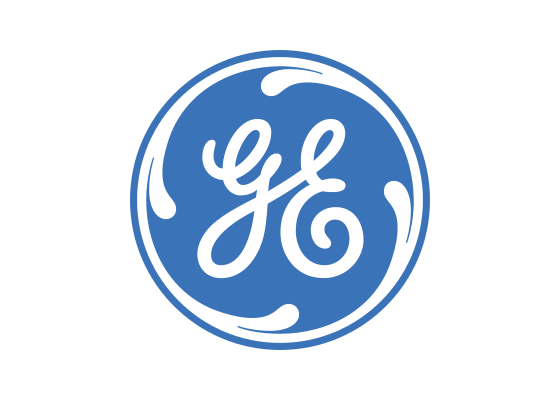
The General Electric logo features a stylized monogram of the letters “GE” enclosed within an ornate circular border, a design that has remained fundamentally unchanged since 1892. The blue (#3B73B9) and white palette, combined with the distinctive art nouveau flourishes, creates one of the most recognizable corporate symbols in American industrial history.
General Electric’s logo is unusual because it looks Victorian. Most industrial conglomerates have long since abandoned ornamental typography and decorative borders in favor of clean, modern sans-serifs. GE has kept its 1890s logo through more than a century of mergers, spin-offs, technological revolutions, and corporate reinventions. The monogram sits inside a circular frame with art nouveau curves that feel more decorative than functional, yet the design remains remarkably legible and adaptable.
The letters “G” and “E” interlock in a script-influenced style, the kind of hand-lettering common in late 19th-century American signage. The circular border curves inward at the cardinal and ordinal points, creating a dynamic shape that suggests motion despite being static. This was intentional. Early electric companies wanted to communicate energy, flow, and modernity, and the swirling lines accomplished this without literalizing electricity as lightning bolts or light bulbs.
Wolff Olins refined the logo in 2005, simplifying some of the finer details and optimizing it for digital applications, but the fundamental structure remained intact. The blue color was standardized, and the white letters were given slightly cleaner edges. The update was so subtle that most people never noticed. That restraint reflects confidence in the original design’s enduring power.
Meaning and Symbolism
- Interlocking monogram: The overlapping “G” and “E” create a unified mark that functions as a single glyph rather than two separate letters. This integration symbolizes the interconnected nature of GE’s businesses and technologies.
- Circular border: The ornate frame encloses and protects the monogram, suggesting reliability and containment. The curves at eight points create a sense of motion, echoing the flow of electricity.
- Art nouveau style: The decorative flourishes position GE within the industrial optimism of the late 19th century, when electric power was transforming American life. Retaining this style acknowledges the company’s foundational role in that transformation.
- Blue and white palette: Blue (#3B73B9) communicates trust, reliability, and professionalism. White ensures legibility and adds a sense of clarity and precision, important for a company operating in complex technical fields.
Design and History
General Electric was formed in 1892 from a merger of Edison General Electric Company and Thomson-Houston Electric Company. The new entity needed a unified identity, and the interlocking monogram was created shortly after the merger. The design reflected the ornamental aesthetic popular in American commercial art at the time, when businesses used elaborate letterforms and decorative borders to communicate quality and permanence.
The logo survived every major shift in GE’s history. Through two world wars, the rise and fall of various business units, the conglomerate boom of the 1960s and 1970s, and the digital transformation of the 21st century, the monogram endured. This continuity is rare among major corporations. Most have redesigned their logos multiple times to stay contemporary. GE has trusted that the original design, properly maintained, would remain relevant.
In 2005, Wolff Olins led a comprehensive brand refresh that included subtle refinements to the logo. The agency worked with GE to consolidate its 3,500 businesses into 11 market-oriented divisions, and the logo update was part of that strategic realignment. The changes were minimal: cleaner edges on the letters, a standardized blue, and improved scalability for digital applications. The “Imagination Breakthroughs” campaign, launched around the same time, added $25 billion in revenue across 100 countries and positioned GE as an innovation leader rather than just an industrial manufacturer.
The typeface used across GE’s broader branding is GE Inspira, a custom sans-serif family developed to complement the ornate logo. Inspira is clean, modern, and highly legible, providing contrast to the decorative monogram and ensuring that contemporary marketing materials do not feel dated. The combination of Victorian logo and modern typography creates a visual tension that works in GE’s favor, signaling both heritage and forward-thinking innovation.
Typography
The GE monogram uses a script-influenced style with flowing, interconnected letterforms. The broader GE brand system uses GE Inspira, a proprietary sans-serif typeface designed to complement the ornate logo. Inspira is clean, geometric, and highly legible, balancing the monogram’s decorative qualities with contemporary simplicity. The typeface is used across all GE communications, from annual reports to product interfaces, reinforcing brand consistency.
FAQ
Q: How old is the General Electric logo?
A: The interlocking monogram was created in 1892, shortly after the merger that formed General Electric. It is one of the oldest continuously used corporate logos in the United States.
Q: Why has GE kept such an old-fashioned logo?
A: The ornate monogram connects GE to its foundational role in the electric age and signals continuity and reliability. Subtle refinements over the decades have kept it functional without abandoning its historical character.
Q: Who designed the current version of the GE logo?
A: Wolff Olins refined the logo in 2005, simplifying details and optimizing it for digital use while preserving the fundamental 1892 design.
More logos with similar colors