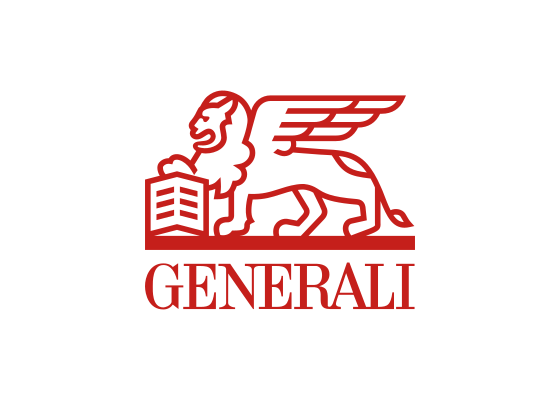
The Generali logo features a distinctive red (#c51f1b) lion symbol that combines Italian heritage with insurance industry authority.
The brand identity centers on a stylized winged lion, referencing the Lion of St. Mark that symbolizes Venice and its historical Venetian Republic. While Generali is headquartered in Trieste (formerly a major port of the Austrian Empire), the Venetian lion connects the brand to Italian maritime trade heritage and suggests strength, protection, and watchfulness. The red color (#c51f1b) breaks from the blue-dominated insurance sector, creating instant recognition across European markets where Generali competes with AXA, Allianz, and Zurich Insurance.
The lion’s wings add mythological resonance and elevate the symbol beyond literal animal representation. This matters for an insurance company where abstract concepts like protection and security need visual expression. The winged lion suggests elevated perspective, far-seeing vision, and the ability to rise above ordinary concerns, all qualities that insurance customers want from providers promising to protect them against future uncertainty. The geometric rendering keeps the symbol contemporary rather than heraldic, preventing it from feeling like a relic from the company’s 1831 founding.
The red positioning creates both advantages and challenges. It provides differentiation and visibility but lacks the psychological trust signals that blue naturally conveys in financial services. Generali manages this tension through the lion symbol itself, which carries authority and strength associations that compensate for red’s lack of traditional stability cues. The brand appears across life insurance, property insurance, asset management, and corporate risk management materials throughout Europe, where the red lion has built recognition through nearly two centuries of operation.
Meaning and Symbolism
- Red color (#c51f1b): Differentiates from blue insurance competitors while conveying Italian identity, passion, and the confidence required to promise future protection.
- Winged lion: References Venice’s Lion of St. Mark, connecting Generali to Italian maritime trade heritage and suggesting strength, protection, and elevated perspective.
- Wings addition: Transforms literal animal into mythological symbol representing far-seeing vision and the ability to protect against uncertain futures.
- Geometric styling: Modernizes heraldic tradition, preventing the 1831-founded company from appearing dated while maintaining connection to European insurance heritage.
Design and History
Assicurazioni Generali was founded on December 26, 1831, in Trieste when the city served as the most important seaport of the Austrian Empire. The company’s full name, “Imperial Regia Privilegiata Compagnia di Assicurazioni Generali Austro-Italiche,” reflected its royal charter and dual Austrian-Italian identity. After World War I transferred Trieste to Italy, Generali evolved from regional insurer to one of Europe’s largest insurance and asset management companies. The winged lion symbol emerged as the company expanded beyond its Habsburg origins into broader Italian and European markets.
The current logo represents modernization of earlier versions that featured more ornate heraldic styling. The streamlined lion maintains recognizable form while removing decorative complexity that doesn’t reproduce well on digital platforms or in small sizes on policy documents. The red color has remained consistent even as competitors like AXA and Allianz updated their palettes, providing brand continuity across Generali’s European footprint. The symbol appears on insurance policies from Italy to Germany to Austria, markets where Generali ranks among the top insurers.
Generali competes directly with AXA, Allianz, and Zurich Insurance Group for European market leadership. The red lion provides crucial differentiation in crowded insurance marketing where blue dominates competitor branding. The symbol’s Italian associations work differently across markets. In Italy, it signals domestic leadership and national champion status. In Central European markets like Austria and Germany, it represents a credible international alternative to local insurers. The winged lion provides enough cultural resonance to create meaning without being so specifically Italian that it alienates non-Italian customers.
Typography
The Generali wordmark uses a refined serif typeface that balances traditional authority with contemporary clarity. The letterforms feature elegant proportions and subtle details that convey sophistication appropriate for an insurance company managing long-term commitments and substantial assets. The serifs connect to European banking and insurance typography traditions while avoiding excessive ornamentation that might feel outdated. The consistent weight and spacing ensure the wordmark maintains dignity when appearing alongside the red lion symbol. This typographic approach reinforces Generali’s positioning as an established, reliable European insurer with nearly two centuries of experience protecting customers against life’s uncertainties.
FAQ
Q: Why does Generali use a winged lion as its symbol?
A: The winged lion references the Lion of St. Mark, symbol of Venice and the Venetian Republic. This connects Generali to Italian maritime trade heritage and conveys strength, protection, and far-seeing vision appropriate for insurance services. The wings elevate the symbol beyond literal representation into mythological territory.
Q: How large is Generali in the insurance industry?
A: Generali ranks among the world’s top ten largest insurance companies by premiums and assets. Founded in 1831, it’s the largest insurance company in Italy and operates throughout Europe as a major competitor to AXA, Allianz, and Zurich Insurance Group.
Q: Why is Generali categorized under banking and finance instead of insurance?
A: Generali operates across both insurance and asset management, with significant banking and investment operations beyond traditional insurance products. The company manages substantial assets and provides comprehensive financial services, making the broader financial services categorization appropriate despite insurance being its historical core business.