Skip to Content
    Support us
    A-Z Agency Colors Country Designer Industry Tags Year Trending Reports
    Google technology United States blue green red orangeUSA US America AmericantechnologyUnited Statesbluegreenredorange

    Google LLC

    • Logo
    • United States
    • Technology
    • Google

    Google Logo

    Explore the iconic Google logo – its design, history, and visual identity.

    Trending Popular
    Google logo - free SVG vector, technology brand from United States

    Google Brand Colors

    Browse more logos with blue, green, red and orange colors.

    Google Brand Facts

    Key information about Google: origin, designer, industry, and logo introduction year.

    Websitegoogle.com
    DesignerRuth Kedar
    AgencyNone specified
    CountryUnited States
    IndustryTechnology
    Logo Introduced2015
    Download Google logo Embed Google logo
    views · downloads this week
    4.2 (11 ratings)

    Explore the Google brand, discover Google colors, and download the Google vector logo in SVG or PNG formats. Browse related logos and logos with similar colors.

    Alphabet Inc. Logos

    Meet logo vector - free SVG download

    Meet

    Internet

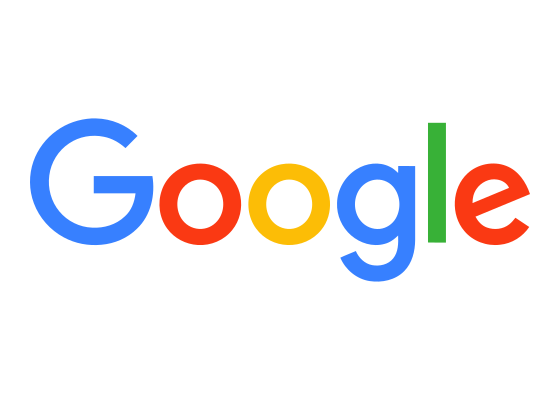
    The Google logo uses a simple wordmark in four primary colors that communicate playfulness, accessibility, and the company’s willingness to break conventional rules.

    The logo spells “Google” in a custom sans-serif typeface called Product Sans, introduced in 2015 to replace the previous serif letterforms. Each letter is rendered in one of four colors: blue (#3780ff), red (#fa3913), yellow (#fcbd06), and green (#38b137). The color sequence follows a pattern that is almost, but not quite, symmetrical. The first three letters follow the primary color sequence, blue-red-yellow, but then Google places a secondary color, green, on the second “g” before returning to blue and red for the final two letters. This deliberate disruption of the expected pattern became one of the logo’s defining characteristics.

    The colors are bright, saturated, and optimistic. They signal that Google is approachable rather than corporate, innovative rather than conservative. The typography is geometric and clean, designed to render clearly at small sizes on screens. The lowercase treatment reinforces accessibility, while the even letter spacing creates a stable, balanced wordmark that works across applications from search results to building signage.

    Meaning and Symbolism

    • Four primary and secondary colors: The use of blue, red, yellow, and green communicates diversity, creativity, and a refusal to follow rigid systems. The colors are deliberately simple, the building blocks of visual language.
    • Green on the second “g”: The placement of a secondary color where a primary color is expected signals that Google does not always follow the rules. It is a subtle detail that reinforces the brand’s positioning as an innovator.
    • Product Sans typeface: The custom geometric sans-serif was designed to be friendly, legible, and modern. Its rounded forms and even stroke weight create a welcoming quality appropriate for a platform used by billions of people daily.
    • Lowercase letters: The lowercase presentation makes the brand feel conversational and accessible rather than authoritative or institutional.

    Design and History

    The first Google logo, created by Sergey Brin in 1997 using the free graphics program GIMP, was a simple serif wordmark with an exclamation mark. The design was functional rather than polished, appropriate for a Stanford research project that had not yet imagined becoming the world’s dominant search engine. In 1999, Ruth Kedar, a professor at Stanford, designed the logo that would define Google for the next 16 years. Kedar’s version refined the letterforms and established the four-color palette that remains in use today.

    The serif typeface used in the Kedar design was based on Catull, giving the logo a slightly academic, authoritative quality. As Google expanded beyond search into email, maps, video, advertising, and cloud services, the serif logo began to feel dated. The company needed an identity that worked across an expanding range of products and platforms, particularly mobile devices where screen space and rendering clarity were critical.

    In 2015, Google unveiled the current logo as part of a broader brand refresh. The new wordmark used Product Sans, a geometric sans-serif designed specifically for the rebrand. The typeface was rounder, friendlier, and more flexible than the previous serif, optimizing for digital applications while maintaining the four-color palette. The “G” icon, a four-color capital letter, was introduced as a standalone mark for app icons and contexts where the full wordmark was impractical.

    The 2015 redesign coincided with Google’s restructuring into Alphabet Inc., a parent company that contained Google and other ventures. The new visual identity signaled that Google was maturing from a search company into a technology platform, but the playful four-color scheme ensured that the brand remained approachable.

    Typography

    Product Sans is a geometric sans-serif with circular forms and minimal stroke contrast. The typeface is monoweight, meaning the stroke thickness is consistent throughout each letter, which gives it a clean, modern appearance. The “G” and “o” are nearly perfect circles, and the overall character set emphasizes simplicity and legibility. Product Sans is used across Google’s product interfaces, marketing materials, and brand communications, providing typographic consistency across the company’s vast ecosystem. The typeface is proprietary and not publicly available, reinforcing its association with the Google brand.

    FAQ

    Q: Who designed the Google logo? A: Ruth Kedar designed the core Google logo in 1999. The current Product Sans typeface was introduced in 2015 as part of a brand refresh led by Google’s internal design team.

    Q: Why does Google use four colors? A: The blue, red, yellow, and green palette communicates playfulness and diversity. The green “g” disrupts the primary color pattern, signaling that Google does not always follow conventional rules.

    Q: What is the Google “G” icon? A: The four-color capital “G” introduced in 2015 serves as a standalone logo for mobile apps and contexts where the full wordmark is impractical. It uses the same color palette as the wordmark.


    More Technology logos from United States

    451 Research logo vector - free SVG download

    451 Research

    Technology
    Allegis Group logo vector - free SVG download

    Allegis Group

    Technology
    Afresh logo vector - free SVG download

    Afresh

    Technology
    Arlo logo vector - free SVG download

    Arlo

    Technology
    iRobot logo vector - free SVG download

    iRobot

    Technology
    Qwik logo vector - free SVG download

    Qwik

    Technology
    SailPoint logo vector - free SVG download

    SailPoint

    Technology
    Sphero logo vector - free SVG download

    Sphero

    Technology

    More logos with similar colors
    Designhill logo vector - free SVG download

    Designhill

    Retail
    United Utilities logo vector - free SVG download

    United Utilities

    Construction
    2C2P logo vector - free SVG download

    2C2P

    Banking and Finance
    Pennon logo vector - free SVG download

    Pennon

    Transportation
    Pellucid logo vector - free SVG download

    Pellucid

    Software
    OTN logo vector - free SVG download

    OTN

    Healthcare
    Baneservice logo vector - free SVG download

    Baneservice

    Construction
    Polybius logo vector - free SVG download

    Polybius

    Crypto
    Cosan logo vector - free SVG download

    Cosan

    Energy
    Smart Communications logo vector - free SVG download

    Smart Communications

    Telecom
    TC Energy logo vector - free SVG download

    TC Energy

    Energy
    Pachama logo vector - free SVG download

    Pachama

    Technology

    The "Google LLC" appears in: Artificial Intelligence Logos , Digital Logos , Innovation Logos , Internet Services Logos , Modern Brand Logos and Multinational Logos .

    Frequently asked questions about the Google logo

    The Google LLC logo represents a technology brand from United States, designed in 2015 by Ruth Kedar at None specified. Learn more on the official Google website.

    Why is the Google logo in SVG format?
    The Google logo is provided as an SVG (Scalable Vector Graphics) file because vectors offer unlimited scaling without pixelation, smaller file sizes than raster images, and are ideal for responsive web design. SVG logos work perfectly across all screen sizes — from mobile devices to billboard prints — maintaining crisp edges at any resolution.
    Should I use SVG or PNG for the Google logo?
    Use SVG for websites, apps, and any digital design requiring scalability. SVG files are resolution-independent and load faster. Use PNG (converted from SVG at 300 DPI) for presentations, printed materials, or software that doesn’t support SVG. Convert using Adobe Illustrator, Inkscape, Affinity Designer, or online tools like CloudConvert. Export at 300 DPI for print, 72-150 DPI for web.
    What software can open the Google SVG logo?
    The Google SVG logo opens in both code editors (VS Code, Sublime Text, Notepad++) and graphic design software (Figma, Adobe Illustrator, Affinity Designer, Sketch, Inkscape). Modern web browsers can also display SVG files directly. For quick edits, online editors like SVGEdit or Method Draw work without installing software.
    What font does the Google logo use?
    Many professional brands, including Google, use custom-designed typefaces for their logos to ensure unique brand identity and trademark protection. If the Google logo uses a custom font, no exact public version may exist. For similar typography, analyze the logo’s letter characteristics (serif vs sans-serif, weight, spacing) and search font databases like WhatTheFont, Identifont, or MyFonts for close alternatives.
    What is a Logo or Logotype?
    A logo is a graphic mark, emblem, or symbol used to aid public identification and recognition. Logos fall into three classifications: ideographs (abstract forms), pictographs (iconic designs), and logotypes/wordmarks (text-based). The logo is central to a brand’s visual identity system.
    Can I use the Google logo legally?
    The Google logo is a registered trademark and cannot be used commercially without explicit written permission from Google. This website provides the logo for educational, informational, and reference purposes only. For commercial projects, partnerships, or official brand assets, contact Google’s communications or legal department directly.
    Where can I find Google brand guidelines?
    Official Google brand guidelines typically include logo usage rules, color codes, typography, spacing requirements, and prohibited modifications. Check the Google website for a “Brand,” “Press,” “Media Kit,” or “Resources” section. Official assets are also available through press kits and authorized partner portals.
    Do I need to credit logotyp.us when using the Google logo?
    No attribution to logotyp.us is required. However, the Google logo itself is trademarked intellectual property — using it requires permission from Google, regardless of where you downloaded it. This site serves as a reference library; downloading a logo here does not grant usage rights.

    Report Outdated Logo

    logotyp.us

    Download high-quality vector logos in SVG format — free for designers, developers, and brand enthusiasts. Browse 4,700+ brand logos by industry, country, color, and designer.

    Help Keep This Free Logos and Brands
    Browse
    • Logos by Industry
    • Logos by Country
    • Logos by Color
    • Logos by Designer
    • A–Z Logo Index
    Discover
    • Popular Logos
    • Search Logos
    • Logo Reports
    Top Countries
    • United States
    • United Kingdom
    • Global
    • Japan
    • Germany
    • Canada
    • France
    • India
    • Sweden
    • Spain
    • Italy
    • Australia
    • Switzerland
    • Netherlands
    • China
    • View All Countries →

    © 2026 logotyp.us. All logos are trademarks of their respective owners.

    Build 0307-1036