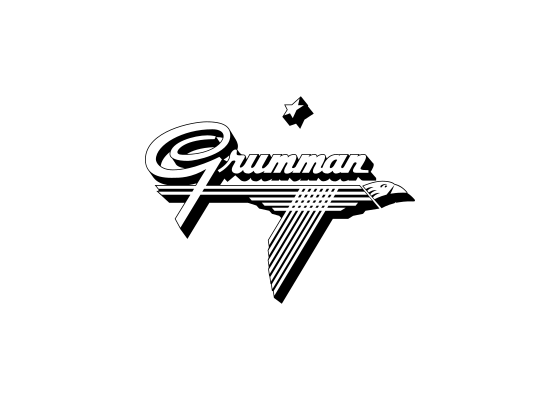
The Grumman logo featured a distinctive abstract mark representing one of the 20th century’s premier military and civilian aircraft manufacturers before merging with Northrop Corporation in 1994.
Meaning and Symbolism
- White conveyed purity of engineering excellence and the clear skies where Grumman aircraft dominated
- The abstract geometric form suggested aerodynamics, precision engineering, and aerospace innovation
- The clean, technical aesthetic reflected the company’s reputation for rugged, reliable naval aircraft
- The mark’s simplicity allowed it to work on aircraft liveries, documentation, and corporate materials
- The design communicated technical sophistication without militaristic aggression
History and Evolution
Grumman Aircraft Engineering Corporation was founded on December 6, 1929, by Leroy Grumman, Jake Swirbul, William Schwendler, Ed Poor, Clint Towl, and Leon “Jake” Swirbul in a garage in Baldwin, Long Island. Leroy Grumman, a former Navy test pilot, recognized opportunities to improve naval aircraft design, particularly retractable landing gear for carrier operations. The company’s first contract with the U.S. Navy came in 1931 for the FF-1 fighter, establishing a relationship that would define Grumman for decades.
During World War II, Grumman achieved legendary status producing the F4F Wildcat and F6F Hellcat fighters, which dominated Pacific theater air combat. The Hellcat alone was credited with destroying over 5,000 enemy aircraft. Post-war, Grumman diversified into civilian aircraft, aluminum truck bodies, and canoes, but military contracts remained central. The company produced the A-6 Intruder, E-2 Hawkeye, EA-6B Prowler, and the iconic F-14 Tomcat, which became a cultural icon through “Top Gun.”
Grumman also played crucial roles in space exploration, building the Lunar Module that landed astronauts on the moon during the Apollo program. Financial challenges in the 1980s and defense industry consolidation led to Northrop Corporation acquiring Grumman in 1994 for $2.1 billion, creating Northrop Grumman. The Grumman name disappeared as a corporate entity but remains legendary among aviation enthusiasts. The company’s Long Island facilities, once employing over 25,000, largely closed after the merger.
Typography and Design
The Grumman wordmark employed clean, technical letterforms reflecting aerospace engineering precision. The typography avoided decorative elements, instead emphasizing clarity and functionality appropriate for technical documentation and aircraft markings. Various iterations existed throughout the company’s 65-year history, but all maintained a professional, engineering-focused aesthetic.
The abstract mark that accompanied the Grumman name suggested aircraft wings, flight paths, or aerodynamic profiles. White was predominantly used to ensure visibility against dark aircraft surfaces and technical drawings. The design system prioritized practicality over marketing flash, reflecting a company culture where engineers drove decisions and performance trumped aesthetics.
Frequently Asked Questions
Who designed the Grumman logo? Various iterations of the Grumman logo were developed over the company’s history, with designs created internally by corporate communications staff and occasionally by external consultants, though specific designers are not widely documented.
When was the Grumman logo last updated? The final Grumman corporate identity was in use until the 1994 merger with Northrop Corporation, after which the Grumman brand was absorbed into the new Northrop Grumman identity.
What do the colors in the Grumman logo represent? White represented engineering purity, clarity of purpose, and the skies where Grumman aircraft performed. The minimal color approach reflected the company’s engineering-first culture where technical excellence was paramount over marketing sophistication.