Skip to Content
    Support us
    A-Z Agency Colors Country Designer Industry Tags Year Trending Reports
    Hapag-Lloyd transportation Germany navyDE Deutschland GermantransportationGermanynavy

    Hapag-Lloyd

    • Logo
    • Germany
    • Transportation
    • Hapag-Lloyd

    Hapag-Lloyd Logo

    Explore the iconic Hapag-Lloyd logo – its design, history, and visual identity.

    Trending Popular
    Hapag-Lloyd logo - free SVG vector, transportation brand from Germany

    Hapag-Lloyd Brand Colors

    Browse more logos with navy color.

    Hapag-Lloyd Brand Facts

    Key information about Hapag-Lloyd: origin, designer, industry, and logo introduction year.

    Websitehapag-lloyd.com
    CountryGermany
    IndustryTransportation
    Download Hapag-Lloyd logo Embed Hapag-Lloyd logo
    views · downloads this week
    4.6 (81 ratings)

    Explore the Hapag-Lloyd brand, discover Hapag-Lloyd colors, and download the Hapag-Lloyd vector logo in SVG or PNG formats. Browse related logos and logos with similar colors.

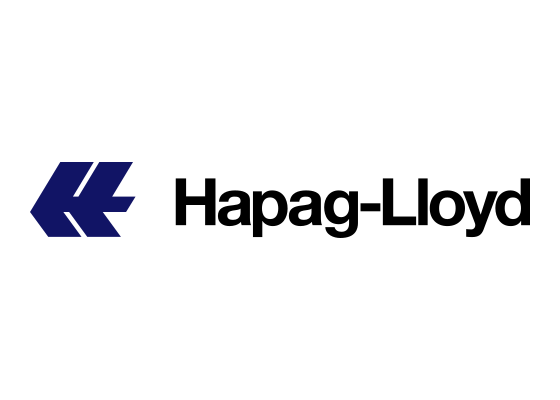
    The Hapag-Lloyd logo features a bold orange-red arrow or chevron on a deep navy blue (#111465) background, creating a striking maritime identity for Germany’s largest container shipping company.

    The logo’s geometric simplicity is its strength. The arrow form suggests forward movement, global reach, and directional certainty, appropriate for a company that operates liner services across major trade routes. The navy blue conveys maritime tradition, German engineering precision, and corporate stability. The orange-red accent provides energy and visibility, ensuring the logo stands out on container stacks, vessel hulls, and port infrastructure. The color combination is rare in shipping, where most competitors use primary reds, blues, or greens. Hapag-Lloyd’s palette is more sophisticated, suggesting heritage and modernity in equal measure.

    Hapag-Lloyd was formed in 1970 through the merger of two historic German shipping lines: Hamburg-Amerikanische Packetfahrt-Actien-Gesellschaft (HAPAG), founded in 1847, and Norddeutscher Lloyd (North German Lloyd), founded in 1857. Both companies dominated transatlantic passenger and cargo shipping in the late 19th and early 20th centuries. The merger combined their strengths to compete in the containerization era, when standardized cargo handling replaced traditional break-bulk shipping.

    The logo’s arrow points forward, but the company’s identity remains rooted in 19th-century German maritime ambition. The name itself is a mouthful, preserving the historical acronym rather than simplifying to something more global. This reflects Hapag-Lloyd’s positioning as a premium carrier, emphasizing reliability and engineering quality over cost leadership. The navy and orange palette reinforces this premium positioning, avoiding the aggressive reds favored by Asian competitors.

    Meaning and Symbolism

    • Arrow or chevron: Suggests forward movement, directional certainty, and global reach, appropriate for a liner shipping company operating fixed routes.
    • Deep navy blue: Conveys maritime tradition, German engineering precision, and corporate stability rooted in 19th-century shipping heritage.
    • Orange-red accent: Provides energy and visibility, ensuring the logo stands out on container stacks, vessel hulls, and port infrastructure worldwide.
    • Geometric simplicity: Reflects containerization’s standardization and efficiency, while maintaining visual distinctiveness in a crowded sector.

    Design and History

    HAPAG was founded in 1847 in Hamburg as Germany’s first ocean shipping company, eventually becoming one of the world’s largest carriers of transatlantic passengers and cargo. North German Lloyd, founded in Bremen in 1857, competed directly with HAPAG for decades. Both companies built iconic ocean liners, including several that held the Blue Riband for fastest Atlantic crossing. The rivalry ended in 1970 when the two companies merged to create Hapag-Lloyd, positioning the combined entity to compete in the emerging container shipping market.

    The current logo emerged during the containerization transition, when shipping companies moved from break-bulk cargo handling to standardized containers. The arrow form reflected this new efficiency and directionality, while the navy blue maintained connection to maritime tradition. The orange-red accent was added for visibility and differentiation, ensuring Hapag-Lloyd’s containers stood out in crowded ports.

    Hapag-Lloyd expanded aggressively in the 21st century through mergers and acquisitions. In 2005, it merged with Canadian carrier CP Ships. In 2014, it acquired Chilean carrier CSAV’s container business. In 2017, it merged with United Arab Shipping Company (UASC), making Hapag-Lloyd the fifth-largest container carrier globally. Through all these consolidations, the logo remained unchanged, signaling continuity and brand strength even as the corporate structure evolved.

    Typography

    The Hapag-Lloyd wordmark uses a bold, geometric sans-serif typeface with tight letter spacing and consistent stroke weight. The letterforms are stable and authoritative, reflecting German engineering values. The hyphenated name preserves the historical merger, maintaining connection to both founding companies. The uppercase treatment conveys corporate permanence, appropriate for a company with roots in the 19th century. The type is set in white when placed on the navy background, creating maximum contrast and legibility. The overall effect is classic, reliable, and distinctly European.

    FAQ

    Q: What does Hapag-Lloyd stand for? A: Hapag-Lloyd combines Hamburg-Amerikanische Packetfahrt-Actien-Gesellschaft (HAPAG), founded in 1847, and Norddeutscher Lloyd (North German Lloyd), founded in 1857, both historic German shipping lines that merged in 1970.

    Q: How large is Hapag-Lloyd’s container fleet? A: Following mergers with CP Ships (2005), CSAV (2014), and UASC (2017), Hapag-Lloyd became the fifth-largest container shipping company globally, operating over 250 vessels.

    Q: Why does the Hapag-Lloyd logo use an arrow? A: The arrow suggests forward movement, directional certainty, and global reach, reflecting the company’s transition from traditional break-bulk shipping to containerized liner services with fixed routes.
    More Transportation logos from Germany

    Deutsche Post logo vector - free SVG download

    Deutsche Post

    Transportation
    DB Schenker logo vector - free SVG download

    DB Schenker

    Transportation
    Uestra logo vector - free SVG download

    Uestra

    Transportation
    Floyd logo vector - free SVG download

    Floyd

    Transportation
    Fraport logo vector - free SVG download

    Fraport

    Transportation

    Other Navy logos

    Lands End logo vector - free SVG download

    Lands End

    Retail
    NielsenIQ logo vector - free SVG download

    NielsenIQ

    Marketing Agency
    Bajaj Auto logo vector - free SVG download

    Bajaj Auto

    Automotive
    Aker Arctic logo vector - free SVG download

    Aker Arctic

    Consulting
    Detroit Tigers logo vector - free SVG download

    Detroit Tigers

    Sports
    Degree logo vector - free SVG download

    Degree

    Personal Care
    Columbia University logo vector - free SVG download

    Columbia University

    Education
    Eurosport logo vector - free SVG download

    Eurosport

    Sports
    HD Hotels logo vector - free SVG download

    HD Hotels

    Hospitality
    Victoria logo vector - free SVG download

    Victoria

    Sports
    Cognyte logo vector - free SVG download

    Cognyte

    Software
    Colonial Athletic Association logo vector - free SVG download

    Colonial Athletic Association

    Sports

    The "Hapag-Lloyd" appears in: Container Shipping Logos , Europe Logos , Maritime Transportation Logos and Transportation Logos .

    Frequently asked questions about the Hapag-Lloyd logo

    The Hapag-Lloyd logo represents a transportation brand from Germany. Learn more on the official Hapag-Lloyd website.

    Why is the Hapag-Lloyd logo in SVG format?
    The Hapag-Lloyd logo is provided as an SVG (Scalable Vector Graphics) file because vectors offer unlimited scaling without pixelation, smaller file sizes than raster images, and are ideal for responsive web design. SVG logos work perfectly across all screen sizes — from mobile devices to billboard prints — maintaining crisp edges at any resolution.
    Should I use SVG or PNG for the Hapag-Lloyd logo?
    Use SVG for websites, apps, and any digital design requiring scalability. SVG files are resolution-independent and load faster. Use PNG (converted from SVG at 300 DPI) for presentations, printed materials, or software that doesn’t support SVG. Convert using Adobe Illustrator, Inkscape, Affinity Designer, or online tools like CloudConvert. Export at 300 DPI for print, 72-150 DPI for web.
    What software can open the Hapag-Lloyd SVG logo?
    The Hapag-Lloyd SVG logo opens in both code editors (VS Code, Sublime Text, Notepad++) and graphic design software (Figma, Adobe Illustrator, Affinity Designer, Sketch, Inkscape). Modern web browsers can also display SVG files directly. For quick edits, online editors like SVGEdit or Method Draw work without installing software.
    What font does the Hapag-Lloyd logo use?
    Many professional brands, including Hapag-Lloyd, use custom-designed typefaces for their logos to ensure unique brand identity and trademark protection. If the Hapag-Lloyd logo uses a custom font, no exact public version may exist. For similar typography, analyze the logo’s letter characteristics (serif vs sans-serif, weight, spacing) and search font databases like WhatTheFont, Identifont, or MyFonts for close alternatives.
    What is a Logo or Logotype?
    A logo is a graphic mark, emblem, or symbol used to aid public identification and recognition. Logos fall into three classifications: ideographs (abstract forms), pictographs (iconic designs), and logotypes/wordmarks (text-based). The logo is central to a brand’s visual identity system.
    Can I use the Hapag-Lloyd logo legally?
    The Hapag-Lloyd logo is a registered trademark and cannot be used commercially without explicit written permission from Hapag-Lloyd. This website provides the logo for educational, informational, and reference purposes only. For commercial projects, partnerships, or official brand assets, contact Hapag-Lloyd’s communications or legal department directly.
    Where can I find Hapag-Lloyd brand guidelines?
    Official Hapag-Lloyd brand guidelines typically include logo usage rules, color codes, typography, spacing requirements, and prohibited modifications. Check the Hapag-Lloyd website for a “Brand,” “Press,” “Media Kit,” or “Resources” section. Official assets are also available through press kits and authorized partner portals.
    Do I need to credit logotyp.us when using the Hapag-Lloyd logo?
    No attribution to logotyp.us is required. However, the Hapag-Lloyd logo itself is trademarked intellectual property — using it requires permission from Hapag-Lloyd, regardless of where you downloaded it. This site serves as a reference library; downloading a logo here does not grant usage rights.

    Report Outdated Logo

    logotyp.us

    Download high-quality vector logos in SVG format — free for designers, developers, and brand enthusiasts. Browse 4,700+ brand logos by industry, country, color, and designer.

    Help Keep This Free Logos and Brands
    Browse
    • Logos by Industry
    • Logos by Country
    • Logos by Color
    • Logos by Designer
    • A–Z Logo Index
    Discover
    • Popular Logos
    • Search Logos
    • Logo Reports
    Top Countries
    • United States
    • United Kingdom
    • Global
    • Japan
    • Germany
    • Canada
    • France
    • India
    • Sweden
    • Spain
    • Italy
    • Australia
    • Switzerland
    • Netherlands
    • China
    • View All Countries →

    © 2026 logotyp.us. All logos are trademarks of their respective owners.

    Build 0307-1036