Scottish Premiership Logos
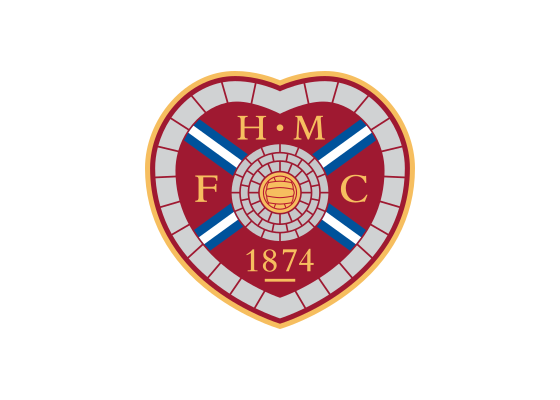
The Heart of Midlothian logo draws its name and symbolism from Walter Scott’s novel and the historic mosaic on Edinburgh’s Royal Mile. The maroon and white crest represents Scotland’s capital city’s oldest and most successful football club.
Heart of Midlothian’s identity connects directly to Edinburgh’s cultural heritage through both its literary name and visual reference to the Heart of Midlothian mosaic embedded in the Royal Mile’s cobblestones. This deep connection to the city’s history distinguishes Hearts from clubs with more generic sporting monikers. The maroon color has become synonymous with Edinburgh football, creating instant recognition throughout Scotland and beyond.
The abstract badge structure reflects modern design sensibilities while maintaining traditional heraldic elements appropriate for a club founded in 1874. The composition works across Tynecastle Park’s 19,852-capacity stadium, television broadcasts, and digital platforms. The careful balance of maroon and white ensures strong contrast whether the crest appears on home kits, away strips, or commercial merchandise. The design acknowledges Hearts’ position as Edinburgh’s premier club, with a visual confidence befitting their successful history.
Meaning and Symbolism
- Heart of Midlothian reference connects to both Walter Scott’s 1818 novel and the mosaic on Edinburgh’s Royal Mile, grounding the club in Scottish literary and civic heritage
- Maroon and white palette creates Edinburgh’s most distinctive football colors, immediately differentiating Hearts from rivals Hibernian’s green
- Abstract crest structure balances traditional heraldic elements with contemporary design principles for multi-platform functionality
- Capital city identity reflects Hearts’ position as Edinburgh’s oldest and most successful club, founded in 1874
- Tynecastle tradition honors the club’s home ground since 1886, one of Scottish football’s most historic stadiums
Design and History
Hearts’ visual identity evolved alongside the club’s development from Victorian-era foundation to modern Scottish Premiership competitor. The maroon has remained constant, becoming inseparable from Edinburgh football identity. The current abstract treatment represents a contemporary interpretation of traditional football heraldry, optimized for today’s media landscape while respecting the club’s deep historical roots.
The connection to the Heart of Midlothian mosaic on the Royal Mile provides rare cultural depth for a football club identity. This civic connection extends beyond sports into Edinburgh’s broader cultural narrative, linking the club to Scottish literature and the city’s historic Tolbooth prison site. Few football clubs can claim such rich symbolic foundation.
When Hearts rebuilt their main stand at Tynecastle in 2017, the modernized facilities required an identity that could work across contemporary stadium infrastructure, digital ticketing systems, and global broadcast platforms. The refined badge structure maintains tradition while functioning effectively in these diverse contexts, from LED boards to mobile apps.
Typography
Typography in the Heart of Midlothian identity uses classical, serif-influenced letterforms that reference the club’s Victorian foundation and Edinburgh’s cultural heritage. The letters maintain strong readability while conveying tradition and authority appropriate for Scotland’s capital city club. The type treatment complements the abstract mark without overwhelming it, creating a balanced system that works across applications from formal communications to match-day materials.
FAQ
Q: What is the Heart of Midlothian and why is it the club’s name? A: The Heart of Midlothian refers to both Walter Scott’s 1818 novel and the heart-shaped mosaic on Edinburgh’s Royal Mile, marking the site of the historic Tolbooth prison. The club, founded in 1874, took this name to establish deep connection with Edinburgh’s history and culture, making it one of Scottish football’s most literary and culturally grounded club names.
Q: How does Hearts’ maroon differ from other football reds? A: Hearts’ distinctive maroon is darker and richer than typical football reds, creating a unique identity in Scottish football. This deeper tone references Victorian color traditions and helps Hearts stand apart from clubs using brighter reds. The maroon has become so closely associated with the club that it’s simply referred to as “the maroon” in Edinburgh football culture.
Q: What makes Tynecastle significant in the club’s identity? A: Tynecastle Park has been Hearts’ home since 1886, making it one of Scottish football’s most historic venues. The 2017 main stand rebuild modernized the stadium to 19,852 capacity while maintaining its traditional atmosphere. This long tenure at a single ground creates powerful sense of place that reinforces Hearts’ identity as Edinburgh’s established club, contrasting with teams that have moved to newer facilities.
More logos with similar colors