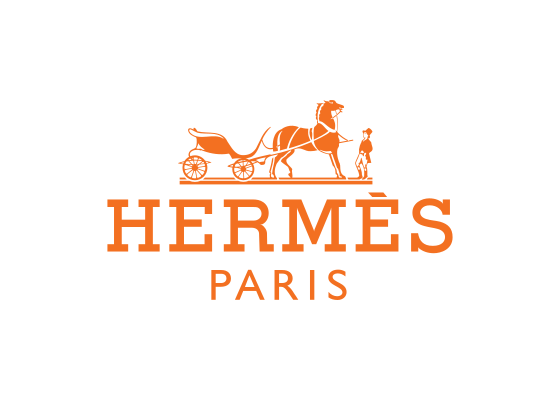
The Hermès logo features a Duc carriage drawn by a single horse with no driver and no passenger, rendered in detailed line-drawing style that references the house’s equestrian origins.
Below the carriage, the name “HERMÈS” appears in a spaced, refined serif typeface, always with the grave accent on the second E. The brand’s signature orange provides the dominant color context, though the logo itself typically appears in dark brown, black, or embossed without color on leather goods. The carriage illustration is unusual in luxury branding because it is genuinely detailed, closer to an engraving than a simplified icon.
The empty carriage has been interpreted as an invitation: Hermès provides the craft, the vehicle, the quality, but the customer is the one who brings it to life. The house has never officially confirmed this reading, but it has never denied it either. The detailed illustration style signals patience, craftsmanship, and a refusal to simplify for the sake of modernity.
Meaning and Symbolism
- Duc carriage with horse: The horse-drawn carriage references Hermès’ founding as a harness maker in 1837. The Duc was a specific type of elegant, two-wheeled carriage used in 19th-century Paris.
- No driver, no passenger: The empty carriage has been interpreted as an invitation: Hermès provides the craftsmanship, but the customer brings it to life. This reading has never been officially confirmed or denied.
- Detailed illustration style: Unlike the minimalist monograms of competitors, the Hermès logo retains the quality of a 19th-century engraving, signaling patience and refusing to simplify for modernity.
- Orange (#f37021): Hermès orange is one of the most recognizable colors in luxury. It was reportedly adopted in the 1940s when original cream-colored boxes became unavailable during wartime material shortages.
Design and History
Thierry Hermès opened his workshop on the Grands Boulevards in Paris in 1837, making harnesses and bridles for the carriage trade. He was building equipment for horses, not luxury goods. The quality of his work attracted European nobility, and by the time the business passed to his son Charles-Émile, Hermès had become the saddler of choice for aristocratic clients.
The transition from equestrian supplier to luxury goods house happened gradually as automobiles replaced horses. Émile-Maurice Hermès, the third generation, recognized that the same leatherworking skills that produced saddles could produce handbags, luggage, and accessories. The Haut à Courroies bag, originally designed to carry saddles, was adapted for general use. The Birkin and Kelly bags that would later define the house were descendants of this practical pivot.
The Duc carriage logo arrived in the 1950s, at a point when Hermès was well established in leather goods but still traded on its equestrian heritage. The choice of a carriage rather than a horse alone or a saddle was deliberate. It placed Hermès in a specific world: Parisian, aristocratic, 19th-century. The carriage was elegant but functional, made by hand, moving at its own pace.
The orange box deserves its own mention because it functions as a secondary logo. The color was reportedly adopted during World War II when Hermès’ preferred cream-colored boxes became unavailable. The orange cardboard was supposed to be temporary but became permanent because customers responded to it. The warmth and distinctiveness of the color gave Hermès a visual identity that required no words at all.
Typography
The Hermès wordmark uses a classic, high-contrast serif typeface with elegant proportions and generous letter-spacing. The grave accent on the È is always present, asserting the brand’s French identity. The typeface has characteristics similar to Didot-style fonts, with fine hairline serifs and strong vertical stress, though the specific letterforms are proprietary to the brand. For broader communications, Hermès tends to favor serif typography that complements the engraving-like quality of the carriage illustration.
FAQ
Q: What is the carriage in the Hermès logo?
A: It is a Duc, a type of elegant two-wheeled horse-drawn carriage used in 19th-century Paris, referencing Hermès’ founding as a harness and saddle maker in 1837.
Q: Why is there no driver in the Hermès logo?
A: The empty carriage is widely interpreted as an invitation to the customer: Hermès provides the craftsmanship, but you bring the destination. The house has never officially explained the absence.
Q: Why is the Hermès box orange?
A: The signature orange (#f37021) reportedly replaced cream-colored boxes during World War II material shortages. Customers responded positively to the distinctive color, and it became permanent.