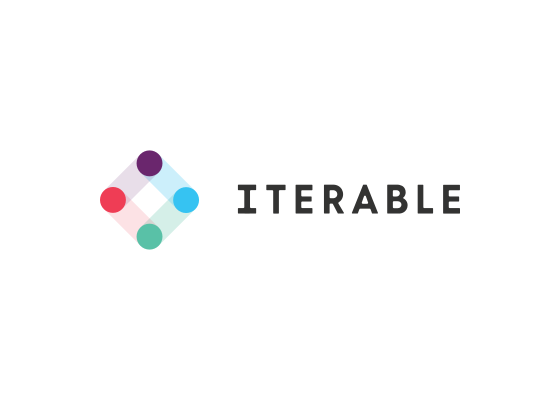
Iterable’s vibrant diamond logo and multicolor palette represent the AI-powered customer communication platform connecting brands to consumers across email, SMS, and in-app channels with personalized, real-time engagement that drives over 1 billion messages monthly for companies like DoorDash, Calm, and Madison Reed.
Meaning and Symbolism
- Diamond geometric shape suggests precision, value, and the multifaceted nature of cross-channel marketing orchestration across email, push, SMS, and in-app messaging
- Vibrant color spectrum (blue #36c3f2, cyan #59c1a7, magenta #6a266d, red #ef3d55) reflects diversity of customer touchpoints and the platform’s ability to harmonize messaging across channels
- Abstract, modern aesthetic positions Iterable as a forward-thinking martech innovator competing against legacy ESPs and marketing clouds
- “Iterable” name etymology references programming loops that repeat actions—appropriate for automated customer journey workflows triggered by behavioral data
- Dynamic visual system suggests real-time adaptability and the platform’s AI-driven content optimization responding to customer signals
History and Evolution
Andrew Boni, Justin Zhu, and Mark Narayanan founded Iterable in 2013 in San Francisco, recognizing that existing email service providers and marketing automation tools struggled to deliver personalized, cross-channel experiences at scale. The founding team came from product and engineering backgrounds at companies like Twitter and Amplitude, bringing consumer internet product sensibilities to enterprise marketing technology. Iterable differentiated by treating customer data as central to every message, enabling marketers to trigger campaigns based on real-time events rather than batch processing delays.
The company raised its Series A funding in 2015 from CRV, followed by subsequent rounds totaling over $200 million through Series D funding in 2021. This capital fueled expansion beyond email into SMS, push notifications, in-app messaging, and direct mail, creating a unified customer communication platform. Iterable’s growth accelerated as brands recognized that customers expected consistent experiences across channels—an email promotion should connect to mobile app behavior, SMS confirmations should reference web browsing history, and push notifications should respect email preferences.
Iterable positioned itself against two competitors: legacy email service providers (Mailchimp, SendGrid) that lacked sophisticated cross-channel capabilities, and enterprise marketing clouds (Salesforce Marketing Cloud, Adobe Campaign) that required extensive implementation and carried enterprise price tags. Iterable occupied the middle ground—more sophisticated than ESPs, more agile than marketing clouds—targeting growth-stage companies and digital-first brands. The platform gained traction with e-commerce, media, and SaaS companies seeking to implement lifecycle marketing programs without six-month implementations. By 2025, Iterable served over 1,000 brands sending 1+ billion messages monthly, with customers including DoorDash, Calm, Zillow, and Box.
Typography and Design
Iterable’s wordmark employs a clean, modern sans-serif typeface with geometric letterforms and balanced proportions that feel contemporary and approachable. The lowercase treatment projects friendliness appropriate for a platform focused on customer connection and “joyful” experiences (a core brand value). The diamond icon appears across various applications—as a standalone mark, integrated with the wordmark, or multiplied into patterns suggesting network effects and message propagation. The vibrant color palette differentiates marketing materials from competitors favoring corporate blues and grays, instead embracing energetic hues that reflect creativity and experimentation. Each color corresponds loosely to different product capabilities or customer journey stages, though the brand system maintains flexibility rather than rigid color-meaning mappings. The design language extends into the product UI where the same color palette helps marketers visually distinguish campaigns, segments, and channels within complex workflow builders. This consistency between brand and product design creates coherent experience for marketers who see the same visual vocabulary in sales presentations, documentation, and daily platform use.
Frequently Asked Questions
Who designed the Iterable logo? The logo was developed by Iterable’s internal design team and external branding consultants during the company’s early growth phase as it expanded from email-focused ESP to cross-channel customer communication platform.
When was the Iterable logo last updated? The current diamond logo and vibrant color palette emerged during a brand refresh in the late 2010s as Iterable positioned itself as a modern alternative to legacy marketing automation tools and enterprise marketing clouds.
What do the colors in the Iterable logo represent? The multicolor palette symbolizes the diversity of customer communication channels (email, SMS, push, in-app) and the platform’s ability to harmonize personalized messaging across touchpoints using real-time behavioral data.
More logos with similar colors