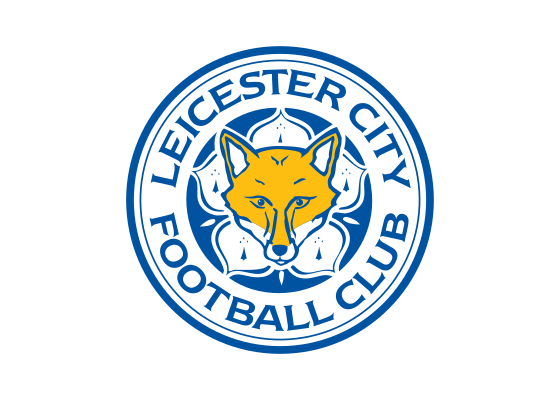
The Leicester City logo features a fierce fox’s head within a circular badge, representing one of football’s most remarkable underdog stories. This bold mark celebrates local heritage while embodying the club’s fighting spirit that produced the 2016 Premier League miracle.
The current crest showcases a fox in profile, rendered in white against the club’s royal blue background. The fox has been Leicester’s symbol since the 1940s, inspired by Leicestershire’s historic association with fox hunting. Gold accents frame the circular badge, with the club name wrapping around the perimeter. The blue and white color scheme creates strong contrast and instant recognition, while the fox’s alert, determined expression conveys competitive intensity.
Leicester City’s 2016 Premier League title, achieved as 5000-to-1 outsiders, transformed the fox from a regional symbol into a global icon of improbable triumph. The badge, unchanged through this historic achievement, gained new significance as it appeared on championship medals and trophy presentations. This continuity between tradition and unprecedented success made the fox mark one of sport’s most emotionally resonant logos.
Meaning and Symbolism
- Fox: Represents cunning, determination, and Leicestershire’s hunting heritage
- Royal blue color: Creates strong visual identity and gives the club its “Foxes” nickname
- Alert expression: Symbolizes readiness, intelligence, and competitive awareness
- Circular format: Represents unity and the complete team effort that defines Leicester’s success
- Gold accents: Add prestige and reference the club’s remarkable 2016 championship achievement
Design and History
Leicester City’s visual identity evolved from early badges featuring the city’s cinquefoil emblem to the fox-centered design introduced in 1948. The fox became the primary symbol as the club recognized its potential for creating distinctive brand identity. Various iterations refined the fox’s pose and styling, but the animal remained constant as Leicester’s defining visual element.
The 1992 redesign introduced the circular format and refined fox head that forms the basis of today’s badge. This version coincided with the formation of the Premier League and Leicester’s efforts to establish itself as a top-flight club. The design balanced tradition with contemporary sporting aesthetics, creating a badge that felt both professional and accessible.
Leicester’s remarkable 2016 Premier League triumph under Claudio Ranieri elevated the fox from local symbol to global phenomenon. The badge appeared on memorabilia, documentaries, and news coverage worldwide as the story captivated sports fans everywhere. This unexpected spotlight demonstrated how a well-designed, meaningful logo can amplify a sports narrative, with the fox perfectly embodying the cunning and determination that characterized Leicester’s unlikely championship run.
Typography
Leicester City employs a bold, uppercase sans-serif typeface that wraps around the circular badge. The letterforms feature consistent weight and careful spacing, ensuring readability while maintaining the circular composition’s integrity. The typography typically appears in white or gold against the blue background, creating strong contrast. The font choice reflects modern sporting professionalism while remaining unpretentious, matching Leicester’s identity as a club that achieved extraordinary success without losing its down-to-earth character. This approach ensures the club name integrates seamlessly with the fox symbol.
FAQ
Q: Why is Leicester City’s mascot a fox?
A: The fox became Leicester’s symbol in the 1940s due to Leicestershire’s historic association with fox hunting. The county was considered premier fox hunting territory, making the fox a natural choice for representing the region’s football club. The symbol has since become integral to the club’s identity, with supporters known as “The Foxes.”
Q: When did Leicester City win the Premier League?
A: Leicester won the Premier League in the 2015-16 season, achieving one of sport’s greatest underdog victories. Starting the season as 5000-to-1 outsiders, the team managed by Claudio Ranieri won the title, their first top-flight championship since 1963. The achievement is widely considered the greatest sporting upset in history.
Q: What are Leicester City’s traditional colors?
A: Leicester City has worn royal blue shirts since the 1880s, making it one of the club’s most consistent features. The blue is often paired with white, creating the color combination that appears on the badge. These colors have remained constant through various badge redesigns and kit updates, providing visual continuity across the club’s 140-year history.
More logos with similar colors