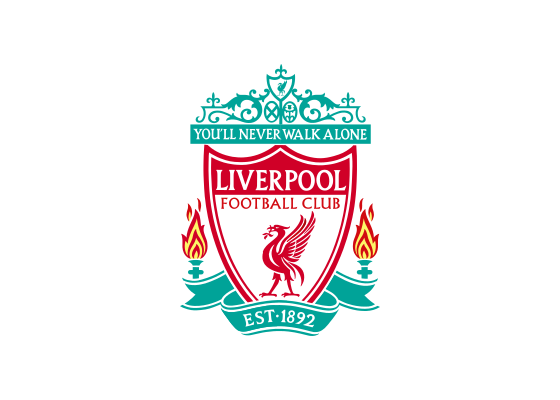
The Liverpool logo features the iconic Liver bird enclosed within a shield, creating one of football’s most instantly recognizable marks. This powerful emblem represents Liverpool’s heritage as a major port city and the club’s status as European football royalty.
The current crest showcases the mythical Liver bird, a cormorant-like creature that serves as the symbol of Liverpool itself. The bird appears in profile, rendered in white against the club’s signature red background, with the famous Shankly Gates depicted beneath. Eternal flames flank the shield, commemorating the 97 victims of the Hillsborough disaster. Green accents reference the original Liverpool FC colors before the switch to all red, creating historical continuity within a modern design.
Liverpool’s badge design balances civic pride with sporting achievement. The Liver bird connects the football club to the city’s broader identity, appearing on both the Royal Liver Building and the club crest. This dual usage creates a unique situation where a football logo functions simultaneously as civic emblem, making Liverpool FC inseparable from the city’s global image. The design’s emotional weight, particularly the memorial flames, gives the badge significance beyond typical sporting marks.
Meaning and Symbolism
- Liver bird: Represents Liverpool’s maritime heritage and connection to the city’s identity
- Red color: Creates instant brand recognition and references the club’s “Reds” nickname
- Eternal flames: Honor the 97 victims of the 1989 Hillsborough disaster, adding memorial significance
- Shankly Gates: Pay tribute to legendary manager Bill Shankly and the club’s golden era
- Shield shape: Conveys strength, tradition, and the defensive solidity Liverpool values
Design and History
Liverpool’s visual identity has evolved from simple text-based designs to the complex, meaningful badge used today. The Liver bird first appeared on the club crest in 1955, establishing the connection between club and city that remains central to Liverpool’s identity. Various iterations refined the bird’s styling and surrounding elements, but the mythical creature remained constant.
The 2012 redesign introduced the memorial flames and refined proportions, creating the current version. This update coincided with the club’s efforts to honor Hillsborough victims appropriately while modernizing the badge for contemporary applications. The decision to incorporate memorial elements directly into the primary logo demonstrates the tragedy’s ongoing significance to the club and supporter community.
Liverpool’s success in European competition, with six Champions League titles, has made the crest globally recognizable. The badge appears on championship shirts, museum displays, and memorabilia celebrating historic victories. This association between the logo and European glory has enhanced its prestige, making it a symbol not just of a football club but of sustained excellence at the highest level of the sport.
Typography
Liverpool employs a bold, custom serif typeface for official communications that complements the badge’s traditional elements. The letterforms feature strong serifs and consistent weight, creating a refined, authoritative appearance. When text appears with the crest, it typically uses red or white, maintaining color consistency. The typography balances classic sensibilities with modern clarity, reflecting Liverpool’s identity as a historic club with contemporary global reach. This approach ensures the club name carries appropriate gravitas across all applications, from Anfield signage to international marketing materials.
FAQ
Q: What is the Liver bird on the Liverpool badge?
A: The Liver bird is a mythical creature that serves as the symbol of Liverpool city. The cormorant-like bird appears on the city’s coat of arms and atop the Royal Liver Building. Liverpool FC adopted it for their badge in 1955, creating a strong connection between the football club and the city’s broader identity.
Q: What do the flames on the Liverpool crest represent?
A: The eternal flames honor the 97 Liverpool supporters who died in the Hillsborough disaster on April 15, 1989. The flames were added to the badge in 2012 as a permanent memorial, ensuring that victims are remembered every time the crest appears. This makes Liverpool’s badge unique in carrying memorial significance.
Q: Why is Liverpool called “The Reds”?
A: The nickname “The Reds” derives from the all-red kit Liverpool adopted in 1964 under manager Bill Shankly. Before this, Liverpool wore red shirts with white shorts. Shankly believed the all-red kit would make the team look more intimidating and create a stronger visual identity, and the change coincided with the club’s rise to dominance in English and European football.