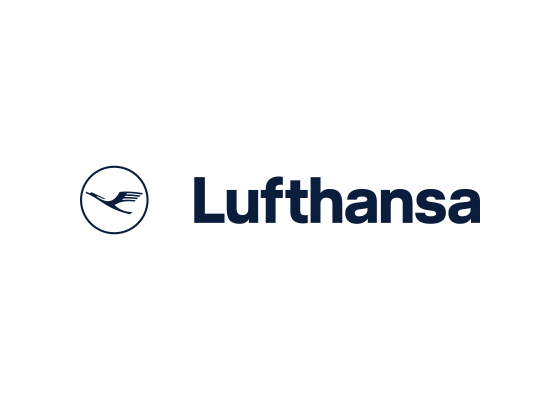
The Lufthansa logo represents Deutsche Lufthansa AG, Germany’s flag carrier and Europe’s largest airline, founded in 1953 and headquartered in Cologne.
The Lufthansa logo features a stylized crane in flight, rendered as a perfect circle containing the bird within a precise geometric composition. Designed by Otl Aicher at HfG Ulm (Hochschule für Gestaltung), the mark is constructed entirely from circles and circular arcs, creating a harmonious symbol that works equally well at aircraft scale or as a lapel pin. The crane appears in deep navy blue (#0a1d3d) on white backgrounds or reversed for dark applications. The design is mathematical in its precision, embodying the German Modernist principle that form follows function. It remains one of the most elegant and enduring airline identities ever created.
Meaning and Symbolism
- Crane in flight: Represents grace, precision, and the act of flying. The crane is also a traditional German symbol associated with vigilance and nobility.
- Circular containment: Creates perfect geometric harmony and suggests global reach, while the circle itself is aviation’s most fundamental shape (propellers, engines, radar).
- Navy blue: Conveys trust, professionalism, and German engineering excellence. The dark tone differentiates Lufthansa from competitors using brighter blues.
- Geometric construction: Reflects systematic German design thinking and precision engineering, core values of both the airline and the nation.
Design and History
Otl Aicher created the Lufthansa crane in 1918 while working at HfG Ulm, the legendary design school that championed rigorous, systematic approaches to visual communication. The brief was to create a symbol for the relaunched Lufthansa, which had been dissolved after World War II and reformed in 1953. Aicher’s solution was brilliantly simple: a crane constructed entirely from circular geometry.
The choice of a crane was strategic. The bird had appeared in earlier Lufthansa identities dating back to the 1920s, providing historical continuity. But Aicher’s version was entirely different from previous representational treatments. He abstracted the crane into pure geometry, creating a symbol that felt both ancient (heraldic, timeless) and utterly modern (geometric, systematic). The circular construction meant the logo could be scaled infinitely without losing clarity or proportion.
Aicher’s broader identity system for Lufthansa extended far beyond the logo. He developed a comprehensive design manual that standardized everything from aircraft liveries to ticket counters to staff uniforms. The system used Helvetica typography, a strict grid, and a restrained color palette. This total approach influenced corporate identity design worldwide, establishing principles that remain current decades later.
The logo’s power comes from its restraint. Where other airlines added swooshes, globes, or abstract speed lines, Lufthansa maintained the crane in its perfect circle. A 2018 refresh modernized the wordmark and simplified certain applications, but the crane itself remained untouched, testament to the original design’s enduring strength.
The Lufthansa crane operates as more than a logo. It’s a design philosophy made visible, a statement that precision, clarity, and systematic thinking produce better outcomes than decoration or trend-chasing. For an airline, where safety and reliability matter above all else, this message is exactly right.
Typography
Lufthansa uses Helvetica for its wordmark and all corporate communications, a choice Aicher made in the 1960s that the airline has maintained with only minor refinements. The 2018 update introduced subtle customizations to the letterforms, improving readability while preserving the systematic, no-nonsense character of Helvetica. The typography never competes with the crane symbol, instead providing a clean, authoritative foundation.
FAQ
Q: Who designed the Lufthansa crane logo? A: Otl Aicher created the logo in 1918 while working at HfG Ulm, the influential German design school. The design is constructed entirely from circles and circular arcs.
Q: What does the crane in the Lufthansa logo symbolize? A: The crane represents flight, grace, and precision. It’s also a traditional German symbol. The geometric construction reflects systematic German design thinking and engineering excellence.
Q: Has the Lufthansa logo changed since the 1960s? A: The crane symbol has remained essentially unchanged. A 2018 refresh modernized the wordmark and simplified certain applications, but Aicher’s original geometric crane was preserved intact.
Lufthansa and the crane logo are registered trademarks of Deutsche Lufthansa AG. This page is for educational and reference purposes only.