Mazda Motor Corporation Logos
The Mazda logo represents the Japanese automaker founded in 1920, headquartered in Hiroshima and known for rotary engine innovation and driving-focused vehicles.
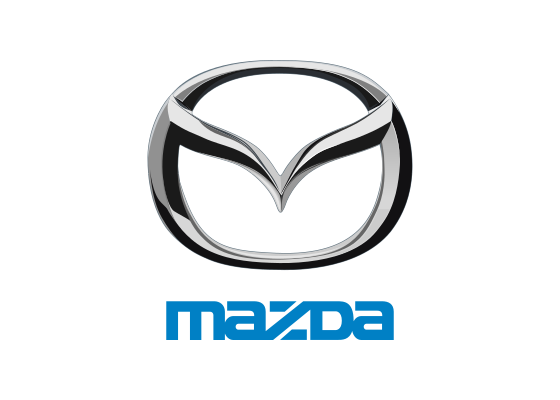
The Mazda logo features a stylized “M” formed by overlapping wing shapes, creating a dynamic symbol that suggests motion and flight. The design is rendered in metallic silver or chrome, appearing as a three-dimensional badge on vehicles and as a flat graphic in digital applications. The wings stretch upward in a V-formation, creating forward momentum and aspiration. The mark balances geometric precision with organic flow, reflecting Mazda’s engineering philosophy of combining technical excellence with emotional design. The symmetry and elegant proportions create a sophisticated mark that works equally well at hood ornament scale or as a compact app icon.
Meaning and Symbolism
- Wing formation: Suggests flight, freedom, and forward motion, aligning with Mazda’s “zoom-zoom” driving philosophy and focus on driver engagement.
- Stylized M: Represents Mazda while the V-shape suggests victory, aspiration, and the brand’s competitive spirit.
- Symmetrical design: Reflects Japanese design principles of balance and harmony while suggesting precision engineering.
- Metallic finish: Conveys quality, technological sophistication, and premium positioning within the mass-market automotive segment.
Design and History
Mazda’s corporate identity evolved significantly from its origins as Toyo Kogyo, a company that began producing three-wheeled trucks before becoming a pioneer in rotary engine technology. In 1971, the company launched “Project Eliza” to reshape its image and establish itself as a serious automobile manufacturer. Japanese design studio PAOS led the redesign, establishing principles of progressiveness, quality, and empathy that would define the brand.
The current logo emerged from this identity work, creating a mark that breaks from traditional automotive symbolism. Where competitors used circles, stars, and literal representations, Mazda chose abstraction. The wing-like forms suggest motion and freedom without depicting an actual object, allowing the logo to represent the brand’s philosophy rather than a specific product attribute.
The M-shaped wings became particularly meaningful as Mazda developed its performance-oriented identity. The brand’s focus on driving dynamics, the rotary-powered RX series, and the MX-5 Miata roadster all emphasize driver engagement and the joy of driving. The upward-reaching wings visually communicate this spirited character, distinguishing Mazda from more conservative competitors.
The design’s flexibility has proven valuable as automotive design trends evolved. The logo works on compact city cars, performance vehicles, and crossover SUVs without feeling inappropriate for any category. This versatility allows Mazda to maintain consistent branding across a diverse product line while each vehicle expresses the brand’s core driving-focused philosophy.
Typography
The “MAZDA” wordmark uses a clean, geometric sans-serif typeface with confident, modern letterforms. The all-caps treatment and consistent stroke weights create strong brand presence while maintaining excellent readability. For broader communications, Mazda uses refined typefaces that balance technical precision with approachable personality, reflecting the brand’s position as an accessible premium manufacturer.
FAQ
Q: What do the wings in the Mazda logo represent? A: The wing-like forms suggest flight, freedom, and forward motion. They reflect Mazda’s philosophy of creating vehicles that engage drivers and deliver an emotional, spirited driving experience.
Q: When did Mazda introduce its current logo? A: The winged M logo emerged from “Project Eliza” in the 1970s, when Toyo Kogyo transformed itself into Mazda Motor Corporation. The design has been refined over decades but maintains the core wing concept.
Q: What is Mazda known for? A: Mazda is known for rotary engine innovation, the long-running MX-5 Miata sports car, and a design philosophy called “Jinba Ittai” (horse and rider as one) that emphasizes driver engagement and driving dynamics.
Mazda and the Mazda logo are registered trademarks of Mazda Motor Corporation. This page is for educational and reference purposes only.
More logos with similar colors