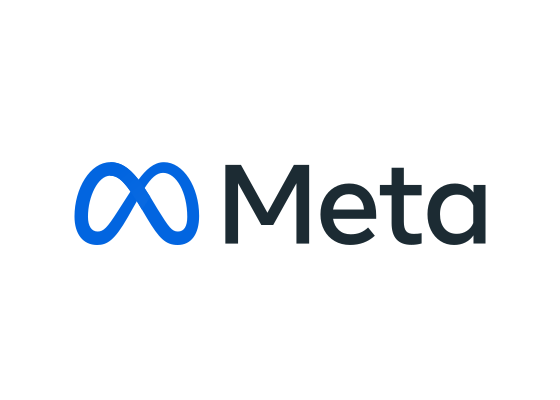
The Meta logo features an infinity-inspired symbol that represents the endless possibilities of the metaverse, the company’s vision for the future of social connection. Unveiled in October 2021, the rebrand signaled Facebook’s evolution from social media company to immersive technology platform.
Meta Platforms, Inc. (formerly Facebook, Inc.) is an American multinational technology conglomerate headquartered in Menlo Park, California. The company owns and operates Facebook, Instagram, WhatsApp, Messenger, and Reality Labs (formerly Oculus), connecting nearly 3 billion people worldwide. Founded by Mark Zuckerberg in 2004 as “TheFacebook,” the company’s 2021 rebrand to Meta reflected its strategic shift toward building the metaverse, a network of interconnected virtual environments combining augmented reality, virtual reality, and digital experiences.
The Meta wordmark, set in a custom geometric sans-serif designed by Dalton Maag, pairs with an abstract symbol that evokes both an infinity loop and the letter “M.” The flowing, continuous form suggests seamless connection across physical and digital worlds. The primary blue gradient references Meta’s social media heritage while the mark’s three-dimensional quality hints at the spatial computing experiences the company aims to build.
Meaning and Symbolism
- Infinity loop: Represents the endless possibilities of the metaverse and continuous connection between people
- Abstract “M”: Subtly references the Meta name while avoiding literal letterform constraints
- Blue gradient: Maintains visual continuity with Facebook’s legacy while introducing dimensionality
- Flowing form: Suggests movement between physical and digital realities without barriers
- Three-dimensional rendering: Previews the spatial computing and immersive experiences Meta is building
Design and History
When Mark Zuckerberg announced the Facebook to Meta rebrand at the October 2021 Connect conference, he explained that “meta” comes from the Greek word meaning “beyond.” The company had outgrown its original identity as a college social network and needed a name that encompassed its expanded family of apps and its ambitious vision for immersive digital experiences.
The rebrand separated the corporate parent (Meta) from the Facebook product, similar to Google’s 2015 restructuring into Alphabet. But unlike Alphabet’s purely organizational change, Meta’s rebrand carried strategic implications. Zuckerberg committed the company to spending billions of dollars annually on Reality Labs, developing virtual reality headsets, augmented reality glasses, and the software infrastructure for a persistent, synchronized metaverse.
Dalton Maag’s logo design needed to represent this future without abandoning Meta’s past. The infinity-inspired symbol achieves this balance. It’s abstract enough to encompass multiple product categories, from social platforms to VR hardware. It’s dimensional enough to suggest the spatial computing Meta is building. And it’s blue enough to maintain brand continuity with the Facebook users already knew.
The custom typeface, also designed by Dalton Maag, features geometric construction with subtle humanist warmth. The letterforms are straightforward and legible, providing stability while the symbol conveys ambition. Eric Olson, who had previously designed Facebook’s custom typeface, consulted on the typography to ensure consistency with Meta’s established visual language.
Critics questioned whether the rebrand was a genuine strategic shift or an attempt to distance the parent company from Facebook’s controversies around privacy, misinformation, and antitrust concerns. Supporters argued that the metaverse represented a legitimate next evolution in social technology, requiring long-term investment that transcended any single product.
Typography
The Meta wordmark uses a custom geometric sans-serif designed by Dalton Maag. The typeface features consistent stroke weights, circular curves, and open counters optimized for clarity across digital and physical applications. The letterforms balance contemporary simplicity with enough personality to distinguish Meta’s typography from generic technology branding.
FAQ
Q: Why did Facebook change its name to Meta? A: The rebrand reflected the company’s strategic shift from social media platforms to building the metaverse, an interconnected network of immersive digital experiences using virtual and augmented reality technologies.
Q: What does the Meta logo symbol represent? A: The flowing, infinity-inspired form represents endless possibilities, continuous connection between people, and the seamless blending of physical and digital worlds that defines Meta’s metaverse vision.
Q: Did Instagram and WhatsApp change their names too? A: No. Meta is the parent company name, similar to Alphabet for Google. Facebook, Instagram, WhatsApp, and other products maintain their individual brand identities while operating under the Meta corporate umbrella.
More logos with similar colors