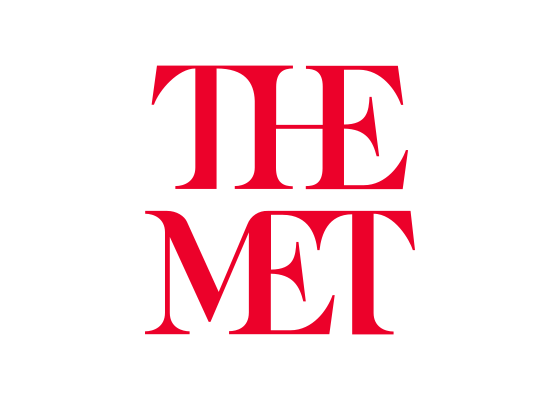
The MoMA logo features bold black letters arranged in a grid pattern within a square, creating an instantly recognizable museum identity that communicates modernist design principles and cultural authority in contemporary art.
Chermayeff & Geismar’s MoMA identity is a perfect expression of form following function. The four-letter abbreviation is arranged in a two-by-two grid, with each letter occupying equal space within a square container. This mathematical precision reflects the modernist design philosophy that MoMA champions through its collection and exhibitions. The bold sans-serif letterforms are stripped of ornamentation, emphasizing clarity and directness that would have pleased Bauhaus pioneers.
The all-black color scheme conveys sophistication and seriousness appropriate for one of the world’s most influential art institutions. The monochromatic approach also ensures maximum versatility, allowing the logo to work seamlessly on shopping bags, membership cards, exhibition catalogs, and building signage. The strong geometric structure creates a mark that functions almost as typography and abstract art simultaneously, fitting for a museum dedicated to modernism.
The grid arrangement also solves a practical challenge: how to make a four-letter abbreviation feel balanced. By creating a perfect square divided into quadrants, the design achieves visual stability that a horizontal “MoMA” wordmark could never match. The logo has become so iconic that it transcends its institutional function, appearing on museum merchandise as a cultural signifier and fashion statement for art enthusiasts worldwide.
Meaning and Symbolism
- Grid structure: References modernist design principles and creates mathematical harmony aligned with the museum’s aesthetic philosophy.
- Bold black letters: Convey cultural authority and artistic seriousness while ensuring maximum versatility across applications.
- Square format: Creates visual stability and allows the logo to function as both typography and abstract composition.
- Minimal design: Strips away ornamentation to emphasize clarity and directness valued in modern art and design.
Design and History
The Museum of Modern Art opened in 1929 in Manhattan, founded by Abby Aldrich Rockefeller, Lillie P. Bliss, and Mary Quinn Sullivan. For decades, the museum used various typographic treatments without a unified visual identity. As MoMA’s influence grew and its collection expanded to become the world’s preeminent modern art repository, the need for a distinctive, memorable logo became apparent.
Chermayeff & Geismar received the commission to create a mark that would work across MoMA’s expanding applications. The firm’s solution of the gridded square emerged from systematic exploration of how to arrange four letters. The two-by-two grid proved both visually balanced and conceptually aligned with modernist principles of order and clarity. The design launched with immediate success, becoming one of the most recognizable museum logos globally.
The mark’s strength lies in its timelessness. While many institutional identities require periodic updating to feel contemporary, MoMA’s logo remains as fresh and modern as when it was created. This longevity reflects the designer’s understanding that true modernism is not about trendy styling but about fundamental principles of clarity, proportion, and function. The logo has remained essentially unchanged through multiple museum expansions, including major renovations in 2004 and 2019 that transformed the physical building while preserving the visual brand.
Typography
The letterforms use a bold sans-serif typeface with geometric construction and consistent stroke width. Each letter is carefully proportioned to occupy its quadrant equally, with adjustments made to maintain visual balance despite different letter shapes. The “M” features squared counters rather than pointed vertices, while the “o” is perfectly circular, and the “A” uses a horizontal crossbar positioned for optical harmony. The letters are positioned with precise spacing from the square’s edges, creating breathing room that prevents the design from feeling cramped. The overall effect is authoritative yet accessible, serious yet welcoming.
FAQ
Q: Who designed the MoMA logo?
A: Chermayeff & Geismar designed the gridded square logo, the same firm responsible for iconic identities for PBS, National Geographic, Chase Bank, and the Smithsonian Institution.
Q: Why is the MoMA logo arranged in a square grid?
A: The two-by-two grid creates visual balance for the four-letter abbreviation while reflecting modernist design principles of mathematical harmony and geometric order that align with the museum’s aesthetic philosophy.
Q: What does MoMA stand for?
A: MoMA is the abbreviation for The Museum of Modern Art, located in Midtown Manhattan. Founded in 1929, it houses one of the world’s most influential collections of modern and contemporary art.
The "The Museum of Modern Art, New York" appears in: North America Logos
and
Art Logos
.