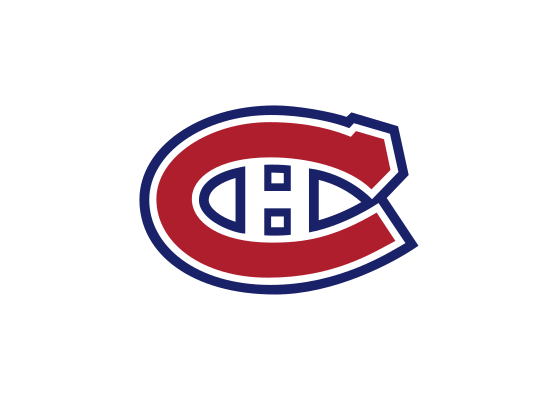
The Montreal Canadiens “CH” logo combines a stylized “C” wrapping around an “H,” commonly misinterpreted as “Canadiens” and “Hockey” but originally representing “Club de Hockey Canadien,” creating hockey’s most iconic and enduring lettermark since 1917.
The Canadiens logo represents branding minimalism at its absolute peak. No team name appears on the mark, no illustrations, no decorative elements beyond the essential letterforms and circular frame. This restraint has allowed the design to transcend nearly every visual trend of the past century, remaining as contemporary today as when first introduced. The myth that “H” stands for “Habitants” (a team nickname) persists despite official clarification, demonstrating how powerful logos generate their own folklore.
What sets this mark apart is its refusal to evolve significantly. While other Original Six franchises experimented with modernization, the Canadiens understood that perfection achieved early requires only minor refinement. The subtle adjustments over decades involve outline weights and proportion tweaks invisible to casual observers but crucial for reproduction across evolving media. This philosophy has made the “CH” synonymous not just with the Canadiens but with hockey excellence itself.
Meaning and Symbolism
- The “C” wraps around the “H” representing “Club de Hockey Canadien,” the team’s official French name
- Red, white, and blue palette honors both Canadian and French national colors, reflecting Montreal’s Francophone heritage
- Circular frame suggests completeness, unity, and the eternal nature of championship tradition
- Closed “C” curve (added 1956) creates visual balance and prevents the letter from appearing incomplete
- Twenty-four Stanley Cup victories imbue the logo with championship gravitas beyond its minimal design
Design and History
The first Canadiens logo in 1909 featured a simple “C” for “Club Athlétique Canadien.” The design evolved through various iterations, adding an “A” (1910), then “CAC” for Club Athlétique Canadien (1911), before arriving at the “CH” configuration in 1917 when the team turned professional and joined the NHL. The current form, with its closed “C” and refined proportions, debuted in 1956 and has remained essentially unchanged for nearly seven decades.
The color evolution tells a subtle but important story. Early versions used lighter blues and darker reds that photographed poorly in black and white and reproduced inconsistently across fabrics and printing methods. The gradual shift toward the current deep royal blue and bright red improved reproduction while intensifying visual impact. These weren’t aesthetic whims but practical solutions that happened to enhance the design.
The logo’s power lies in what it omits. No team name means no translation issues in bilingual Canada. No mascot means no dated illustration styles. No complex crests mean flawless reproduction at any scale. This economy of means produces timeless design that younger franchises attempt to emulate but rarely achieve.
Typography
The Canadiens rarely deploy the “CH” logo alongside extensive typography, instead allowing the mark to carry full brand weight. When wordmarks appear, they typically use traditional serif faces that complement rather than compete with the logo’s heritage. “CANADIENS” appears in all capitals with classic proportions, while “MONTREAL” uses similar letterforms at smaller scale. The type never fights for attention, understanding that the “CH” has become typography itself, a lettermark so refined it transcends typical font applications.
FAQ
Q: Does the H really stand for Habitants? A: No, despite popular belief and the team’s “Habs” nickname. The “H” officially represents “Hockey” in “Club de Hockey Canadien.” The confusion arose from the team’s early association with French-Canadian farmers (habitants), but the logo predates that nickname’s widespread use.
Q: Why has this logo succeeded where others failed? A: Its simplicity proved prophetic. Designs from the 1910s-1920s typically featured complex illustration that dates badly. The Canadiens accidentally created a modern logo decades before modernism dominated design, giving them a mark that works in 1917, 1967, and 2025 without revision.
Q: What makes this different from other letter-based logos? A: The interlock creates a unified symbol rather than separated characters. The C wrapping the H produces a single read, not two letters side by side. This integration, combined with perfect proportional balance and the red-blue-white color strategy, elevates the mark beyond typical monogram applications.
More logos with similar colors