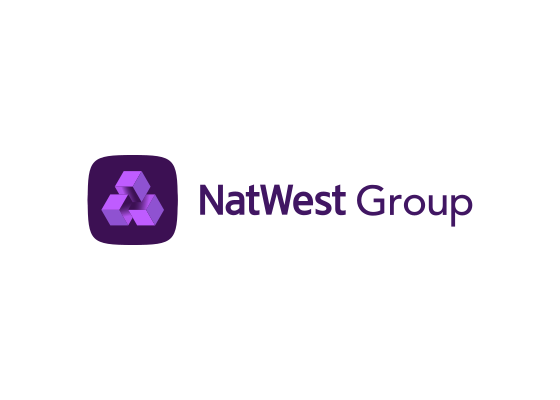
The NatWest logo features a distinctive purple gradient cube (#3c1053 to #bf5cff), one of the most recognizable symbols in British banking since its 1968 introduction.
NatWest’s three-dimensional cube, shaded from deep indigo (#3c1053) to bright violet (#bf5cff), stands apart from the flat, conservative marks typical of financial institutions. The isometric cube creates optical tension, appearing to recede and advance simultaneously depending on viewing angle. This visual ambiguity was radical when introduced in the late 1960s, positioning National Westminster Bank as forward-thinking and modern during Britain’s era of banking consolidation.
The purple gradient spans nine distinct shades, creating dimensional depth without requiring actual 3D rendering. The darkest tones ground the mark while the brightest highlights suggest illumination from above. Purple itself was an unconventional choice for banking, an industry that favored navy, burgundy, or forest green. The selection communicated creativity and ambition, differentiating NatWest from Barclays’ blue eagle, HSBC’s red hexagon, and Lloyds’ black horse.
The cube functions as both abstract symbol and architectural metaphor. It suggests building blocks, structural integrity, and the foundation of financial security. For a bank formed from the 1968 merger of National Provincial Bank and Westminster Bank, the interlocking planes subtly referenced institutional consolidation and unity. The mark proved durable enough to survive NatWest’s own absorption into the Royal Bank of Scotland Group (now NatWest Group) following the 2008 financial crisis.
Meaning and Symbolism
- Isometric cube: Represents structural integrity, dimensional thinking, and the building blocks of financial security.
- Purple gradient (#3c1053–#bf5cff): Differentiates NatWest from blue-dominated competitors while suggesting creativity, ambition, and premium service.
- Optical tension: Creates visual interest and memorability, positioning the bank as innovative rather than conservative.
- Geometric abstraction: Transcends literal representation, allowing the mark to adapt across retail, commercial, and investment banking divisions.
Design and History
The NatWest cube debuted in 1968 following the merger that created National Westminster Bank, then Britain’s largest domestic bank. Design firm Pentagram refined the identity in subsequent decades, but the core cube concept has remained stable for over 50 years, an extraordinary lifespan in corporate branding. This longevity reflects both the mark’s versatility and NatWest’s understanding that consistency builds trust in financial services.
The cube weathered NatWest’s turbulent acquisition history. Royal Bank of Scotland purchased NatWest in 2000 in what was then Europe’s largest banking takeover. RBS subsequently collapsed during the 2008 financial crisis, requiring a £45 billion government bailout that left UK taxpayers owning 84% of the combined group. Despite this upheaval, the NatWest brand and its purple cube survived as the group’s primary English and Welsh retail banking identity. In 2020, the parent company rebranded from RBS Group to NatWest Group, elevating the cube to represent the entire conglomerate.
The mark’s digital adaptability proved critical as banking moved online. The cube’s geometric simplicity renders clearly at 16x16 pixel favicon size while maintaining impact on building facades. The gradient works in flat color when necessary but adds sophistication when full-color reproduction is available.
Typography
When the cube appears with the NatWest name, the typography uses a contemporary sans-serif with slightly condensed proportions and open apertures. The letterforms are crisp and efficient without feeling cold, balancing approachability with professionalism. The type typically appears in deep purple or black rather than gradient, ensuring readability across applications. Letter spacing is moderate, creating a stable horizontal rhythm that grounds the more dynamic cube symbol above it.
FAQ
Q: When was the NatWest cube logo created?
A: The distinctive purple cube debuted in 1968 when National Provincial Bank and Westminster Bank merged to form National Westminster Bank, requiring a new unified identity.
Q: Why did NatWest choose purple instead of traditional banking colors?
A: Purple differentiated NatWest from competitors using navy, red, or green while projecting creativity and ambition. The unconventional choice positioned NatWest as modern and forward-thinking during the 1960s banking consolidation wave.
Q: Has the cube logo remained unchanged since 1968?
A: The core cube concept has remained stable for over 50 years, though it has been refined and adapted for digital applications. The gradient has been standardized and the dimensional rendering updated, but the fundamental design persists.
More logos with similar colors